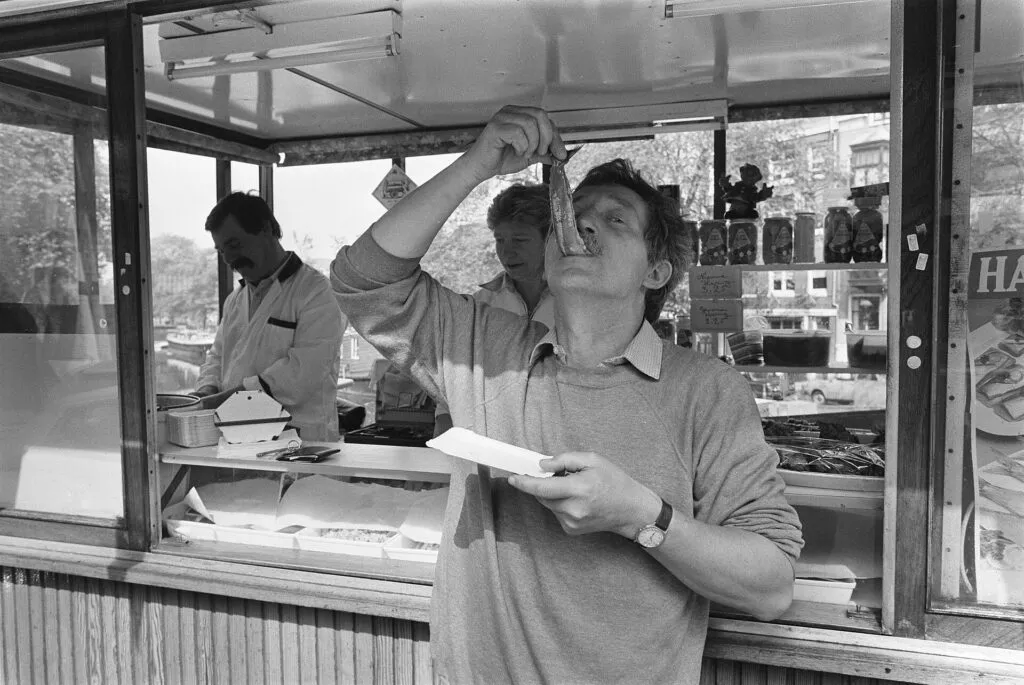
Raw herring is Amsterdam’s signature street snack: a lightly salted, soft fillet eaten at an outdoor herring stand (haringkar), usually cut into pieces and topped with chopped raw onion and pickles. Expect to pay roughly €3.50–€6 for a herring or a herring sandwich, and try it between June and autumn, when the new-season Hollandse Nieuwe is on sale.
| Quick facts | Details |
|---|---|
| What it is | Young herring, lightly brined (“soused”), served raw and cold |
| Best season | June to about September for Hollandse Nieuwe; available all year |
| Typical price | About €3.50–€6 per herring or broodje haring |
| How Amsterdam eats it | Cut into pieces, with uitjes (onions) and zuur (pickles), eaten with a small flag toothpick |
| Where | Herring stands on bridges, squares and at markets across the city |
What is Dutch raw herring?
Dutch herring is not smoked or cooked. The fish are caught in the North Sea, gutted in a way that leaves part of the pancreas in place, and put in a light salt brine. Enzymes from the pancreas gently “ripen” the fish over a few days, which is why good herring is soft and buttery rather than fishy. In English this is often called soused herring; in Dutch it is simply haring, or maatjesharing for young fish that have not yet spawned.
The most prized herring is the Hollandse Nieuwe (“Dutch new”): the first catch of the season, when the fish have built up plenty of fat. It traditionally goes on sale in June and is celebrated with events in fishing towns such as Scheveningen. You can still eat good herring later in the year, but early summer is when locals queue for it.
Because the fish is eaten raw, Dutch and EU food-safety rules require it to be frozen before sale to kill any parasites. That is standard practice at every legitimate stand, so you do not need to worry about it as a visitor.
How to order herring in Amsterdam
Ordering is quick, and a few Dutch words make it easier. Stands post their prices, and most accept cards.
| Say | Meaning | What you get |
|---|---|---|
| Een haring, alstublieft | A herring, please | A herring cut into pieces on a paper tray, usually with onions and pickles |
| Een broodje haring | A herring sandwich | Herring in a soft white roll with onions and pickles; easier to eat on the move |
| Met uitjes / zonder uitjes | With / without onions | Chopped raw onion on top |
| Met zuur | With pickles | Sliced gherkins |
| Hollandse Nieuwe | New-season herring | Ask whether it is nieuwe in summer |
Local tip: in Amsterdam the herring is normally cut into chunks and eaten with a toothpick. The famous way of holding it by the tail and lowering it into your mouth is more common in Rotterdam and The Hague. Both are fine, and stand staff will happily do it either way.
Where to eat herring in Amsterdam
You rarely need to plan a special trip: herring stands are part of the street furniture in central Amsterdam, especially near bridges, busy squares and markets. Look for a stand with a steady local queue and fish on ice behind glass. A few reliable places to start:
- Stands along the canal ring and near Centraal Station – convenient if you arrive by train; long-running stands such as Stubbe’s Haring on the Singel are popular with locals.
- Albert Cuypmarkt (De Pijp) – the city’s best-known street market has fish stalls selling herring alongside other Dutch snacks.
- Neighbourhood fish shops (viswinkels) – many sell herring to take away, often a little cheaper than stands in tourist areas.
Opening hours and exact locations of stands change, so treat these as starting points and check current details before you go.
What else to eat at a herring stand
Most stands sell more than raw herring. If raw fish is not for you, these are good alternatives:
- Kibbeling – battered, fried pieces of white fish (usually cod) with garlic or remoulade sauce.
- Lekkerbekje – a whole fried fillet of white fish.
- Gerookte paling – smoked eel, a richer Dutch classic.
- Broodje makreel – smoked mackerel in a roll.
Tips for first-timers
- Start with a broodje haring: the bread softens the texture if you are unsure about raw fish.
- Try it as early in the season as you can; new-season herring is noticeably milder and fattier.
- Pregnant travellers and anyone told to avoid raw fish should skip it or choose the cooked options above.
Frequently asked questions
Is the herring in Amsterdam really raw?
It is not cooked or smoked, but it is lightly salted and ripened in brine, and it is frozen before sale for safety. The texture is closer to sashimi than to pickled herring from a jar.
When is herring season in the Netherlands?
The new-season Hollandse Nieuwe goes on sale in June and is best through the summer. Herring stands sell herring all year, using fish that was frozen at its peak.
How much does a herring cost in Amsterdam?
Roughly €3.50–€6 for a single herring or a herring sandwich at a street stand, a bit more in the most touristy spots. Prices were checked in 2026 and change every season.
What do you eat herring with?
In Amsterdam, chopped raw onions and sliced pickles. In a broodje haring they go inside the roll. Nothing else is needed.
Planning more Dutch food stops? Read our guides to stroopwafels in Amsterdam and Indonesian rijsttafel in Amsterdam, browse all Netherlands food guides, or estimate your food budget for the Netherlands.
Sources
- I amsterdam – the city’s official visitor information.
- Netherlands Food and Consumer Product Safety Authority (NVWA) – food-safety rules for raw fish.
- Soused herring – background on how Dutch herring is prepared.