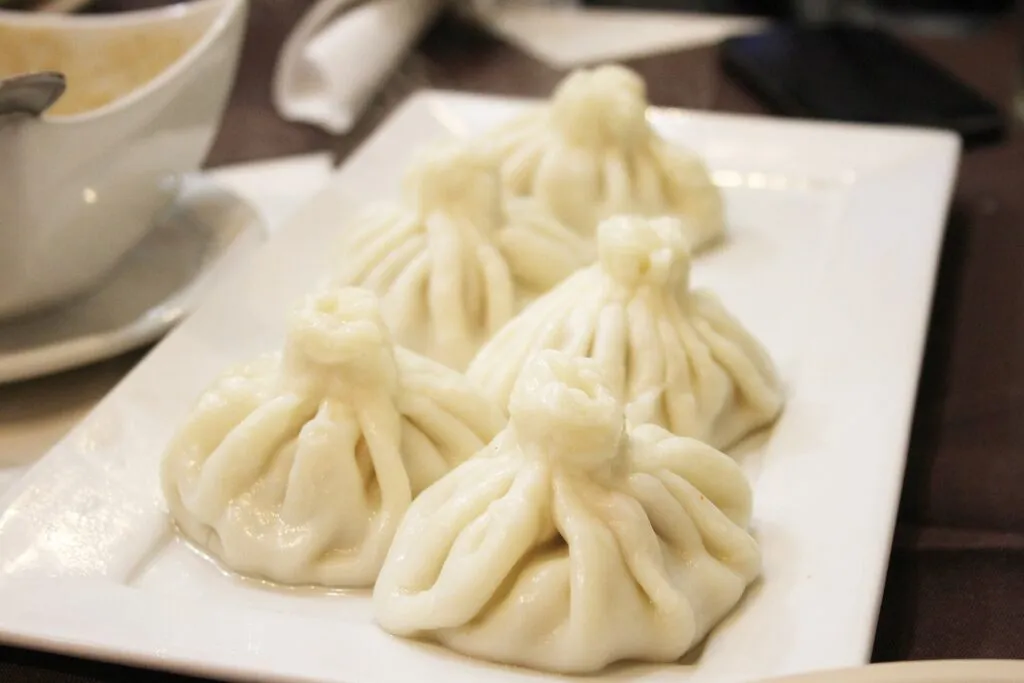
Khinkali are Georgia’s big, pleated dumplings, filled with spiced meat and a hot broth. In Tbilisi you order them by the piece (usually five or more), eat them with your hands, bite a small hole, drink the broth, then eat the rest, leaving the doughy knob on the plate. Expect roughly 1.5–3 lari (GEL) per dumpling in a local sakhinkle (khinkali house).
| Quick facts | Details |
|---|---|
| What it is | A large twisted dumpling with meat and broth inside, or cheese, potato or mushroom |
| Where it comes from | The mountain regions north of Tbilisi, such as Pshavi, Khevsureti and Tusheti |
| How it is ordered | By the piece, often a minimum of five |
| Typical price | About 1.5–3 GEL per khinkali in local places (2026) |
| Drink with it | Georgian beer, lemonade or a shot of chacha |
The main types of khinkali
| Georgian name | Filling | Notes |
|---|---|---|
| Kalakuri (“city-style”) | Usually beef and pork with herbs such as coriander | The most common version in Tbilisi; not halal unless the restaurant says so |
| Mtiuluri (“mountain-style”) | Meat with onion, pepper and cumin, no fresh herbs | Simpler and more peppery |
| Kvelis | Cheese | Good vegetarian option |
| Kartopilis | Mashed potato | Vegetarian; filling and mild |
| Sokos | Mushroom | Vegetarian; popular during fasting periods |
How to eat khinkali
- Pick the khinkali up by the knob at the top (the kudi). Cutlery is not used.
- Turn it upside down and bite a small hole in the side.
- Sip the hot broth first. This is the best part, and it stops the juice running down your arm.
- Eat the rest of the dumpling, but leave the thick knob on your plate. Georgians sometimes count the knobs at the end to see who ate the most.
- Add freshly ground black pepper if you like; it is on most tables.
Careful: the broth is very hot when khinkali first arrive. Wait a minute before your first bite.
Where to eat khinkali in Tbilisi
You will find khinkali on the menu of almost every Georgian restaurant, but the best value is at a dedicated sakhinkle, a simple khinkali house where locals go for a quick meal. Busy places turn over dumplings fast, so they come out fresh.
- Local sakhinkle in neighbourhoods such as Vake, Saburtalo and Vera – cheaper and more local than the Old Town.
- Old Town (Kala) restaurants – convenient and often good, though pricier and aimed at visitors.
- Pasanauri and the Georgian Military Road – if you are driving north towards Kazbegi, the town of Pasanauri is famous across Georgia for its khinkali.
Useful Georgian words
| Say | Meaning |
|---|---|
| Khinkali, ati tsali | Khinkali, ten pieces |
| Kalakuri / mtiuluri | City-style / mountain-style |
| Gaumarjos! | Cheers! |
| Madloba | Thank you |
| Angarishi, tu sheidzleba | The bill, please |
Many restaurant staff in Tbilisi speak some English or Russian, but a few words of Georgian are always appreciated.
Frequently asked questions
How many khinkali should I order?
Five to seven is a normal meal for one person, fewer if you are also ordering other dishes. Many places have a minimum order of five of one kind.
Why don’t people eat the top of the khinkali?
The knob is thick, doughy and often undercooked, and it works as a handle. Leaving it is normal and nobody will think you are wasteful.
Are there vegetarian khinkali?
Yes: cheese (kvelis), potato (kartopilis) and mushroom (sokos) khinkali are widely available.
How much do khinkali cost in Tbilisi?
Roughly 1.5–3 GEL each in local places and more in tourist restaurants (2026 prices).
Also in Georgia: khachapuri, the Georgian supra feast. Browse all Georgia food guides or estimate your food budget for Georgia.
Sources
- Georgia National Tourism Administration – official tourism site.
- Khinkali – background and regional varieties.