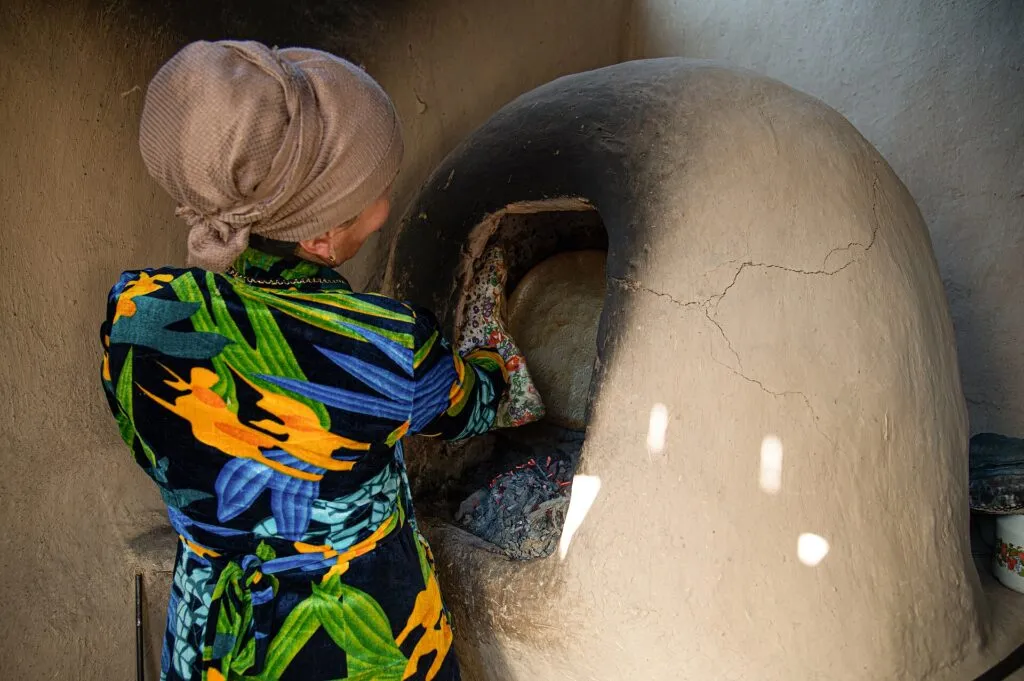
Every Uzbek bread is stamped. Before it goes into the oven, the baker presses the centre with a chekich, a wooden handle set with nails or pins, leaving a pattern of tiny holes like a flower or a star. Then the round goes onto the burning-hot wall of the tandir and comes out golden, shiny and smelling of wheat and sesame.
Uzbek bread (non) is a round flatbread with a thick rim and a thin, stamped centre, baked on the inner wall of a clay tandir oven. The most famous is Samarkand non, heavy and dense, which keeps for days; other styles include everyday obi non and flaky, rich patir. In Samarkand and Tashkent you can watch bakers at work in small bakeries and bazaars, and some let visitors try stamping and baking. In 2026 a round costs roughly UZS 3,000–15,000, with famous Samarkand non at the top of the range. Bread in Uzbekistan contains no pork or alcohol.
This guide covers the types of non, how it is baked, bread customs, where to watch or join a bake, prices and phrases.
Types of non
| Bread | What it is |
|---|---|
| Obi non | The everyday round loaf with a flat, stamped centre |
| Samarkand non | Heavy, dense and glossy, with a thick rim; a famous souvenir that keeps for days |
| Patir | Rich, flaky bread made with butter or fat; festive |
| Katlama | Layered, fried flatbread |
| Gijda | Small, thick bread from the Fergana Valley |
How non is baked
- Dough of flour, water, yeast and salt (sometimes milk) is kneaded and left to rise.
- It is shaped into rounds with a thick edge and a thin centre.
- The baker stamps the centre with a chekich so it does not puff up.
- The top is brushed with water or egg and sprinkled with sesame or nigella seeds.
- The baker reaches into the tandir and presses the bread onto the hot clay wall.
- A few minutes later it is lifted off with a hook, crisp outside and soft inside.
Bread customs
- Bread is sacred in Uzbek culture. Never place it upside down or throw it away.
- At the table, the host tears the bread by hand and shares it; it is not cut with a knife.
- When someone leaves on a journey, they may bite a piece of bread and the rest is kept until they return.
- If bread falls, people pick it up and touch it to their forehead.
Halal note: Uzbek bread is made from flour, water, yeast and salt, sometimes with milk, butter or lamb fat for richer styles, and contains no pork or alcohol. Uzbekistan is a Muslim-majority country, so food is halal as standard. See our halal food travel guide.
Where to watch or join a bake
- Samarkand, around Siab Bazaar – the bread section of the market and nearby bakeries sell Samarkand non fresh from the tandir.
- Tashkent, Chorsu Bazaar – rows of bread sellers under the great blue dome.
- Neighbourhood bakeries (nonvoyxona) – many bakers will let you watch, and some will let you try stamping a round if you ask politely.
- Guesthouse and tour experiences – some Samarkand guesthouses arrange baking sessions with local families.
Taking bread home
Samarkand non is famous for keeping well; many travellers carry a few rounds home. Let it cool fully, wrap it in paper, and refresh it with a sprinkle of water in a hot oven.
What it costs (2026)
| Item | Typical price |
|---|---|
| Obi non (everyday round) | About UZS 3,000–8,000 |
| Samarkand non | About UZS 8,000–15,000 |
| Patir | About UZS 10,000–25,000 |
Plan your trip with the Uzbekistan food budget calculator.
Uzbek phrases
| Say | Meaning |
|---|---|
| Non | Bread |
| Issiq non bormi? | Is there hot bread? |
| Ikkita non, iltimos | Two breads, please |
| Ko’rsam bo’ladimi? | May I watch? |
| Rahmat | Thank you |
Frequently asked questions
What is Uzbek non?
A round flatbread with a thick rim and a stamped centre, baked in a clay tandir oven.
Why is Samarkand bread famous?
It is dense, glossy and keeps for days, and is closely tied to the city’s identity.
Can I learn to bake Uzbek bread?
Many bakers in Samarkand and Tashkent will let you watch, and some guesthouses arrange baking sessions.
Eat it with plov or samsa. See all Uzbekistan food guides.
Sources
- Uzbekistan Travel – official tourism site.
- Non (bread).