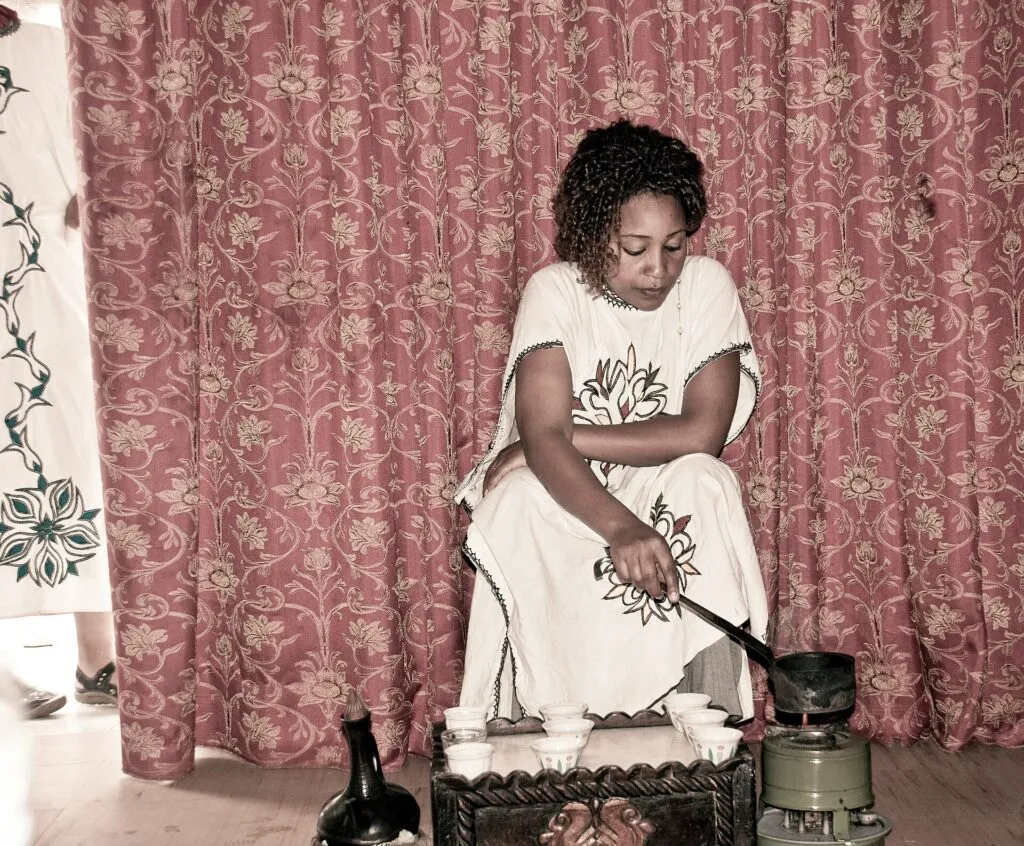
It starts with smoke. A woman kneels by a small charcoal stove and shakes green coffee beans in a flat pan until they crackle and turn glossy brown. Then she walks the smoking pan around the room so everyone can breathe it in. Nobody is in a hurry, and that is the point.
The Ethiopian coffee ceremony (buna ceremony) is a ritual of roasting, grinding and brewing coffee in front of guests, served in three rounds from a clay pot called a jebena, usually with incense and popcorn. It takes an hour or more and is a sign of hospitality and friendship. In Addis Ababa you can join one in homes, cultural restaurants, hotels and some cafés. Coffee is halal and the ceremony involves no alcohol, so it is a perfect experience for Muslim travellers.
This guide explains each step, the three rounds, etiquette, where to experience it in Addis and a few Amharic words.
The birthplace of coffee
Ethiopia is widely regarded as the original home of the coffee plant. A popular legend tells of a goat herder named Kaldi who noticed his goats dancing after eating red berries. The story cannot be proven, but coffee grows wild in Ethiopia’s forests to this day.
Coffee is at the centre of Ethiopian social life. Neighbours gather for it, disputes are talked through over it, and guests are welcomed with it.
The ceremony, step by step
- Setting the scene – fresh grass or flowers are spread on the floor, and frankincense is lit.
- Washing and roasting – green beans are washed, then roasted in a pan over charcoal.
- Sharing the aroma – the host carries the smoking beans around the guests.
- Grinding – the beans are crushed by hand with a wooden mortar and pestle.
- Brewing – ground coffee is boiled with water in the clay jebena, then left to settle.
- Pouring – the host pours in one continuous stream into small handleless cups (sini), from a height, without spilling.
The three rounds
| Round | Name | What it means |
|---|---|---|
| First | Abol | The strongest cup |
| Second | Tona | Made by adding water to the same grounds; milder |
| Third | Bereka | “Blessing”; the lightest cup, said to bless the guests |
It is polite to stay for all three rounds. Leaving after the first can seem abrupt.
What comes with it
- Popcorn, roasted barley or bread as a snack.
- Sugar is common; in some regions coffee is taken with salt or a little butter.
- Frankincense smoke throughout.
Halal note: the coffee ceremony involves only coffee, water, sugar, snacks and incense, with no alcohol. Ethiopia has a large Muslim population, and the ceremony is shared across faiths. Some cultural restaurants serve tej (honey wine) at dinner; simply decline. See our halal food travel guide.
Where to experience it in Addis Ababa
- Cultural restaurants – many perform a ceremony after dinner, with music.
- Hotels – several hotels hold ceremonies for guests in the lobby or garden.
- Local cafés – small places where women brew jebena coffee on the pavement.
- Historic coffee shops – such as Tomoca, open since the 1950s, for a quick, strong espresso-style Ethiopian coffee.
- A home – if you are invited, accept. It is the real thing.
Etiquette
- Take the cup with your right hand, or both hands.
- Compliment the coffee; the host has worked hard.
- Stay for all three rounds if you can.
- Do not rush the host or offer to help unless invited.
- Photos are usually fine, but ask first.
What it costs (2026)
In homes it is hospitality, never paid. In cafés, a cup of jebena coffee is inexpensive; cultural restaurants may include it with dinner. Prices in Ethiopia change quickly, so check locally.
Plan your trip with the Ethiopia food budget calculator.
Amharic words
| Say | Meaning |
|---|---|
| Buna | Coffee |
| Buna tetu | “Drink coffee” – an invitation |
| Jebena | The clay coffee pot |
| Abol, tona, bereka | The three rounds |
| Ameseginalehu | Thank you |
Frequently asked questions
How long does an Ethiopian coffee ceremony take?
Usually an hour or more, including three rounds of coffee.
What are the three rounds called?
Abol (first and strongest), tona (second) and bereka (third, the “blessing”).
Is the coffee ceremony halal?
Yes. It involves coffee, water, sugar, snacks and incense, with no alcohol.
Where can I join a coffee ceremony in Addis Ababa?
At cultural restaurants, hotels and local cafés, or in a home if you are invited.
Eat before you drink: our guide to injera in Addis Ababa. See all Africa food guides.