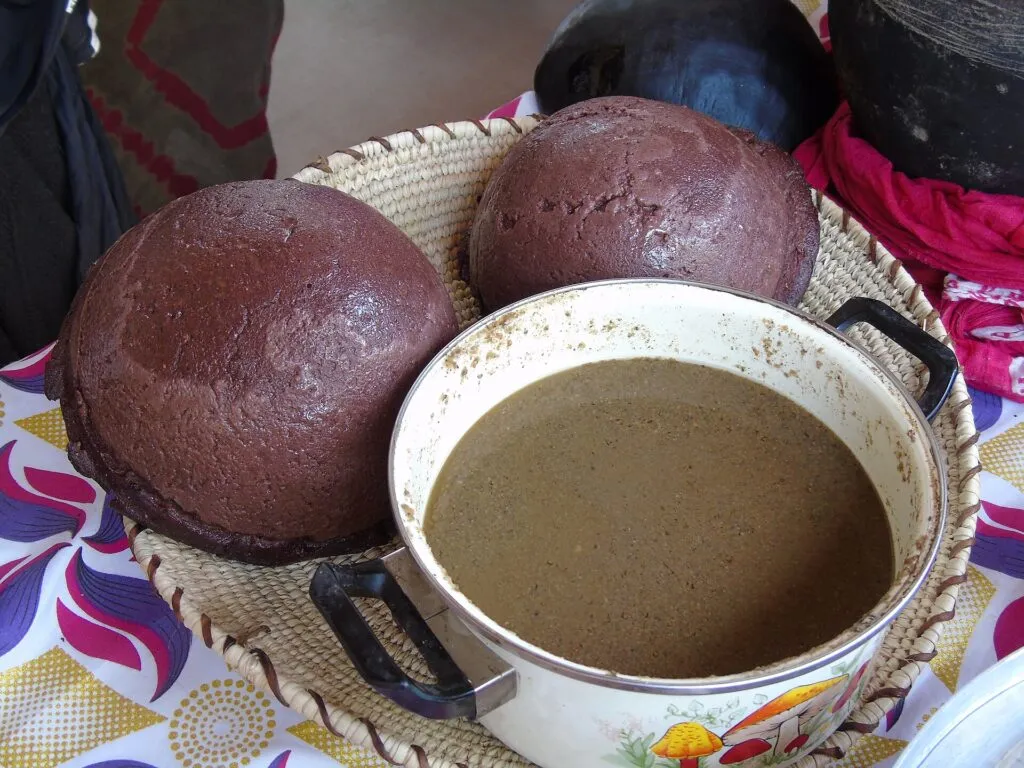
In a family courtyard in N’Djamena, everyone sits around a single large bowl. In the middle stands a smooth brown dome of millet, and around it a pot of okra sauce, thick and savoury. Each person tears a piece from the dome with their right hand, dips it into the sauce, and the meal begins.
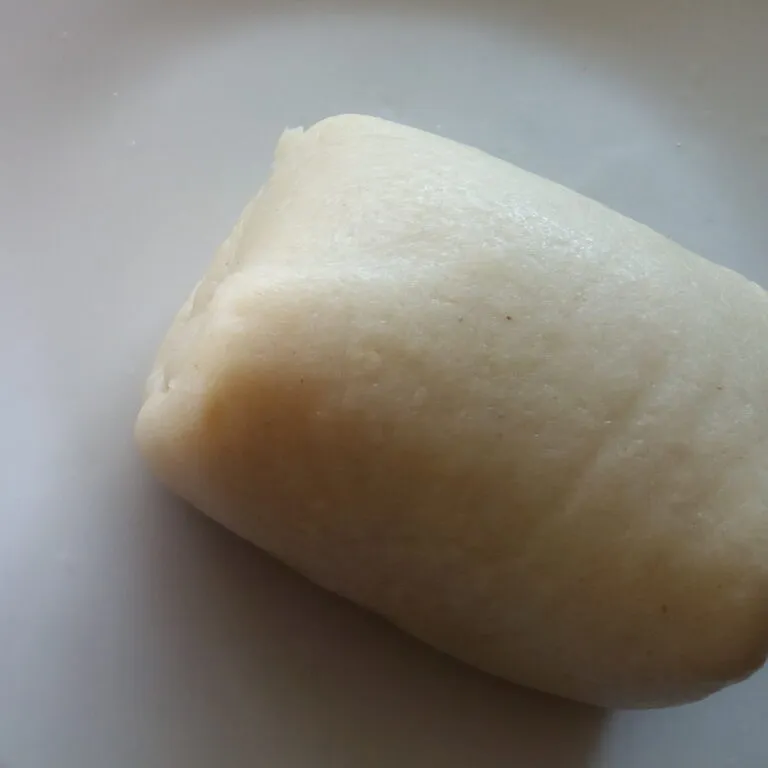
Boule is Chad’s national staple: a dense, smooth ball of cooked millet or sorghum flour (sometimes maize, rice or cassava), served with a sauce, most often okra (gombo), and eaten by hand from a shared bowl. It is the everyday meal across the country, from the Arab and Muslim north to the Christian south, and its sauces change with the region and season.
This guide explains how boule is made and eaten, the sauces that go with it, other Chadian dishes and drinks, and dietary and halal notes.
How Boule Is Made
- Millet or sorghum flour is mixed with a little cold water.
- It is stirred into boiling water and cooked, with constant stirring, until very thick and smooth.
- The paste is shaped in a bowl, often a calabash, and turned out as a dome.
- It is served immediately, warm, with sauce poured alongside or around it.
In the south, where cassava grows well, boule is often made from cassava flour or mixed flours. In towns, maize and rice versions are common.
The Sauces
| Sauce | What it is |
|---|---|
| Sauce gombo | Okra sauce, made with fresh okra in the rainy season or dried, powdered okra the rest of the year, often with beef, goat or dried fish |
| Daraba | A stew of okra, tomato, peanuts and leafy greens, often vegetarian |
| Mouloukhiya | A green, slightly slippery sauce of jute leaves, popular in the Arab north |
| Sauce longue | A thin, light sauce of leaves and peanuts in the south |
| Fish sauce | With fish from the Chari river and Lake Chad, such as Nile perch (capitaine) and tilapia |
How to Eat Boule
- Wash your hands first; water is usually brought to the table.
- Eat with your right hand only, from your own side of the shared bowl.
- Pinch off a piece of boule, shape it slightly and dip it into the sauce.
- Guests are often offered the best pieces of meat; it is polite to accept.
Other Chadian Food to Try
- Kissar: a thin, slightly sour fermented sorghum crêpe from the north, eaten with stews.
- Jarret de bœuf: slow-cooked beef shank with garlic, onion and tomato.
- Grilled fish from the Chari and Lake Chad, sold along the river in N’Djamena.
- Brochettes of beef or mutton from street grills.
- Karkanji: a sweet, ruby-red hibiscus drink, sometimes with ginger and cloves, especially popular during Ramadan.
- Spiced tea: strong and sweet, poured in several rounds.
Where to Eat in N’Djamena
- Family homes: boule is above all home food; if invited, accept.
- Local eateries and markets, such as around the Grand Marché, for boule with sauce at lunchtime.
- Riverside grills along the Chari for fish in the evening.
- Street stalls for brochettes, kissar and karkanji.
Dietary and Halal Notes
Halal note: Chad has a Muslim majority, concentrated in the north, the centre and N’Djamena, where meat is generally halal-slaughtered and pork is not eaten. In the Christian south, ask about meat and note that local millet beer (bili-bili) is common. Boule itself is just grain and water, and daraba and fish sauces are easy halal choices. During Ramadan, families break the fast with karkanji, dates and porridge before the main meal. See our halal food travel guide.
Millet and sorghum boule is naturally gluten-free, and many sauces, such as daraba, can be vegetarian. Ask whether sauces contain dried fish, which is common.
What It Costs in 2026
| Item | Typical price |
|---|---|
| Boule with sauce at a local eatery in N’Djamena | About XAF 500–2,000 |
| Grilled fish by the Chari | About XAF 3,000–8,000 |
| Karkanji from a street seller | A few hundred francs |
The Central African CFA franc (XAF) is pegged to the euro at about 656 francs to one euro.
Frequently Asked Questions
What is the national dish of Chad?
Boule, a ball of millet or sorghum paste, served with okra or other sauces.
What is boule made of?
Millet or sorghum flour and water, cooked into a thick paste. Maize, rice and cassava versions also exist.
What does boule taste like?
Mild and slightly earthy; it takes its flavour from the sauce.
How do you eat boule?
With your right hand from a shared bowl: tear a piece, dip it in the sauce and eat.
What is sauce gombo?
An okra sauce, fresh or made with dried okra powder, often with meat or dried fish, the most common partner for boule.
What is kissar?
A thin, fermented sorghum crêpe from northern Chad and Sudan, eaten with stews.
What is karkanji?
Chad’s hibiscus drink, sweet and tart, often spiced with ginger or cloves.
Is Chadian food halal?
In the north and N’Djamena, meat is generally halal. In the south, ask, and avoid millet beer.
Is Chadian food spicy?
Sauces can be spicy, especially in the south, but chilli is often served separately.
Is boule gluten-free?
Yes, when made from millet, sorghum, maize, rice or cassava.
Is boule similar to ugali or fufu?
Yes. It belongs to the same family of African grain and starch pastes eaten with sauces, such as ugali in East Africa and fufu in West Africa.
More from Africa: ubugali and beans in Burundi, ndolé in Cameroon and couscous in Algeria.
Sources
- Chadian cuisine, Wikipedia (grains, regional differences, fish)
- Boule, plat national du Tchad, Remitly (preparation, eating customs, daraba)
- Boule de mil et sauce gombo, Bonnes recettes du monde