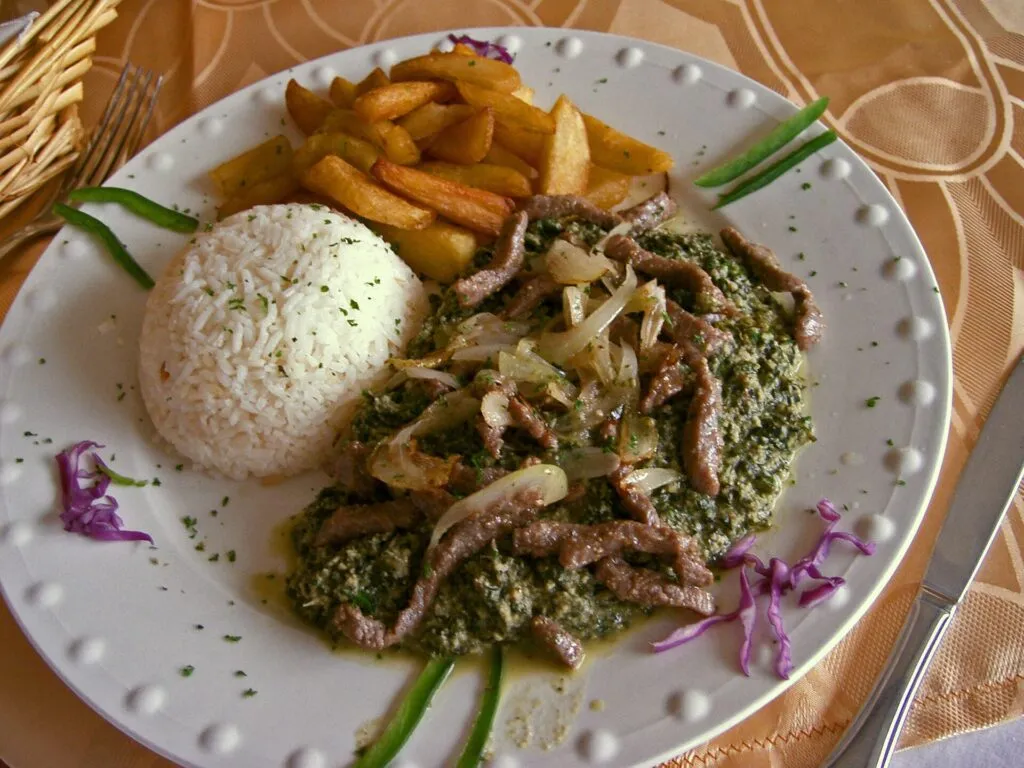
In Douala on a Sunday, the smell of roasted peanuts and garlic drifts from family kitchens. A big pot of dark green leaves simmers in a creamy peanut sauce with beef and prawns, and beside it lies a pile of sweet fried plantain or a bundle of thin cassava sticks wrapped in leaves. This is ndolé, the dish Cameroonians cook to celebrate.
Ndolé is often called Cameroon’s national dish: bitterleaf greens (Vernonia) washed and boiled to soften their bitterness, then cooked with a paste of ground peanuts, onion, garlic and oil, and enriched with beef, prawns, smoked fish or stockfish. It comes from the Sawa (coastal) peoples of the Littoral region around Douala and is now eaten across Cameroon and by the diaspora in France, Belgium, the UK and North America.
This guide covers what ndolé tastes like, how it is made, what it is served with, where to eat it, and dietary and halal notes.
What Ndolé Tastes Like
Creamy, nutty and pleasantly bitter. The bitterleaves give a gentle bitterness that cuts through the richness of the peanut sauce, and the prawns or smoked fish add a savoury, sea-like depth. Cameroonians often describe it as bittersweet.
The Leaves: Bitterleaf (Vernonia)
Ndolé is the Cameroonian name for edible Vernonia species, shrubs grown in gardens around Douala and Yaoundé for their leaves. The leaves are naturally very bitter, so cooks wash, squeeze and boil them two or three times, often with rock salt, until the bitterness is softened. Outside Cameroon, dried or frozen ndolé leaves are sold in African grocery shops.
How Ndolé Is Made
- Bitterleaves are washed, boiled and squeezed repeatedly to reduce bitterness, then chopped.
- Raw peanuts are boiled, skinned and ground into a smooth paste.
- Beef (or other meat) is cooked with onion, garlic and seasoning until tender.
- The peanut paste is cooked with the meat and its stock until it thickens and the oil separates.
- The leaves go in, followed by prawns, smoked fish or stockfish, and the stew simmers until rich and creamy.
- It is finished with fried onions and a little oil on top.
Ndolé royal, served at weddings and feasts, combines several proteins, such as beef, prawns and fish, in one pot.
What Ndolé Is Served With
- Miondo: thin sticks of fermented cassava wrapped in leaves, the classic Douala partner; the pairing is so famous it is called ndolé-miondo.
- Plantain: fried ripe plantain (sweet) or boiled green plantain.
- Bobolo: a thicker cassava stick, common in the Centre region.
- Rice or macabo (cocoyam).
When and Where to Eat Ndolé
- Sundays and celebrations: ndolé is a festive dish for family lunches, weddings and holidays.
- Douala: the home of ndolé, served in family restaurants and local eateries (tourne-dos and chantiers).
- Yaoundé: widely available in restaurants serving Cameroonian classics.
- Abroad: Cameroonian restaurants in Paris, Brussels, London, Montreal and Houston, and home kitchens wherever the diaspora lives.
Ndolé belongs to a family of Central African leaf and peanut stews; compare it with Angola’s muamba de galinha.
Dietary and Halal Notes
Halal note: ndolé is usually made with beef, prawns and fish, with no alcohol, but some cooks add pork, so ask. In southern Cameroon, beef at ordinary restaurants is not necessarily halal-slaughtered; the north is mostly Muslim, and Douala and Yaoundé have halal butchers and Muslim-run eateries. A prawn and fish ndolé is the easiest choice. Some Hanafi scholars permit only fish, so check with your scholar about prawns. See our halal food travel guide.
Ndolé contains peanuts, so people with nut allergies must avoid it. It is naturally gluten-free, and vegetarian versions without meat or seafood are possible.
What It Costs in 2026
| Where | Typical price |
|---|---|
| Ndolé with plantain at a local eatery in Douala | About XAF 1,500–3,500 |
| Ndolé royal at a restaurant | About XAF 4,000–8,000 |
| At a Cameroonian restaurant in Paris | About EUR 14–20 |
The Central African CFA franc (XAF) is pegged to the euro at about 656 francs to one euro.
Frequently Asked Questions
What is ndolé in English?
Ndolé is the Cameroonian name for bitterleaf (Vernonia), and also for the stew made from it: bitterleaf cooked in peanut sauce with meat and prawns.
What is the national dish of Cameroon?
Ndolé is the dish most often called Cameroon’s national dish, though the country has many regional favourites, such as eru, koki and achu.
What is ndolé made of?
Bitterleaves, ground peanuts, onion, garlic, oil, and usually beef, prawns and smoked fish or stockfish.
How do you remove the bitterness from ndolé?
Wash, squeeze and boil the leaves two or three times, often with rock salt, until the bitterness softens to a pleasant edge.
What do you eat ndolé with?
Miondo (cassava sticks), fried or boiled plantain, bobolo, rice or macabo.
What is ndolé royal?
A festive version with several proteins, such as beef, prawns and fish, cooked together for weddings and celebrations.
Is ndolé spicy?
Not usually. Chilli sauce is served separately.
Where does ndolé come from?
From the Sawa peoples of the Littoral region around Douala, on Cameroon’s coast.
Can I make ndolé with spinach?
Yes, as a substitute when bitterleaf is unavailable. Some cooks mix spinach with kale and a few bitterleaves for a closer flavour.
Is ndolé halal?
It can be, if made with halal beef or only prawns and fish, and without pork. Ask, especially in southern Cameroon.
Where can I buy ndolé leaves abroad?
African grocery shops in Europe and North America sell dried, frozen or pre-washed ndolé leaves.
More from Central and West Africa: poulet nyembwe in Gabon, attiéké, street food in Benin and mufete in Angola.
Sources
- Ndolé, Wikipédia in French (Vernonia, preparation, ndolé-miondo)
- Le ndolé, classique doux-amer, Le Monde Afrique
- Le ndolè, un plat typique du Cameroun, BBC News Afrique