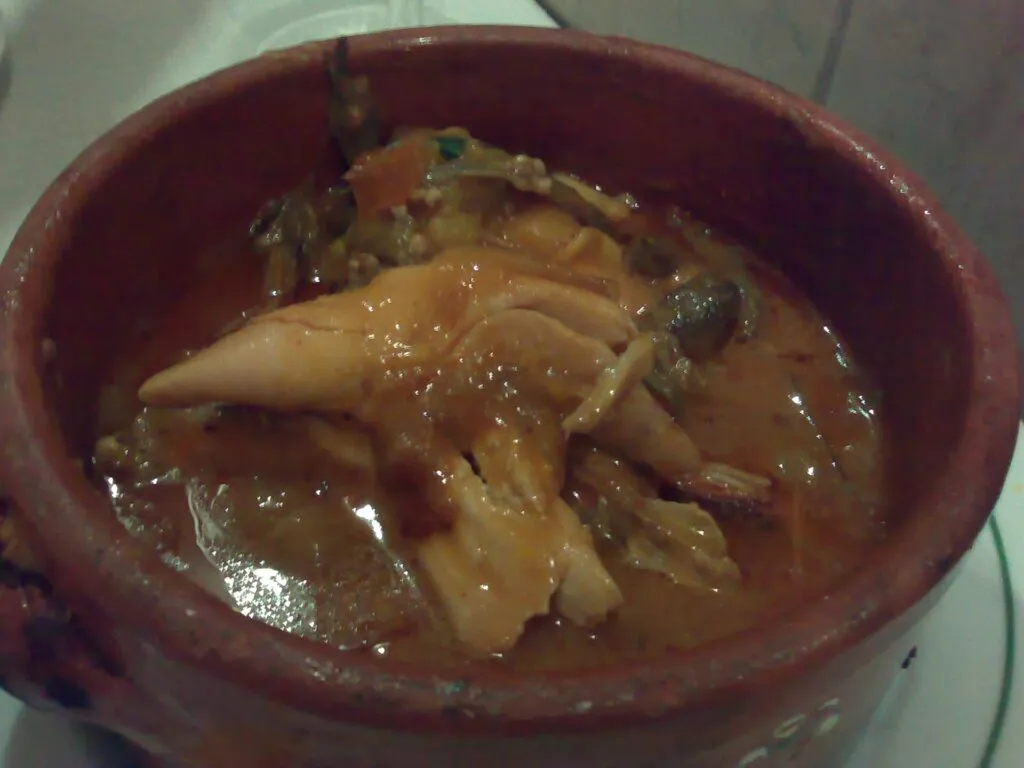
On a Sunday in Luanda, the family pot is bright orange-red. Pieces of chicken have been simmering for an hour in palm oil with garlic, onion, chilli, okra and chunks of pumpkin, and beside it sits a bowl of smooth, sticky funge, ready to be pulled apart with your fingers and dipped into the sauce.
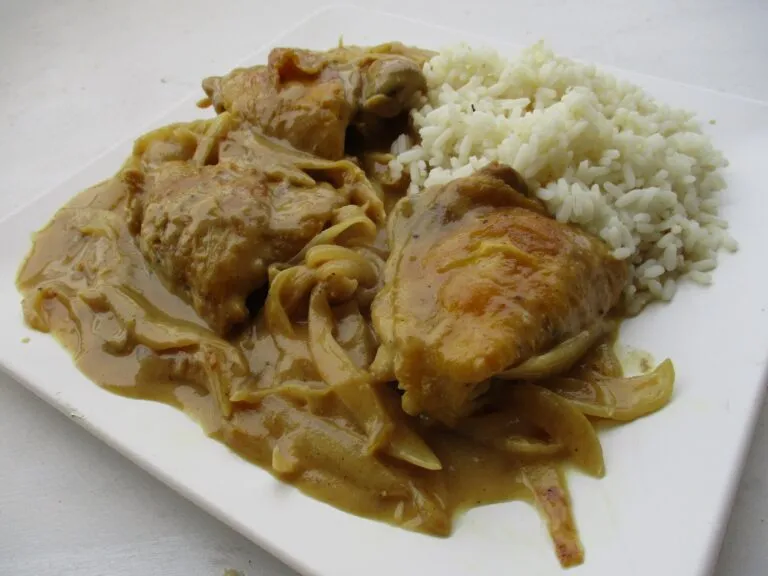
Muamba de galinha (also moamba) is Angola’s national dish: chicken stewed in red palm oil (or palm-nut sauce) with garlic, onion, gindungo chilli, okra and pumpkin, served with funge, a smooth cassava or maize porridge. It is the dish of family gatherings and celebrations, and a taste of home for Angolans in Portugal and Brazil.
This guide covers what muamba tastes like, how it is made, how to eat it with funge, its relatives across Central Africa, where to eat it, and dietary and halal notes.
What Muamba de Galinha Tastes Like
Rich, earthy and gently spicy. Red palm oil gives the sauce its colour and a deep, slightly nutty flavour; okra thickens it, pumpkin adds sweetness, and gindungo brings heat. The chicken is meltingly tender after slow cooking.
How It Is Made
- Chicken pieces are marinated with lemon or lime, garlic, salt and gindungo for at least half an hour.
- They are browned with onion in a heavy pot.
- Red palm oil (or palm-nut cream) and tomato are added, with a little water or stock.
- Chunks of pumpkin go in, and the stew simmers gently.
- Okra is added near the end so it thickens the sauce without disappearing.
- It is served hot with funge.
Angolans on forums share one key tip: traditionally the dish is made with a free-range hen (galinha), not a young broiler chicken (frango), because its firmer meat and richer flavour stand up to long cooking.
Funge: The Essential Side
Funge (or funji) is made by whisking flour into boiling water and stirring hard until it becomes a smooth, elastic paste. In Luanda and the north it is usually made from cassava flour (funge de bombó), which is stretchy and translucent; in the south it is often made from maize (funge de milho). Pinch off a piece, shape it with your fingers and use it to scoop up the stew.
Muamba’s Relatives Across Central Africa
Palm-nut chicken stews are eaten across Central Africa: moambe in the Democratic Republic of the Congo and the Republic of the Congo, and nyembwe in Gabon. In Brazil, the palm-oil cooking of Bahia, with its dendê oil, shares the same African roots. São Tomé and Príncipe has its own versions too.
When Angolans Eat It
- Sunday family lunch, the classic occasion.
- Celebrations: birthdays, weddings and holidays.
- Welcoming guests: muamba is a dish of hospitality.
- Abroad: Angolan restaurants in Lisbon and other Portuguese cities often serve it at weekends.
Where to Eat It
- Luanda: traditional Angolan restaurants and family-run places on the Ilha de Luanda and in the city serve muamba with funge, especially at weekends.
- Benguela, Lubango and other cities: local restaurants, often with maize funge in the south.
- Lisbon: Angolan restaurants in the Greater Lisbon area are the easiest place to try it in Europe.
- Brazil: Angolan community restaurants in Rio de Janeiro and São Paulo.
Dietary and Halal Notes
Halal note: muamba de galinha contains no pork or alcohol in its traditional form, but Angola is mainly Christian and chicken at ordinary restaurants is not halal-slaughtered. Angola has a small Muslim community, mostly in Luanda, where a few halal butchers and restaurants exist; ask locally. At home you can make muamba with halal chicken, or ask for a fish or vegetable stew with funge. See our halal food travel guide.
Muamba and funge are naturally gluten-free. Red palm oil is rich in saturated fat, so the dish is filling and best enjoyed as a weekend treat rather than an everyday meal.
What It Costs in 2026
| Where | Typical price |
|---|---|
| Muamba with funge at a local Luanda restaurant | Roughly USD 6–15 |
| At an Angolan restaurant in Lisbon | About EUR 10–16 |
| Red palm oil at African grocers abroad | About EUR 3–6 per bottle |
Luanda is an expensive city for imported goods, but local dishes at family restaurants are much cheaper than international menus.
Frequently Asked Questions
What is muamba de galinha?
Angola’s national dish: chicken stewed in red palm oil with garlic, onion, chilli, okra and pumpkin, served with funge.
What is the national dish of Angola?
Muamba (or moamba) de galinha, usually eaten with funge.
What does muamba mean?
It refers to the palm sauce at the heart of the dish. Related palm-nut stews are called moambe in the Congo.
What is funge?
A smooth, stretchy porridge made from cassava or maize flour and water, used to scoop up stews.
Is muamba de galinha spicy?
Moderately. Gindungo chilli gives heat, and many families serve extra on the side.
Can I make muamba without palm oil?
Palm oil gives the dish its colour and flavour, so substitutes change it a lot. Some cooks use palm-nut cream instead; vegetable oil with paprika is a distant substitute.
What is the difference between muamba and moambe?
They are related palm-based chicken stews. Muamba is the Angolan version; moambe is made in the Congo, often with palm-nut pulp and sometimes peanut.
Should I use hen or chicken?
Traditional cooks prefer a free-range hen (galinha) for flavour and texture, cooked longer than a young broiler.
Is muamba de galinha halal?
It contains no pork or alcohol, but chicken in Angolan restaurants is generally not halal-slaughtered. Use halal chicken at home or ask about the meat.
Where can I eat Angolan food in Europe?
Lisbon has the largest number of Angolan restaurants, with others in Porto, Paris and London.
Is muamba de galinha healthy?
It is nourishing, with vegetables and protein, but rich in palm oil. Enjoy it with plenty of vegetables and moderate portions.
More from Africa: ndolé in Cameroon, mufete, attiéké in Côte d’Ivoire, yassa in Senegal and chop bars in Accra.
Sources
- Moamba de galinha, Wikipédia in Portuguese
- Muamba de galinha, Sabores da Lusofonia
- Muamba da galinha, prato nacional, Remitly blog