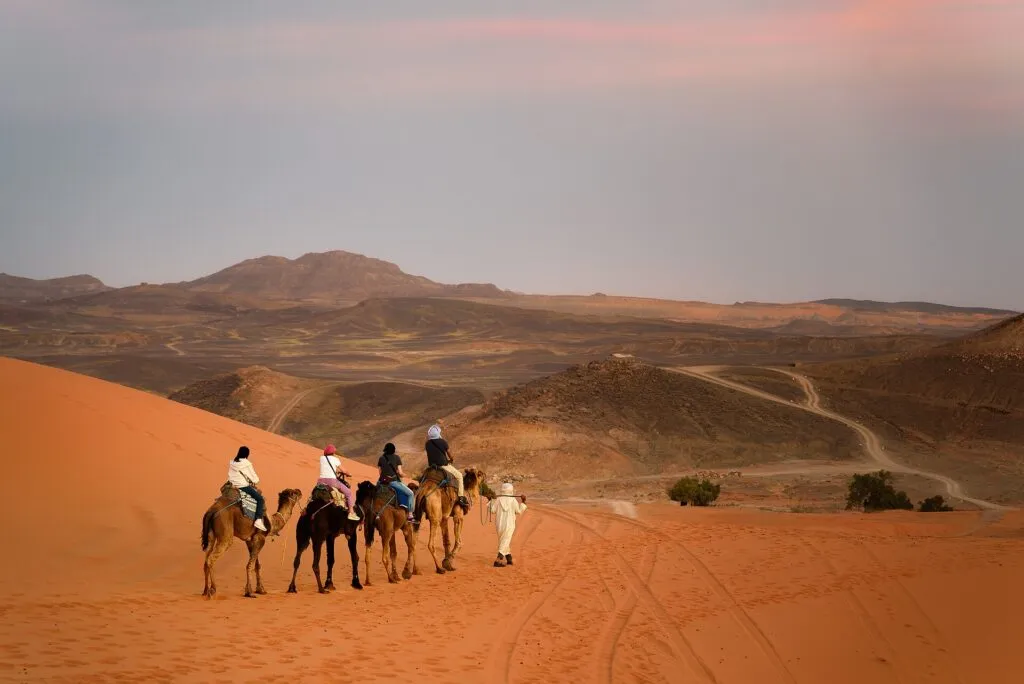
The camels kneel in the sand as the sun drops behind the dunes, and your guide leads you to a ring of tents lit by lanterns. Inside the dining tent, someone pours mint tea from high above the glasses. Then the lids come off the tagines, and the smell of chicken, preserved lemon and olives fills the cold desert air.
Dinner at a Sahara desert camp in Morocco follows a familiar pattern: a bowl of harira soup or a Moroccan salad, a tagine as the main course, bread, and fresh fruit, with mint tea before and after. Breakfast is bread, msemen pancakes, jam, cheese, eggs and tea at sunrise. Both meals are usually included in the price of the camel trek and camp night.
This guide explains what you will eat on a camel trek in Merzouga (Erg Chebbi), Zagora or Erg Chigaga, how luxury and budget camps differ, how to get vegetarian, vegan and gluten-free meals, water and safety tips, and what to bring.
A Typical Evening Menu
| Course | What you usually get |
|---|---|
| Welcome | Mint tea, poured from a height, often with dates or nuts |
| Starter | Harira (tomato, lentil and chickpea soup) or a Moroccan salad of tomato, cucumber, onion and peppers |
| Main course | A tagine: chicken with preserved lemon and olives, kefta (meatballs) in tomato with egg, beef with vegetables, or lamb with prunes at higher-end camps; sometimes couscous |
| Bread | Round Moroccan bread (khobz), sometimes baked in the hot sand |
| Dessert | Fresh fruit: oranges, dates, watermelon in summer; pastries at luxury camps |
| After dinner | More mint tea around the campfire, often with Berber drumming and singing |
The tagine arrives in its conical clay pot and is usually shared. Moroccans eat from their own side of the dish, using bread to scoop up the food.
Breakfast at Sunrise
After watching sunrise over the dunes, breakfast is usually served in the dining tent: bread, msemen (flaky square pancakes), jam, honey, olive oil, butter, processed cheese wedges, sometimes eggs, plus coffee and mint tea. Many groups then ride the camels back to the village in the morning, where some tours serve a second breakfast or lunch.
Madfouna: The “Berber Pizza” of Merzouga and Rissani
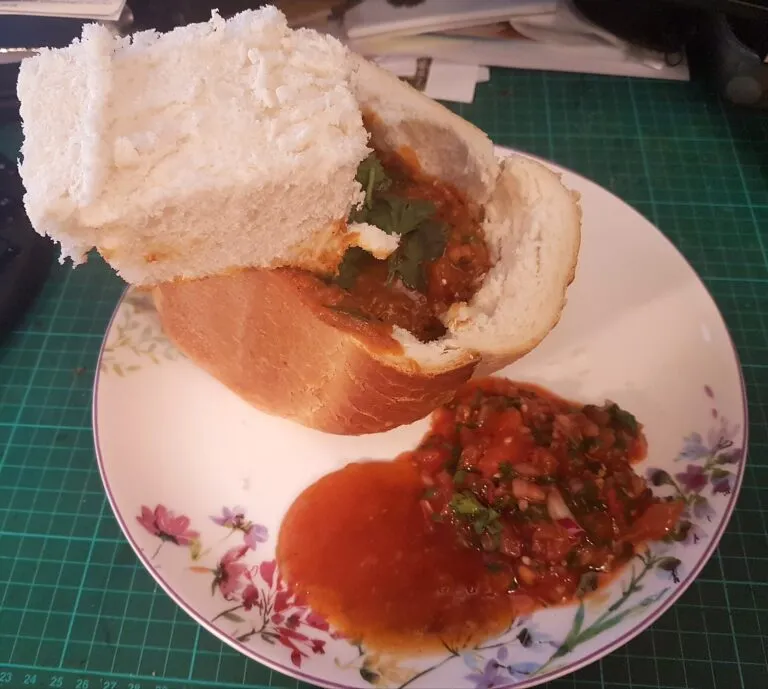
Before or after your trek, look for madfouna (also medfouna), a speciality of the Merzouga and Rissani area: a large flatbread stuffed with minced meat, onion, spices, egg and herbs, then baked in a clay oven or buried in hot sand and embers. Locals call it Berber pizza, and many restaurants in Merzouga and Rissani make it to order.
Luxury, Mid-Range and Budget Camps
| Camp type | What dinner is like |
|---|---|
| Budget | Long communal tables, shared tagines, simple but often very home-style; food may be cooked earlier and brought in |
| Mid-range | Individual plates, more variety, sometimes a different tagine each night |
| Luxury | Multi-course meals at candlelit tables: salad trio, chicken pastilla, tagines, couscous and desserts, cooked on site |
Reviewers often say small private tours eat best, because the cook is preparing for a handful of people rather than a large group. Food quality also depends more on the camp than on the price tier, so read recent reviews.
Merzouga, Zagora, Erg Chigaga or Agafay?
- Merzouga (Erg Chebbi): the classic high orange dunes and the most camps, from simple to luxurious. Usually reached on a 3-day tour from Marrakech or Fes. Food is easy to find in the village, including madfouna.
- Zagora: closer to Marrakech, with smaller dunes; popular for 2-day tours. Camp food is similar but simpler.
- Erg Chigaga: remote, wilder dunes beyond M’Hamid, reached by 4×4. Camps run on gas and charcoal, and menus are simpler; bring snacks.
- Agafay: a rocky stone desert about 40 minutes from Marrakech, not Saharan sand. Camps here are more like resorts, often with pools and fuller menus.
Vegetarian, Vegan, Gluten-Free and Allergies
- Vegetarian: easy. A vegetable tagine of potato, carrot, courgette and tomato is standard Moroccan cooking.
- Vegan: possible with notice. Ask for no butter or smen (preserved butter) in the tagine and bread, and no honey.
- Gluten-free: harder, because bread and couscous appear at every meal. Ask for rice or extra vegetables and bring gluten-free snacks.
- Allergies: tell your tour operator in writing at least 48 hours ahead, and remind the guide on the day, because messages do not always reach remote camps.
Halal and Alcohol
Halal note: Morocco is almost entirely Muslim, and the meat served at desert camps is halal; pork is not served. Alcohol is generally not served at standard camps, but some luxury camps and many Agafay camps offer wine or beer to guests; if that matters to you, ask before booking, or choose an alcohol-free camp. During Ramadan, camps usually serve guests as normal and can prepare an iftar meal and an early suhoor if you ask. See our halal food travel guide.
Water, Hygiene and Comfort
- Drink bottled water only, and use it to brush your teeth. Camp water often comes from wells.
- Bring hand sanitiser; washing facilities are basic at simple camps.
- Evenings are cold from October to April, even when days are hot. A warm layer makes dinner far more enjoyable.
- Eat lightly before the camel ride if you get motion sickness.
What to Bring
- Snacks you like: nuts, dates, cereal bars
- Enough bottled water for the ride and the night
- A torch or headlamp for the walk to the toilets
- A warm layer and a scarf for wind and sand
- Small notes for tipping your guide and the camp team
What It Costs in 2026
| Option | Typical price |
|---|---|
| Shared 3-day tour from Marrakech to Merzouga with camp night | Roughly EUR 80–150 per person, dinner and breakfast included |
| Private tour with a luxury camp | Often EUR 300 or more per person |
| Madfouna in Merzouga or Rissani | About MAD 60–120, enough to share |
| Bottled water at the camp | About MAD 10–30, more than in town |
Plan your Morocco budget with our food budget calculator and check tipping in Morocco; tipping your camel guide and camp staff is customary.
Frequently Asked Questions
What do you eat at a Sahara desert camp?
Usually harira soup or salad, a tagine with chicken, beef, kefta or vegetables, bread and fruit, with mint tea throughout. Breakfast is bread, pancakes, jam, cheese and tea.
Is food included on a Sahara camel trek?
Dinner and breakfast at the camp are almost always included. Lunches on multi-day tours and drinks beyond tea and water are usually extra.
Is the food at desert camps good?
Most travellers find it better than expected, especially at small camps and on private tours. Budget camps serving large groups can be more basic.
Is desert camp food halal?
Yes. Morocco is a Muslim country, and the meat served at camps is halal. Pork is not served.
Do desert camps serve alcohol?
Most standard camps do not. Some luxury camps and Agafay camps serve wine and beer, so ask if you want an alcohol-free stay.
Can vegetarians eat well on a Sahara tour?
Yes. Vegetable tagines, salads, soups, bread and fruit are standard. Tell your tour company in advance.
Is it safe to drink water at a desert camp?
No. Drink and brush your teeth with bottled water only.
What time is dinner at a desert camp?
Usually after dark, around 8 to 9 pm, after the sunset camel ride and mint tea. Moroccans generally eat dinner late.
What is madfouna?
A stuffed flatbread from the Merzouga and Rissani area, filled with spiced minced meat, onion and egg and baked in a clay oven or in hot sand. Locals call it Berber pizza.
Is bread really baked in the sand?
At some camps, yes: dough is buried in hot sand and embers until cooked. Many camps bake bread in ovens instead.
Should I bring snacks on a desert tour?
Yes. Nuts, dates and cereal bars are useful on long drives and if dinner is late or you have dietary needs.
What is the best season for a desert trek?
October to April, when days are pleasant and nights are cold enough to enjoy hot soup and tea. Summer days can be extremely hot.
How do Moroccans serve mint tea?
Green tea, fresh mint and sugar are brewed in a teapot and poured from a height to create foam. Several rounds are usually served, and accepting a glass is part of the welcome.
Is Agafay the real Sahara?
No. Agafay is a rocky stone desert near Marrakech. For Saharan sand dunes, go to Merzouga, Zagora or Erg Chigaga.
More from North Africa: couscous in Algeria, tagine and street food in Casablanca, koshari in Cairo, yassa in Senegal and injera in Addis Ababa.
Sources
- Sahara desert camp food, Memento Morocco (menus, camp types, dietary notice)
- Desert camp food in Morocco, Visit Agafay Desert (Agafay vs Sahara, prices)
- Food in the Moroccan Sahara, Relaxing Desert Camp