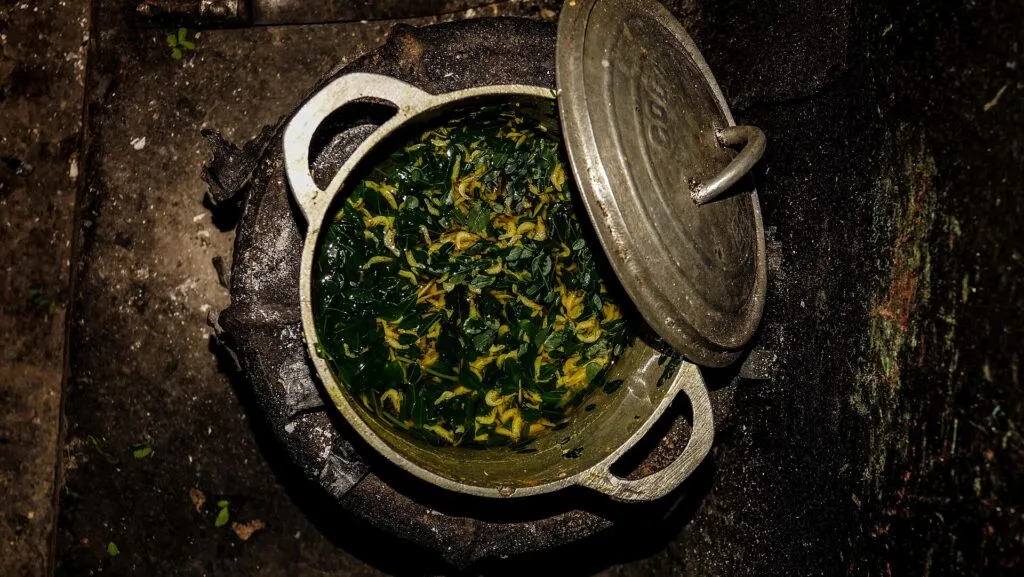
In a Malagasy home at midday, a big pot of rice (vary) sits at the centre of the table, and beside it a smaller pot of broth crowded with dark greens and pieces of zebu beef. You ladle the broth over your rice, take a bite of a yellow flower bud from the greens, and your mouth starts to tingle.
Romazava is Madagascar’s national dish: a light, savoury broth of zebu beef (or chicken or fish) with tomato, onion, garlic, ginger and leafy greens called brèdes, above all brède mafana, whose flowers make your lips tingle and go slightly numb. It is eaten over plenty of white rice, with chilli relish on the side, and is also cooked in the Comoros.
This guide explains what romazava tastes like, the greens that make it unique, how it is made and eaten, where to try it, and dietary and halal notes.
What Romazava Tastes Like
Clean, savoury and gently peppery, more of a brothy stew than a thick sauce. The meat gives depth, tomato and ginger add brightness, and the greens bring a fresh, slightly bitter edge. The surprise is brède mafana: its leaves and yellow flower buds cause a tingling, numbing sensation that Malagasy diners love.
The Greens: Brède Mafana and Friends
Brède mafana is paracress (Acmella oleracea), the same plant used in the Amazon, where it is called jambu and gives Belém’s tacacá its famous tingle. In Madagascar, cooks combine it with other greens such as mustard greens, cress and nightshade leaves, and with Chinese cabbage (petsai).
Read more about the Amazonian side of the same plant in our guide to Amazonian food.
How Romazava Is Made
- Pieces of fatty zebu beef or beef are browned in a little oil.
- Onion or shallots, crushed garlic, fresh ginger and chopped tomato are added and cooked down.
- Water is added, and the meat simmers until tender, about an hour.
- The greens go in near the end, with a few brède mafana flower buds, and cook just until wilted.
- It is seasoned with salt and often Madagascar’s wild pepper (voatsiperifery).
How Malagasy People Eat It
Rice is the centre of every Malagasy meal, and romazava is a laoka, the dish that goes with the rice. Spoon the broth, meat and greens over a generous mound of rice, and add sakay (chilli relish) or a tomato rougail to taste. Many families end the meal with ranon’apango, a drink made from the water boiled in the toasted rice pot.
Other Malagasy Dishes to Try
- Ravitoto: pounded cassava leaves, often cooked with pork or with fish; ask which.
- Henakisoa sy ravitoto: ravitoto with pork, a classic, but not halal.
- Akoho sy voanio: chicken in coconut sauce, popular on the coast.
- Mofo gasy: small rice-flour cakes sold at breakfast stalls.
- Koba: a sweet of peanuts, banana and rice flour wrapped in leaves.
Where to Eat Romazava
- Hotely: small local restaurants across Madagascar, which serve rice with a choice of laoka at lunchtime, often including romazava.
- Antananarivo: hotely in the city centre and markets, and restaurants serving Malagasy classics.
- Abroad: Malagasy restaurants in Paris and other French cities, and Comorian and Malagasy communities in Réunion and Mayotte.
Dietary and Halal Notes
Halal note: romazava itself is usually made with zebu beef, chicken or fish and no alcohol, but Madagascar is mainly Christian and meat at ordinary hotely is not halal-slaughtered; pork is common in other Malagasy dishes such as ravitoto. Madagascar has an established Muslim community, especially in the north-west and in cities such as Mahajanga, and in the Comoros, where romazava is also cooked, meat is halal. Fish romazava is a good choice elsewhere. See our halal food travel guide.
Romazava is naturally gluten-free and low in fat compared with many stews. Vegetarians can ask for a version with greens only, though it is traditionally made with meat.
What It Costs in 2026
| Where | Typical price |
|---|---|
| Rice with romazava at a hotely | About MGA 5,000–12,000 |
| At a restaurant in Antananarivo | About MGA 15,000–35,000 |
| At a Malagasy restaurant in Paris | About EUR 12–18 |
Frequently Asked Questions
What is romazava?
Madagascar’s national dish: a broth of zebu beef, tomato, ginger and leafy greens, eaten over rice.
What is the national dish of Madagascar?
Romazava, served with rice.
Why does romazava make my mouth tingle?
Because of brède mafana (paracress), whose leaves and flower buds contain compounds that cause a tingling, numbing sensation.
What is zebu?
A humped breed of cattle central to Malagasy farming and culture. Its meat is used much like beef.
What can I use instead of brède mafana?
Outside Madagascar, use watercress, mustard greens or spinach with a little Sichuan pepper for a hint of tingle. Paracress is sometimes sold as an ornamental plant or in Asian and African grocers.
Is romazava spicy?
Not in itself. Heat comes from the sakay chilli relish served alongside.
What do Malagasy people eat with romazava?
Plenty of white rice, chilli relish, and sometimes a tomato rougail.
Is romazava halal?
It has no pork or alcohol, but meat in Madagascar is usually not halal-slaughtered. Choose fish romazava, or eat it in Muslim communities and in the Comoros.
Is romazava eaten in the Comoros?
Yes. It is part of Comorian cooking too, and is also found in Réunion and Mayotte.
How long does romazava take to cook?
About one and a half hours, mostly simmering the meat before the greens go in.
Is romazava healthy?
Yes, it is a light, vegetable-rich broth with lean protein, especially with fish or chicken.
More from Africa: Zanzibar’s spice farms and food, muamba de galinha and nyama choma.
Sources
- Romazava, Wikipédia in French (meats, brèdes, Comoros, serving)
- Romazava, Wikipedia
- Romazava au poivre sauvage, Île aux Épices