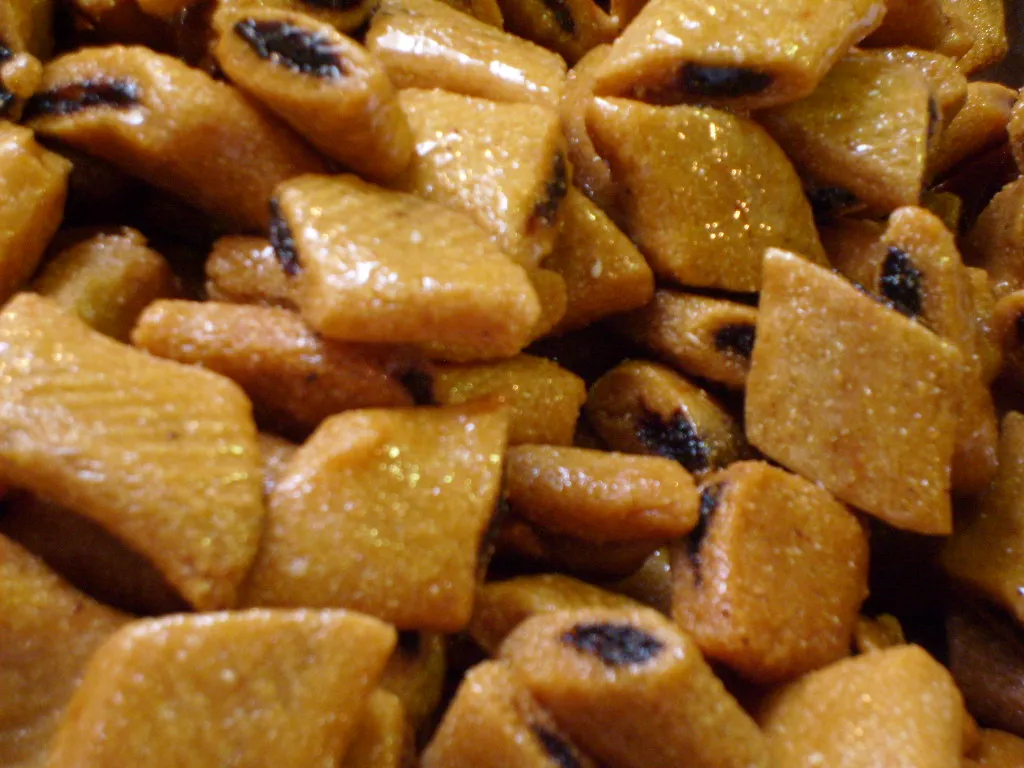
In the last nights of Ramadan, kitchens across Algeria smell of warm butter, orange blossom and hot honey. Trays of golden diamond-shaped pastries, each with a dark line of dates running through the middle, come out of the oil and slide straight into a pot of honey. By Eid morning they are stacked on every table for guests.
Makroud (also makrout or maqroudh) is a Maghrebi pastry of semolina dough filled with date paste, cut into diamonds, then fried or baked and soaked in honey or syrup. It is made across Algeria, Tunisia, Morocco and Libya, and in Algeria it is a centrepiece of Eid al-Fitr, weddings and family celebrations. Algiers is also famous for makrout el louz, a delicate almond version.
This guide explains the main types, how makroud is made, where it comes from, the Algeria–Tunisia question, where to buy it in Algiers and abroad, and dietary notes.
The Main Types of Makroud in Algeria
| Type | Region | What makes it different |
|---|---|---|
| Makrout tmar (date makrout) | From the edge of the Sahara, made everywhere | The classic: semolina dough around date paste |
| Makrout lassel (honey makrout) | Sétif and the high plateaus, adopted in Algiers | Fried, then soaked in honey |
| Makroud el koucha | Constantine and eastern Algeria | Baked in the oven rather than fried, drier and crumblier |
| Makrout el louz | Algiers | Made of ground almonds, sugar and egg, no semolina, dipped in syrup and rolled in icing sugar |
| Mkirat | Tlemcen | Rich with eggs, peanuts and toasted sesame |
| Makroud el dgig | Souk Ahras | Made with flour instead of semolina |
Makrout el louz has become a star abroad too: Algerians on forums proudly point out that it was ranked first in a TasteAtlas list of the world’s best cookies.
How Makroud Is Made
- The dough: medium semolina is rubbed with melted butter or smen (aged butter) and left to rest, then bound with orange blossom water and a little salted water.
- The filling: dates, often the Algerian Deglet Nour variety, are kneaded with cinnamon, a little butter and sometimes cloves into a smooth paste.
- Shaping: the dough is rolled into a long log, a channel is made down the centre, the date paste is laid in, and the dough is closed over it.
- Pattern and cutting: the top is pressed with a wooden mould or patterned tool, and the log is cut into diamonds.
- Cooking: fried in oil until golden, or baked in the oven.
- Honey: while still warm, the pastries are dipped in warm honey or sugar syrup, often scented with orange blossom.
Many families still use carved wooden moulds passed down through generations to stamp the pattern on top.
Where Makroud Comes From
The oldest known recipe appears in a 13th-century Arabic cookbook by Ibn Razin al-Tujibi, from Muslim Spain and North Africa, which describes a date-filled semolina pastry. Several origins are claimed. One tradition credits Kairouan in Tunisia, from where the pastry is said to have spread to Fez and, under the Aghlabid dynasty, to Malta, where similar date pastries called imqaret are still sold.
In Algeria, the date version is associated with the south-east and the edge of the Sahara, where dates are plentiful, and every region has developed its own style.
Algerian or Tunisian?
Online, Algerians and Tunisians debate whose makroud it is. In truth it belongs to the whole Maghreb, and each country has its own pride: Kairouan is famous for its makroudh and holds a festival in its honour, while Algeria has the widest range of regional styles, from Constantine’s baked el koucha to Algiers’ almond makrout el louz. Morocco and Libya make their own versions too.
When Makroud Is Eaten
- Eid al-Fitr: the most important time, when families make large batches in the last days of Ramadan.
- Ramadan evenings: with tea or coffee after iftar.
- Weddings and engagements: trays of makrout el louz and other sweets are part of the celebration.
- Guests: offered with mint tea or coffee as a sign of welcome.
Where to Buy Makroud
- Algiers: traditional pastry shops in the Casbah and the city centre sell makroud by the kilo, especially before Eid; quality is highest where it is made fresh daily.
- Constantine and Sétif: for the regional baked and honey versions.
- Tunisia: Kairouan’s pastry shops are famous for makroudh.
- Abroad: North African bakeries in Paris, Marseille, Lyon, Brussels and Montreal sell makroud, especially during Ramadan.
Pair your pastry with something savoury from the region: our guides to couscous in Algeria and Tunisian harissa.
Dietary and Halal Notes
Halal note: makroud is made from semolina, dates, butter, oil and honey or syrup, with no meat or alcohol, so it is naturally halal. In North Africa it is a staple of Muslim celebrations. Abroad, check shop-bought versions for any unusual additives. See our halal food travel guide.
Makroud contains wheat, so it is not gluten-free, except makrout el louz, which is made with almonds rather than semolina (check for added flour). It is high in sugar and fat, so most people eat one or two with tea. Makrout el louz is unsuitable for people with nut allergies.
What It Costs in 2026
| Where | Typical price |
|---|---|
| Makroud at a pastry shop in Algiers | Sold by the kilo; roughly DZD 1,500–3,000 per kg, more for makrout el louz |
| North African bakery in France | About EUR 15–30 per kg |
Frequently Asked Questions
What is makroud?
A Maghrebi pastry of semolina dough filled with date paste, cut into diamonds, fried or baked and soaked in honey or syrup.
Is makroud Algerian or Tunisian?
Both, and Moroccan and Libyan too. It is a shared Maghrebi pastry, with famous traditions in Kairouan in Tunisia and many regional styles across Algeria.
What is the origin of makroud?
The oldest known recipe is in a 13th-century Arabic cookbook by Ibn Razin al-Tujibi. Tunisian tradition links it to Kairouan, from where it spread across the region.
What is makrout el louz?
An Algiers speciality made from ground almonds, sugar, egg and lemon zest, flavoured with orange blossom, dipped in syrup and rolled in icing sugar. It contains no semolina.
Is makroud fried or baked?
Either. Many households fry it, while Constantine’s makroud el koucha is baked.
What dates are best for makroud?
Soft, sweet dates such as Algeria’s Deglet Nour, or ready-made date paste.
How long does makroud keep?
About one to two weeks in an airtight tin at room temperature. It also freezes well.
When do Algerians make makroud?
Above all for Eid al-Fitr, and for weddings, celebrations and guests.
Is makroud the same as Maltese imqaret?
They are close relatives. Imqaret is a Maltese fried date pastry thought to share the same North African origins.
Can makroud be made without frying?
Yes. Baked versions, like Constantine’s el koucha, are crumblier and less oily.
Is makroud vegan?
Usually not, because it contains butter or smen and is often soaked in honey. Some home versions use oil and sugar syrup instead.
More from North Africa: Algerian couscous, harissa and dinner at a Sahara desert camp.
Sources
- Makroudh, Wikipedia (13th-century recipe, Eid)
- Makroud, Wikipédia in French (Algerian regional types, Kairouan, Malta)
- Origine du makroud, Nessma Cuisine