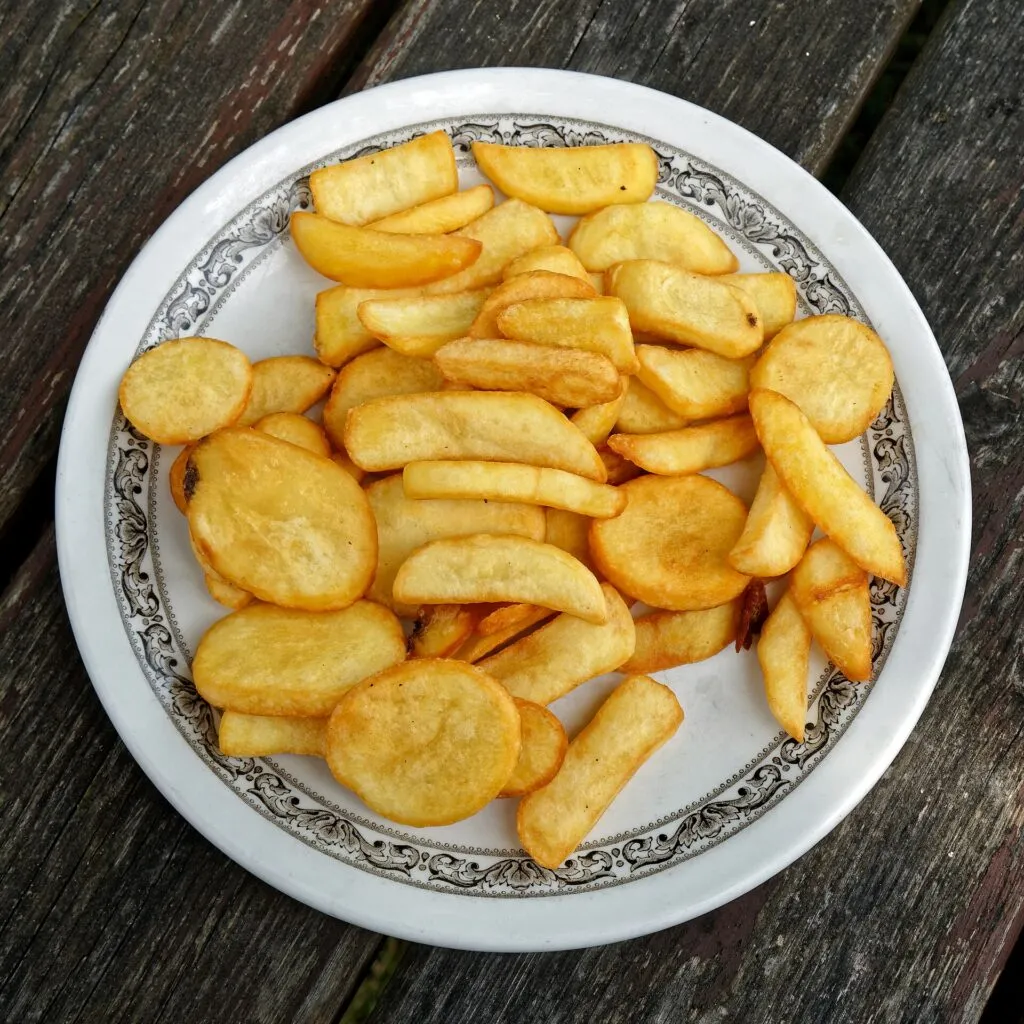
Belgian fries are thick-cut potatoes fried twice, served in a paper cone with a generous spoon of sauce. In Brussels you buy them from a friterie (French) or frituur/frietkot (Dutch), usually a small kiosk or snack bar. A portion costs about €3.50–€5, sauce around €1 extra, and the best-known stops are neighbourhood institutions such as Maison Antoine on Place Jourdan and Frit Flagey on Place Flagey.
| Quick facts | Details |
|---|---|
| Local names | Frites (French), frieten (Dutch). Never “French fries” |
| What makes them different | Cut thick, fried twice: once to cook, once to crisp |
| Classic sauces | Mayonnaise, andalouse, samurai, tartare, curry ketchup |
| Typical price | About €3.50–€5 per cone, plus €1 or so for sauce |
| Where to buy | A friterie / frituur kiosk or snack bar |
Why Belgian fries are different
Belgians are proud of their fries, and with reason. The potatoes (often the Bintje variety) are cut into thick batons, fried at a lower temperature until soft inside, rested, then fried again at a high temperature so the outside turns crisp and golden. Some traditional friteries still fry in beef fat (blanc de bœuf), which gives a richer flavour; many now use vegetable oil, so ask if it matters to you.
The frietkot itself is part of Belgian culture. These small fry kiosks have been recognised as intangible cultural heritage in Belgium, and most towns have a favourite one.
Where to eat fries in Brussels
- Maison Antoine, Place Jourdan (Etterbeek) – probably the most famous kiosk in the city, near the European Quarter.
- Frit Flagey, Place Flagey (Ixelles) – a much-loved kiosk on a lively square, popular in the evening.
- Your nearest neighbourhood friterie – locals rarely cross town for fries. A busy kiosk with a queue is usually a good sign.
Opening hours vary and kiosks can close for holidays, so check before making a special trip.
How to order fries in Brussels
Brussels is officially bilingual, and most friteries work in French. Sizes are usually small, medium and large; a small is plenty for one person.
| Say | Meaning |
|---|---|
| Une petite frite, s’il vous plaît | A small fries, please |
| Avec mayonnaise | With mayonnaise |
| Une sauce andalouse | Andalouse sauce (mayonnaise with tomato and peppers) |
| Samouraï | Samurai sauce (spicy mayonnaise with harissa) |
| Een kleine friet met mayonaise | A small fries with mayonnaise (in Dutch) |
Which sauce? First time, go for mayonnaise or andalouse. Belgian mayonnaise is richer and less sweet than most. Sauce is usually charged separately.
What to order with your fries
- Fricadelle – a long, deep-fried minced-meat sausage, usually containing pork.
- Boulette – a deep-fried meatball.
- Mitraillette – a Brussels speciality: half a baguette stuffed with meat, fries and sauce.
Frequently asked questions
Where are the best fries in Brussels?
Maison Antoine on Place Jourdan and Frit Flagey on Place Flagey are the most famous. Many locals will tell you the best ones are at their own neighbourhood kiosk.
Are Belgian fries fried in beef fat?
Traditionally, yes, and some friteries still use beef fat. Many now use vegetable oil. If you are vegetarian, ask before ordering.
How much do fries cost in Brussels?
About €3.50–€5 for a cone and roughly €1 for sauce in 2026.
Are fries Belgian or French?
Both countries claim them and nobody can prove who was first. In Belgium they are a national dish, and the double-frying style is distinctly Belgian.
More in Brussels: where to eat Belgian waffles and the Brussels chocolate guide. See all Belgium food guides or estimate your food budget for Belgium.
Sources
- visit.brussels – official Brussels tourism site.
- French fries (history and Belgian style).