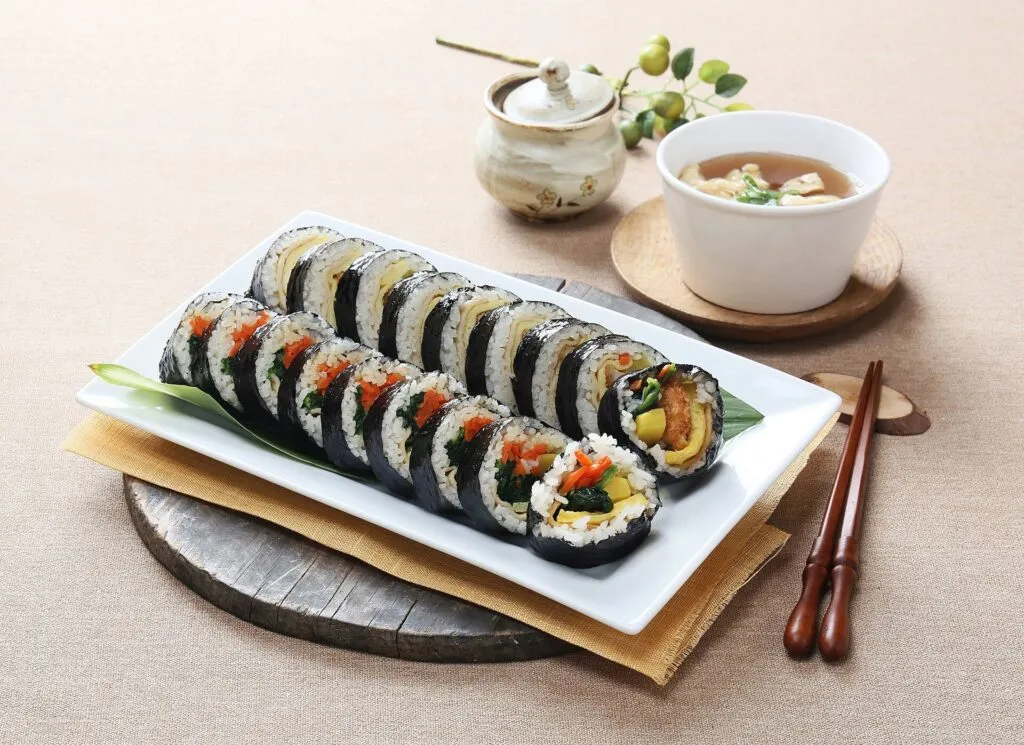
On a sunny weekend in Seoul, the lawns along the Han River fill with picnic mats. Out of every bag comes the same thing: rolls of gimbap, sliced into neat rounds that show a flower of colour inside, yellow pickled radish, green spinach, orange carrot, a strip of egg.
Gimbap is Korea’s rice roll: seasoned rice and fillings such as pickled radish, spinach, carrot, egg, fish cake, tuna or beef, rolled in dried seaweed (gim), brushed with sesame oil and sliced. It is sold at snack shops, markets and convenience stores all over Seoul, and is the classic picnic food. In 2026 a roll costs roughly ₩3,000–7,000. The basic roll often includes ham, which is pork, but vegetable, tuna and fish-cake versions are common, and most shops will leave the ham out if you ask.
This guide covers the types of gimbap, how to order it without pork, where to buy it, a Han River picnic plan, prices and Korean phrases.
Types of gimbap
| Gimbap | Filling | Halal check |
|---|---|---|
| Basic (yachae or wonjo) | Radish, spinach, carrot, egg, fish cake, often ham | Ask to remove ham |
| Chamchi gimbap | Tuna mayo with perilla leaf | Usually pork-free |
| Chijeu gimbap | Cheese | Usually pork-free; check for ham |
| Bulgogi gimbap | Marinated beef | Beef not halal; marinade may contain rice wine |
| Mayak gimbap | Mini rolls with mustard dipping sauce, famous at Gwangjang Market | Usually vegetables only; ask |
| Chungmu gimbap | Plain rice rolls with spicy squid and radish on the side | Seafood; ask about sauces |
| Triangle samgak gimbap | Convenience-store rice triangle | Read the label |
Halal note: the standard gimbap includes a strip of ham; say haem ppaejuseyo (햄 빼주세요, “please take out the ham”), or choose tuna, cheese or vegetable rolls. Some fillings are cooked in shared pans, and bulgogi is not halal. Seoul’s halal restaurants are clustered in Itaewon. See our halal food travel guide.
Where to buy gimbap
- Gimbap shops (gimbap-jip) – cheap snack restaurants that roll to order; you can customise fillings.
- Gwangjang Market – famous for mayak (“addictive”) mini gimbap.
- Convenience stores – triangle gimbap and rolls; check the label for 햄 (ham) or 돼지고기 (pork).
- Markets and train stations – ready-rolled for the journey.
A Han River picnic
- Buy two or three rolls (tuna, vegetable, cheese) and some fruit.
- Take the subway to a Han River park such as Yeouido or Banpo.
- Rent or bring a mat; shade tents are common in summer.
- Add instant ramyeon from the riverside convenience stores (check labels).
- Stay for sunset; Banpo Bridge has a fountain show in the warmer months.
Gimbap vs sushi
They look similar but taste different. Gimbap rice is seasoned with sesame oil and salt, not vinegar, and fillings are mostly cooked or pickled rather than raw fish.
What it costs (2026)
| Item | Typical price |
|---|---|
| Basic gimbap roll | About ₩3,000–5,000 |
| Tuna or cheese gimbap | About ₩4,000–7,000 |
| Mayak gimbap (portion) | About ₩4,000–6,000 |
| Convenience-store triangle | About ₩1,200–2,000 |
Plan your budget with the South Korea food budget calculator.
Korean phrases
| Korean | Say | Meaning |
|---|---|---|
| 햄 빼주세요 | Haem ppaejuseyo | Please take out the ham |
| 참치김밥 하나 주세요 | Chamchi gimbap hana juseyo | One tuna gimbap, please |
| 돼지고기 들어가요? | Dwaejigogi deureogayo? | Does it contain pork? |
| 포장이요 | Pojang-iyo | To take away |
Frequently asked questions
What is gimbap?
A Korean rice roll filled with vegetables, egg and fish cake or tuna, wrapped in seaweed and sliced.
Is gimbap halal?
Basic gimbap often includes ham. Ask for it without ham, or choose tuna, cheese or vegetable gimbap.
What is the difference between gimbap and sushi?
Gimbap rice is seasoned with sesame oil and salt, and fillings are cooked or pickled; sushi uses vinegared rice and often raw fish.
How much is gimbap in Seoul?
About ₩3,000–7,000 a roll in 2026.
More from Seoul: Myeongdong street food, halal Korean BBQ and kimchi classes. See all South Korea food guides.
Sources
- VisitKorea – Korea Tourism Organization.
- Gimbap.