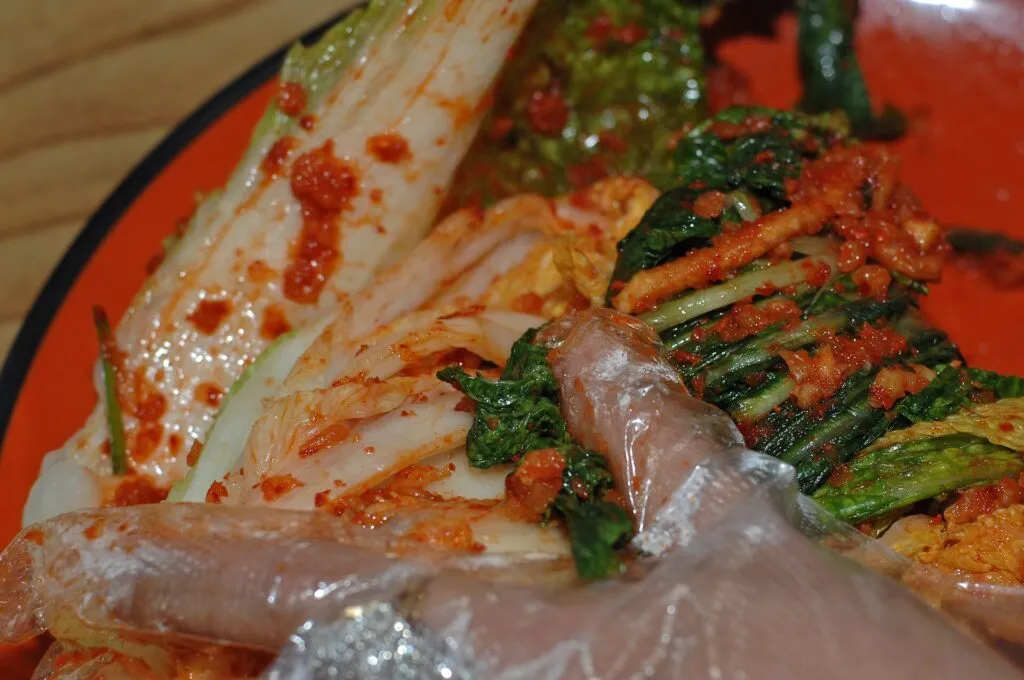
You pull on plastic gloves, and the instructor hands you a salted half-cabbage. The trick, she says, is to lift every leaf and rub the red paste all the way to the core. Ten minutes later your gloves are scarlet and the room smells of garlic and chilli.
A kimchi-making class in Korea is a one- to two-hour hands-on session where you learn to season salted napa cabbage with a paste of red pepper flakes, garlic, ginger and fish sauce, and take your own kimchi home. Classes run in Seoul, including at the Museum Kimchikan, cultural centres and cooking schools. In 2026 expect roughly 30,000–70,000 won per person. Kimchi itself usually contains no pork, which makes it one of the easiest Korean foods for Muslim travellers.
This guide covers what kimchi is, what happens in a class, how to choose one, halal points, taking kimchi home and useful Korean.
What is kimchi?
Kimchi is fermented vegetables, most often napa cabbage, seasoned with red pepper and aromatics. Koreans eat it at almost every meal, and there are hundreds of kinds.
Every autumn families gather for kimjang, making and sharing large amounts of kimchi for the winter. UNESCO added kimjang to its intangible cultural heritage list in 2013.
| Kimchi | What it is |
|---|---|
| Baechu kimchi | Whole napa cabbage kimchi; the classic |
| Kkakdugi | Cubed radish kimchi, crunchy |
| Oi sobagi | Stuffed cucumber kimchi, fresh and summery |
| Baek kimchi | “White” kimchi without chilli, mild |
| Pa kimchi | Green onion kimchi |
What you do in a class
- Learn about kimchi’s history and types, often with a tasting.
- See how cabbage is salted (usually done in advance, since it takes hours).
- Mix the paste: gochugaru (red pepper flakes), garlic, ginger, fish sauce or salted shrimp, a little sugar and sometimes rice paste.
- Rub the paste between every leaf of the cabbage.
- Fold and pack your kimchi into a container to take away.
- Some classes also cook a dish such as kimchi pancakes (kimchijeon).
How to choose a class
- Language: most tourist classes run in English; check the time slot.
- Length: one hour is a demo plus mixing; two hours often includes cooking and lunch.
- Take-home size: ask how much kimchi you keep and in what container.
- Location: Insadong and central Seoul are convenient; the Museum Kimchikan also explains kimchi’s history.
- Season: in November and December some centres run kimjang-style events.
Halal note: kimchi is made from vegetables, chilli, garlic, ginger and usually fish sauce or salted shrimp, which most scholars accept as seafood. It normally contains no pork or alcohol. Tell the class if you want a vegan version without seafood. Watch out for cooked dishes such as kimchi jjigae (stew), which is often made with pork. For halal Korean meals, go to Itaewon near the Seoul Central Mosque. See our halal food travel guide.
Taking kimchi home
- Ask the class for a sealed, leak-proof container, then double-bag it.
- Kimchi keeps fermenting and can swell; leave room in the container.
- On flights it usually counts as a liquid or gel in hand luggage, so pack it in checked baggage.
- Check your destination’s food import rules.
- Store it in the fridge as soon as you can. It gets more sour over time, which is perfect for stews and fried rice.
What it costs (2026)
| Class | Typical price |
|---|---|
| Short kimchi-making session (about 1 hour) | About 30,000–50,000 won |
| Longer class with cooking or lunch | About 50,000–80,000 won |
| Museum entry without a class | A small fee |
Plan your budget with the South Korea food budget calculator.
Korean phrases
| Korean | Say | Meaning |
|---|---|---|
| 김치 | Kimchi | Kimchi |
| 돼지고기 들어가요? | Dwaejigogi deureogayo? | Does it contain pork? |
| 할랄이에요? | Hallal-ieyo? | Is it halal? |
| 맵지 않게 해 주세요 | Maepji anke hae juseyo | Not spicy, please |
| 포장해 주세요 | Pojang hae juseyo | Please pack it to take away |
Frequently asked questions
Where can I take a kimchi-making class in Seoul?
At the Museum Kimchikan, cultural centres and cooking schools, mostly in central Seoul. Book ahead.
Is kimchi halal?
Kimchi usually contains vegetables, chilli, garlic and fish sauce or salted shrimp, with no pork or alcohol. Dishes cooked with kimchi, such as kimchi stew, often contain pork.
How much is a kimchi class in Korea?
About 30,000–80,000 won in 2026, depending on length.
Can I take kimchi on a plane?
Pack it sealed in checked luggage; in hand luggage it usually counts as a liquid.
More from Korea: Myeongdong street food and Buddhist temple food. See all South Korea food guides and tipping in South Korea.
Sources
- VisitKorea – Korea Tourism Organization.
- UNESCO: Kimjang and Kimchi.