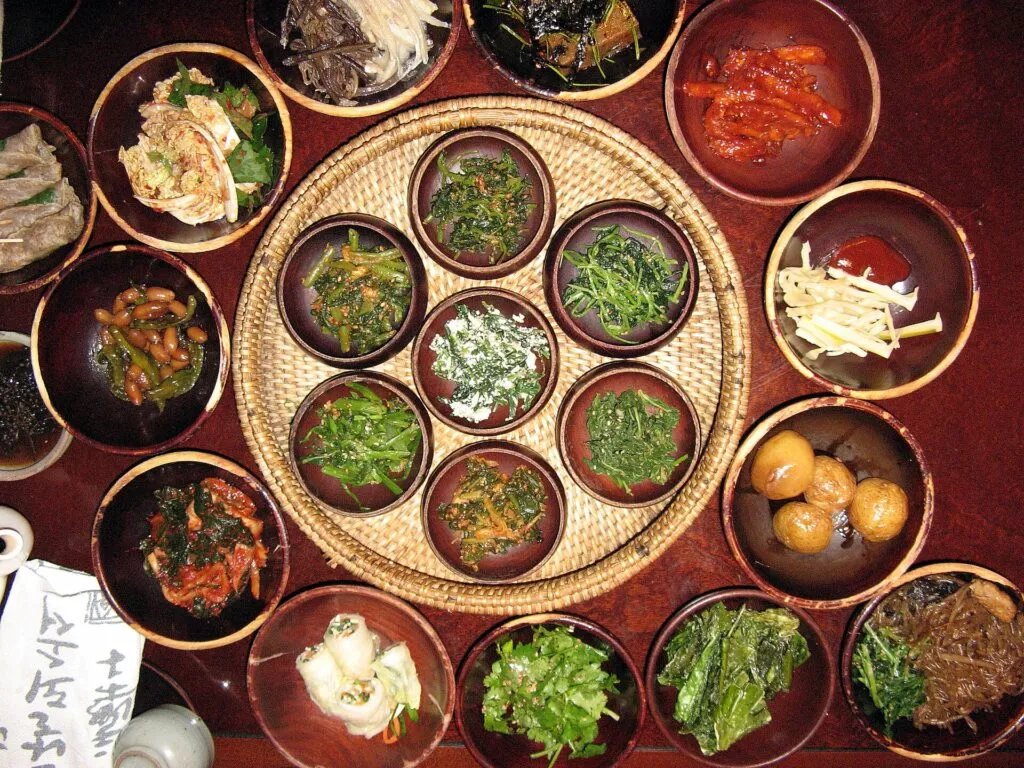
In a Korean temple kitchen nothing is wasted and nothing is rushed. Monks and nuns ferment soy sauce and soybean paste in earthenware jars for years, dry mountain greens in the sun, and cook with seasonal vegetables, mushrooms and grains. There is no meat, no fish, and no garlic or onion.
Korean temple food (sachal eumsik) is the plant-based cooking of Korea’s Buddhist monasteries: no meat or seafood and no “five pungent vegetables” (garlic, onion, green onion, chives and leeks), built instead on fermented sauces, mountain vegetables, mushrooms, tofu and grains. In Seoul you can taste it at specialist temple-food restaurants near Jogyesa Temple, and experience it at temples through the Templestay programme. In 2026 set meals at temple-food restaurants start at roughly ₩30,000. Because it contains no meat, fish or alcohol, temple food is one of the most halal-friendly ways to eat Korean cuisine.
This guide covers the principles, typical dishes, where to eat it in Seoul, Templestay, halal points and phrases.
The principles
- No animal products in the traditional form: no meat, fish or eggs, and usually no dairy.
- No five pungent vegetables, believed to disturb meditation.
- Seasonal and local ingredients, gathered and preserved at their best.
- Fermentation for depth: soy sauce (ganjang), soybean paste (doenjang) and chilli paste (gochujang).
- Mindful eating and no waste: every grain of rice is eaten.
Typical dishes
| Dish | What it is |
|---|---|
| Temple kimchi | Kimchi made without garlic, onion or fish sauce |
| Namul | Seasoned wild greens and vegetables |
| Tofu dishes | Pan-fried or braised tofu |
| Mushroom dishes | Shiitake, pine mushrooms and others, braised or grilled |
| Bibimbap | Rice with vegetables and chilli paste |
| Lotus leaf rice | Rice steamed in a lotus leaf with nuts and grains |
| Doenjang-guk | Soybean paste soup |
| Rice cakes and teas | Traditional sweets and herbal teas |
Balwoo gongyang: the monastic meal
In temples, monks eat a formal meal called balwoo gongyang from four nested wooden bowls. Food is served in silence, every scrap is eaten, and the bowls are rinsed with water and a piece of pickled radish, which is also eaten. Templestay guests often join this ritual.
Halal note: traditional temple food contains no meat, fish or alcohol, which makes it naturally halal-friendly. Fermented sauces are made from soybeans, salt and water. Modern restaurants may occasionally use dairy; ask if it matters to you. See our halal food travel guide.
Where to eat temple food in Seoul
- Around Jogyesa Temple, Insadong – the headquarters of Korea’s largest Buddhist order, with temple-food restaurants nearby, including a Michelin-recognised one.
- Temple food cultural centres – run cooking classes and demonstrations.
- Mountain temples outside Seoul – for simple meals in a monastery setting.
Templestay
Korea’s Templestay programme lets visitors stay overnight at Buddhist temples, joining meditation, chanting, tea ceremonies and temple meals. Programmes run from a few hours to several nights and can be booked online. Some temples in Seoul, such as those in the city centre, offer short day programmes.
What it costs (2026)
| Experience | Typical price |
|---|---|
| Temple-food set meal in Seoul | From about ₩30,000 |
| Temple-food cooking class | Priced per person |
| Templestay overnight | Priced per night, including meals |
Plan your budget with the South Korea food budget calculator.
Korean phrases
| Korean | Say | Meaning |
|---|---|---|
| 사찰음식 | Sachal eumsik | Temple food |
| 고기 들어가요? | Gogi deureogayo? | Is there meat in it? |
| 템플스테이 | Templestay | Templestay |
| 감사합니다 | Gamsahamnida | Thank you |
Frequently asked questions
What is Korean temple food?
The plant-based cooking of Korean Buddhist monasteries, without meat, fish or the five pungent vegetables.
Is temple food halal?
It contains no meat, fish or alcohol, so it is naturally halal-friendly.
Where can I try temple food in Seoul?
At restaurants around Jogyesa Temple in Insadong, and through Templestay programmes.
Why is there no garlic in temple food?
Garlic and the other pungent vegetables are traditionally believed to disturb meditation.
More from Korea: kimchi classes, gimbap and halal Korean BBQ. See all South Korea food guides.
Sources
- Templestay Korea – official Templestay programme.
- Korean temple cuisine.