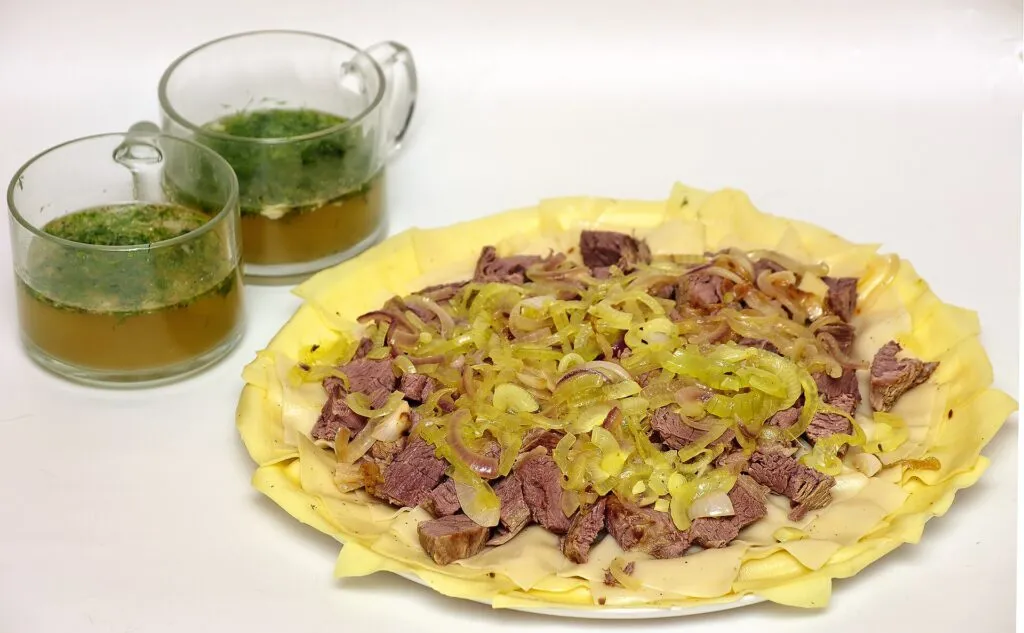
Beshbarmak arrives on a wide platter for the whole table: sheets of soft, flat noodles, a mountain of boiled meat carved into pieces, and a scattering of onions softened in hot broth. Bowls of that same broth are poured alongside. The name means “five fingers”, because it was traditionally eaten by hand.
Beshbarmak is Kazakhstan’s national dish: boiled meat, most often horse, mutton or beef, served over wide, thin noodles with an onion sauce (tuzdyk) and a bowl of rich broth (sorpa). It is cooked for guests and celebrations and served in traditional restaurants in Almaty and Astana. In 2026 a portion costs roughly KZT 3,000–8,000. Kazakhstan is a Muslim-majority country and restaurant meat is usually halal, but horse meat is common; the Hanafi school traditionally regards it as disliked, so ask for a mutton or beef version if you prefer.
This guide covers how beshbarmak is made and served, the customs around it, where to eat, halal points, prices and some Kazakh.
How it is made
- Large pieces of meat on the bone are simmered slowly for hours, making a rich broth.
- Dough of flour, egg and water is rolled thin and cut into wide squares or diamonds.
- The noodles are cooked in the meat broth.
- Onions are sliced and softened in hot broth with pepper to make tuzdyk.
- Meat is carved and piled on top of the noodles, with the onions over it.
What you might find on the platter
| Meat | Notes |
|---|---|
| Horse (kazy sausage, karta, boiled horse meat) | Traditional and prized in Kazakhstan |
| Mutton | Very common, especially in the south |
| Beef | Common in cities |
| Mixed | Many platters combine horse and mutton |
Customs at the table
- The host carves the meat and offers the best pieces to honoured guests.
- At traditional feasts, a boiled sheep’s head may be presented to the most senior guest, who shares it out.
- The broth (sorpa) is drunk from bowls after or alongside the meat.
- Tea with milk follows, often with sweets and baursak (fried dough).
Halal note: Kazakhstan is a Muslim-majority country and meat in traditional restaurants is usually halal; look for a halal sign if you want certainty, since pork is sold in some shops and international restaurants. Horse meat is widely eaten: many scholars permit it, while the Hanafi school traditionally regards it as disliked (makruh). Ask for mutton or beef beshbarmak if you prefer. See our halal food travel guide.
Where to eat beshbarmak
- Almaty – traditional Kazakh restaurants, many in yurt-style dining rooms.
- Astana – the capital, with national-cuisine restaurants.
- Family homes – if you are invited, beshbarmak is the dish of honour.
- Kyrgyzstan – neighbouring Kyrgyzstan serves its own version, often with mutton.
Beshbarmak is often cooked for groups; some restaurants need notice for large platters.
More Central Asian food
- Baursak – puffy fried dough, served with tea.
- Manty – large steamed dumplings with meat and onion.
- Lagman – hand-pulled noodles with meat and vegetables.
- Kurt – dried, salty balls of fermented milk.
- Plov – see our guide to plov in Samarkand.
Market culture across the region is covered in our Central Asian bazaar guide.
What it costs (2026)
| Order | Typical price |
|---|---|
| Beshbarmak portion | About KZT 3,000–8,000 |
| Platter for a group | Priced per platter |
| Tea with baursak | About KZT 800–2,000 |
Plan your budget with the food budget calculator.
Kazakh phrases
| Say | Meaning |
|---|---|
| Halal ma? | Is it halal? |
| Jylqy eti bar ma? | Is there horse meat? |
| Qoi etimen | With mutton |
| Qansha? | How much? |
| Rakhmet | Thank you |
Frequently asked questions
What is beshbarmak?
Kazakhstan’s national dish of boiled meat over wide noodles with onion sauce and broth.
Is beshbarmak halal?
Restaurant meat in Kazakhstan is usually halal. Horse meat is common; the Hanafi school regards it as disliked, so ask for mutton or beef if you prefer.
What does beshbarmak mean?
“Five fingers”, because it was traditionally eaten by hand.
Where can I eat beshbarmak?
In traditional Kazakh restaurants in Almaty and Astana, and in family homes.
See all Asia food guides.
Sources
- Kazakhstan Travel – official tourism site.
- Beshbarmak.