Stand at a Kolkata roll counter in the evening and the whole thing happens in under a minute. A ball of dough is slapped flat and hits a wide iron tawa. An egg is cracked over it and spread with the edge of a spatula. The paratha is flipped, the filling goes on, onions, chilli, a squeeze of lime, and it is rolled into a paper wrap and handed over the counter.
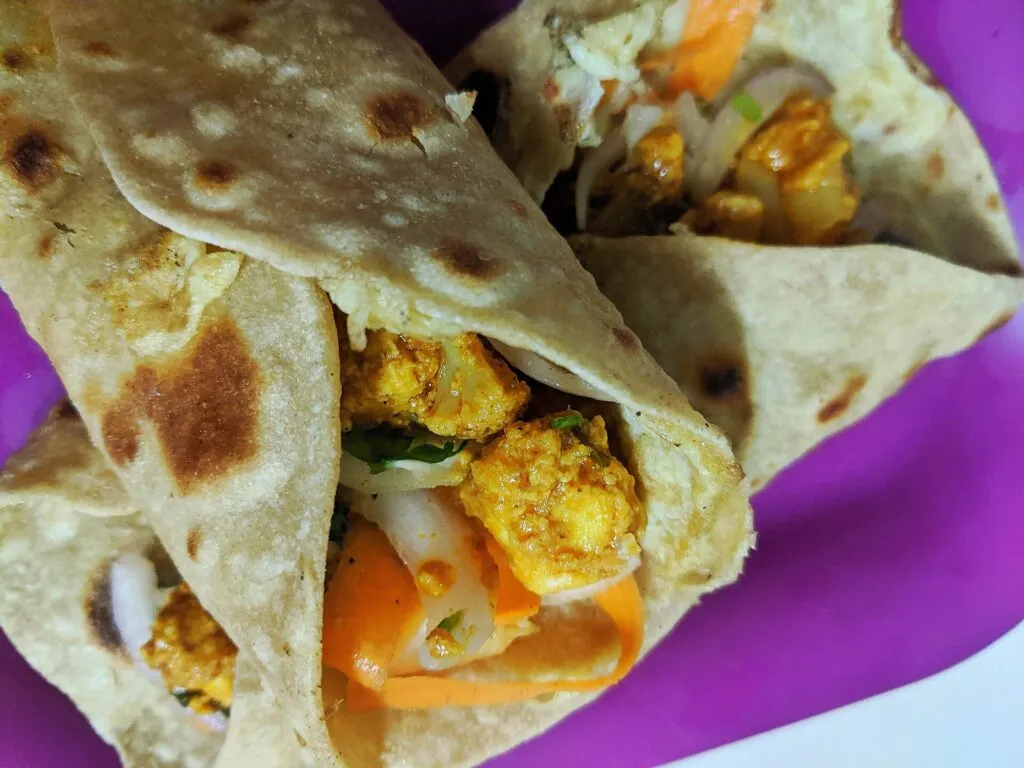
A kathi roll is Kolkata’s street wrap: a flaky paratha, often fried with a layer of egg, rolled around skewer-grilled chicken, mutton or paneer with raw onion, green chilli and lime. Stalls sell it across the city, and the most famous name is Nizam’s near New Market, widely credited as the roll’s birthplace. In 2026 expect roughly ₹50–200 a roll, depending on the filling and the shop.
It is cheap, quick, filling and eaten standing up. For many Kolkatans it is the taste of the city after dark.
Why it is called “kathi”
Kathi means stick. The original filling was kebab cooked on bamboo skewers, and wrapping it in paratha let office workers and shoppers eat it on the move without greasy fingers.
The story most often told credits Nizam’s, near New Market, in the first half of the 20th century. Details vary with the teller, but the name stuck, and today “roll” covers almost any wrap in Kolkata, vegetarian ones included.
Anatomy of a good roll
- The paratha – layered, flaky and fried on the tawa until crisp at the edges. It should be light, not greasy.
- The egg – cracked straight onto the paratha as it cooks, so the two fuse. One egg is standard; “double egg” means two.
- The filling – chicken or mutton kebab, grilled on skewers or cooked on the tawa, or paneer for vegetarians.
- The finish – raw onion, green chilli, lime juice and sometimes a sprinkle of chaat masala. Some stalls add sauce; purists skip it.
A great roll is crisp outside, juicy inside and sharp from the lime and onion. If it is soggy, the paratha sat too long.
Reading the menu board
Roll counters use a shorthand that confuses first-timers. This is what it means.
| On the board | What you get |
|---|---|
| Egg roll | Paratha with one egg fried onto it, onion, chilli, lime. The cheapest and a classic. |
| Double egg roll | Two eggs on the paratha. |
| Chicken roll | Grilled chicken pieces, no egg. |
| Chicken egg roll | Chicken plus one egg; the most-ordered roll. |
| Mutton roll | Goat kebab. Richer and pricier. |
| Paneer roll | Grilled cottage cheese, for vegetarians. |
| Double chicken, double egg | Twice the filling, twice the egg. A full meal. |
Where to eat one
- Nizam’s, near New Market – the name most Kolkatans give when asked where the kathi roll began. Busy and simple, and worth it for the history.
- Park Street and its side lanes – long-running counters such as Kusum Rolls keep going late into the evening.
- Around New Market – a dense cluster of roll counters, kebab shops and Mughlai restaurants.
- Your neighbourhood roll stall – every para (neighbourhood) has one. Look for a crowd and fresh parathas coming off the tawa.
Hours shift and prices rise, so check before you cross the city for one.
When to go
- Evening is roll time; many counters are busiest from about 6pm to late.
- Winter (December–February) is the most pleasant season for walking and eating outdoors in Kolkata.
- Ramadan evenings around Zakaria Street turn into a food festival, with kebabs, haleem and sweets.
What rolls cost (2026)
| Order | Typical price |
|---|---|
| Egg roll | About ₹50–80 |
| Chicken roll / chicken egg roll | About ₹80–160 |
| Mutton roll | About ₹120–200 |
| Paneer roll | About ₹80–150 |
| Double chicken, double egg | About ₹150–220 |
Plan your food spending with the India food budget calculator, and check tipping in India (not expected at roll counters).
Kathi roll vs frankie vs other wraps
| Wrap | Where | Difference |
|---|---|---|
| Kathi roll | Kolkata | Crisp flaky paratha fried with egg; kebab filling |
| Frankie | Mumbai | Softer flatbread, tangier spice mix, often with a masala sprinkle |
| Delhi rolls | Delhi | Often thinner rumali-style bread, sometimes with mint chutney |
| Shawarma wrap | Middle East | Pita or thin bread with spit-roasted meat and garlic sauce |
Halal note: Kolkata has a large Muslim community, and halal chicken and mutton are easy to find, especially around New Market, Park Circus and Zakaria Street. Pork almost never appears in rolls. If you need certainty, ask the stall directly (phrases below).
More Kolkata street food to try
- Puchka – Kolkata’s version of pani puri, with tangy tamarind water. Compare it with fuchka in Dhaka.
- Jhalmuri – puffed rice with mustard oil, onion and chilli.
- Telebhaja – fritters of onion, aubergine or potato, eaten with tea.
- Ghugni – spiced yellow-pea curry, often topped with onion and tamarind.
- Mughlai paratha – a paratha stuffed with egg and minced meat, fried and cut into squares.
- Kolkata biryani – light, fragrant and famous for its potato. Compare it with Hyderabadi biryani.
Finish with something sweet from one of the city’s historic sweet shops.
Ordering in Bangla
| Say | Meaning |
|---|---|
| Ekta double egg chicken roll | One double-egg chicken roll |
| Jhal kom | Less spicy |
| Peyaj beshi, lebu diye | Extra onion, with lime |
| Sauce diben na | No sauce, please |
| Eta ki halal? | Is this halal? |
| Ete ki shuorer mangsho ache? | Does this contain pork? |
| Koto holo? | How much? |
Questions people ask
Who invented the kathi roll?
It is usually credited to Nizam’s in Kolkata, in the first half of the 20th century. The exact story varies.
What is the difference between a kathi roll and a frankie?
A frankie is Mumbai’s version, with softer bread and a tangier spice mix. The Kolkata roll uses a crisp, flaky paratha fried with egg.
How much does a kathi roll cost in Kolkata?
About ₹50–200 in 2026. An egg roll is at the bottom of that range; mutton or double fillings sit at the top.
Is there a vegetarian kathi roll?
Yes. Paneer rolls and plain vegetable rolls are on most menus. Ask for no egg if you avoid it.
More from India: Delhi chaat and regional thalis. Browse India food guides and our halal food travel guide.
Sources
- West Bengal Tourism – official state tourism site.
- Kati roll – history and variants.