Nobody in Delhi sits down for chaat. You stand at the counter, point, and eat off a leaf bowl while the next plate is already being built beside you: a crack of papdi, a ladle of yoghurt, two chutneys, a shake of masala, and it is in your hand.
Chaat is Delhi’s savoury snack family: crisp, soft, sweet, sour and spicy on one plate, usually built on potato, chickpeas, yoghurt and two chutneys. The classic places to try it are the lanes of Chandni Chowk in Old Delhi and Bengali Market near Connaught Place. A plate costs roughly ₹40–150 from a street stall and ₹150–300 at a sit-down sweet shop in 2026.
Chaat is almost always vegetarian, cheap, and eaten from late afternoon into the night. This guide covers the plates to know, how they are built, a short route through Old Delhi, calmer alternatives, prices, safety and the Hindi you need.
What makes something “chaat”
The word comes from the Hindi for “to lick”, and that is the idea: food so tangy and moreish you lick your fingers.
Almost every chaat balances the same five things. Something crisp (papdi, fried shells, puffed rice). Something soft (potato, lentil dumplings). Something cool (yoghurt). Something sweet-sour (tamarind chutney). Something sharp and green (mint-coriander chutney). A final shake of chaat masala, with black salt and dried mango, ties it together.
Eight chaats worth knowing
- Aloo tikki – a potato patty fried slowly on a flat pan until the outside is deep brown and crunchy, then smothered in chickpeas, yoghurt and chutneys.
- Papdi chaat – crisp fried wafers layered with potato, chickpeas, yoghurt, both chutneys and masala.
- Dahi bhalla – soft lentil dumplings soaked in water, then drowned in chilled, lightly sweet yoghurt. A gentle place to start.
- Golgappe – Delhi’s name for pani puri: hollow shells filled with spiced water, eaten in one bite.
- Raj kachori – a large puffed shell stuffed with almost everything above. Share it.
- Aloo chaat – cubes of fried potato tossed with lime, chilli and masala. Sharp and simple.
- Bhalla papdi – dahi bhalla and papdi chaat on one plate, for the undecided.
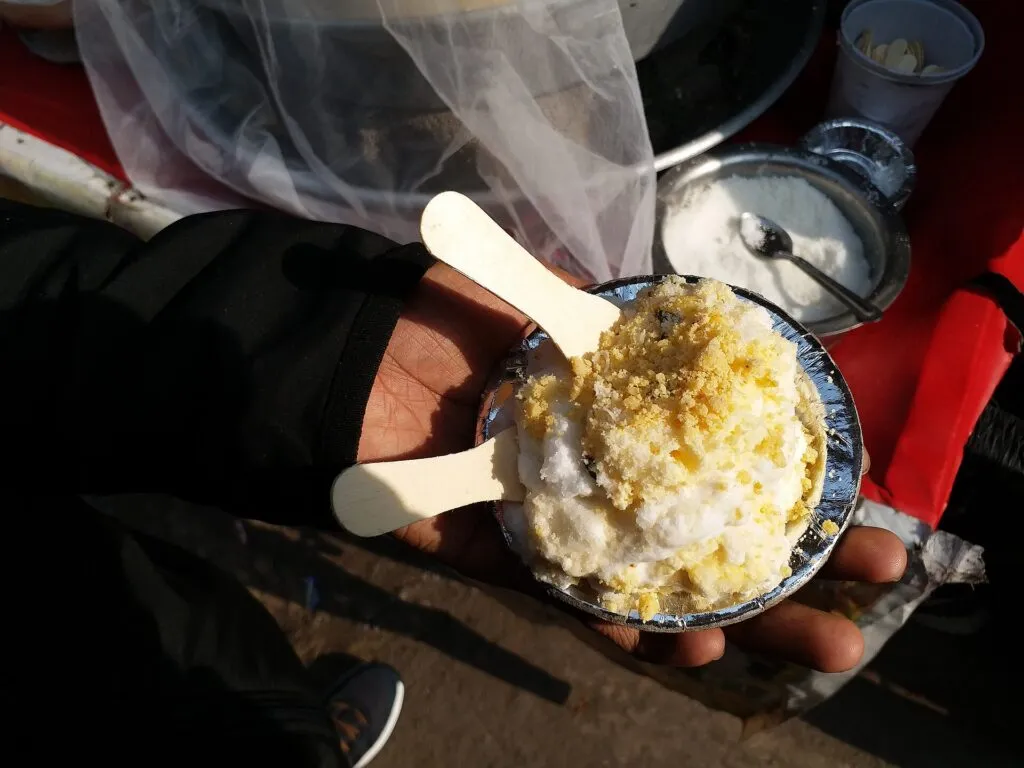
- Ram laddoo – fried lentil balls topped with grated radish and green chutney, sold from winter carts.
How golgappe are eaten
- The vendor hands you a small leaf bowl and stands ready.
- He cracks a shell, adds a little potato or chickpea, dips it in spiced water and puts it in your bowl.
- You eat it whole, immediately. He makes the next one while you chew.
- Say bas (enough) when you are done. The last one is often a free sukha puri, a dry shell with masala.
A short chaat walk in Old Delhi
Chandni Chowk is crowded and loud, and that is part of it. Go in the late afternoon, on foot or by cycle rickshaw, and take the metro to Chandni Chowk station to avoid traffic.
- Start with dahi bhalla at Natraj Dahi Bhalle Wala, a small counter trading since the 1940s.
- Walk the main street and side lanes for aloo tikki and golgappe from whichever stall is busiest.
- Stop for something sweet from one of the old halwai shops along the way.
- If you want a proper meal afterwards, the lanes around Jama Masjid are famous for kebabs and nihari (see the halal note below).
If Old Delhi feels too intense, Bengali Market near Mandi House is calmer, with long-running sweet-and-chaat shops such as Nathu’s. Lajpat Nagar market is another local favourite, with plenty of chaat stalls among the clothes shops.
Shops open and close at their own pace, so check hours before a special trip.
When to go
- Late afternoon to evening is chaat time; many stalls set up after 4pm.
- October to March is the best season. Summer afternoons are extremely hot.
- Winter brings seasonal treats such as ram laddoo and hot aloo tikki.
Stomach-friendly chaat
Most visitors eat chaat without trouble. A few habits help.
- Choose busy stalls where food turns over fast.
- Start with cooked or yoghurt-based chaat (aloo tikki, dahi bhalla) before golgappe, whose water is the usual risk.
- Sit-down shops are a gentler first step than street carts.
- Carry hand sanitiser and drink bottled water.
What chaat costs (2026)
| Order | Street stall | Sit-down shop |
|---|---|---|
| Aloo tikki | About ₹40–80 | About ₹120–200 |
| Papdi chaat | About ₹50–100 | About ₹150–250 |
| Dahi bhalla | About ₹50–100 | About ₹150–250 |
| Golgappe (6–8) | About ₹30–60 | About ₹100–180 |
| Raj kachori | About ₹80–150 | About ₹180–300 |
Plan your food budget with the India food budget calculator and read about tipping in India.
Halal note: classic chaat is vegetarian, so meat is not an issue. If you want meat, the lanes around Jama Masjid in Old Delhi are known for Muslim-run kebab, korma and nihari shops. Ask if you need certainty.
Chaat across South Asia
Delhi’s golgappe have cousins everywhere: fuchka in Dhaka (heavier, with egg), puchka in Kolkata (sharper tamarind water) and pani puri in Mumbai. Kolkata’s evening favourite is the kathi roll.
Hindi words that help
| Hindi | Meaning |
|---|---|
| Ek plate papdi chaat | One plate of papdi chaat |
| Teekha kam | Less spicy |
| Meethi chutney zyada | More sweet chutney |
| Bas, bhaiya | That’s enough, brother |
| Kya yeh halal hai? | Is this halal? |
| Kya ismein suar ka maans hai? | Does this contain pork? |
| Kitne ka hai? | How much is it? |
Quick answers
Where is the best chaat in Delhi?
Chandni Chowk in Old Delhi is the traditional heart. Bengali Market and Lajpat Nagar are easier alternatives with long-running shops.
Is Delhi chaat vegetarian?
Almost always. It is built on potato, chickpeas, lentils, yoghurt and chutneys.
Is chaat safe for tourists?
Most visitors are fine if they pick busy stalls, start with cooked chaat and go easy on golgappe water in the first days.
What is the difference between golgappe and pani puri?
They are the same snack. Golgappe is the Delhi name; pani puri is used in Mumbai and western India.
More from India: Hyderabadi biryani, Bengali sweets and Gujarati thali. See all India food guides.
Sources
- Delhi Tourism – official tourism site.
- Chaat – overview of types.