“Single or full?” It is the first thing a Hyderabad biryani waiter asks, usually before you have sat down properly. A single is a heaped plate for one hungry person. A full is meant for two, and often feeds three.
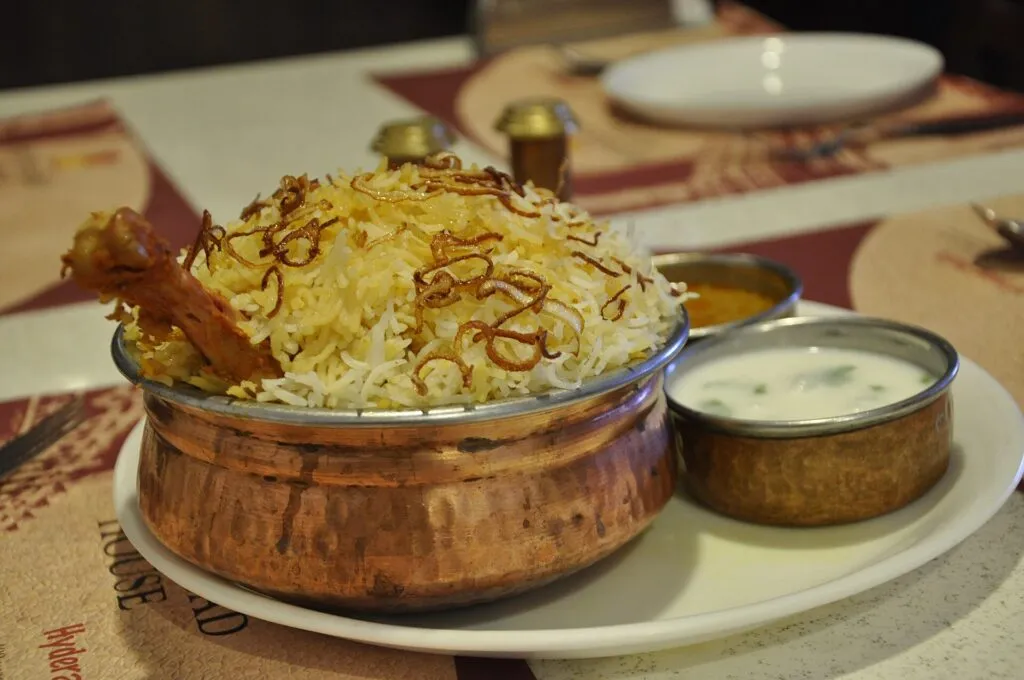
Hyderabadi biryani is long-grain basmati layered with spiced, yoghurt-marinated meat and slow-cooked in a sealed pot (dum), served with a chilli-peanut curry called mirchi ka salan and a yoghurt raita. The best-known houses include Paradise in Secunderabad, Bawarchi at RTC X Roads, and Shah Ghouse and Shadab in the Old City. In 2026 a single plate costs roughly ₹250–550, with mutton at the top of the range.
This guide covers what makes the Hyderabadi style different, how it is cooked, what to order with it, where locals go, what it costs and how to eat it without looking like a first-timer.
What makes a biryani “Hyderabadi”
Hyderabad was ruled for more than two centuries by the Nizams, and their court kitchens mixed Mughal cooking with the spice and heat of the Deccan. Biryani is the most famous result.
Three things set it apart. The meat goes in raw in the classic version. The rice is long, separate and never sticky. And the spicing is bolder than in the north, with green chilli, mint and fried onion running through every layer.
There is no potato and usually no boiled egg in the pot. If you find one, you are probably eating a Kolkata-style biryani.
Kacchi and pakki: two ways to cook it
Kacchi gosht ki biryani (the classic)
Kacchi means raw. Goat meat is marinated for hours in yoghurt, ginger-garlic paste, green chilli, fried onion, mint, coriander and whole spices.
The raw meat is spread at the bottom of a heavy pot. Rice boiled only part-way goes on top, with saffron milk, ghee and more fried onion. The lid is sealed with a rope of dough.
Then the pot cooks slowly over low heat, sometimes with embers on the lid. The meat cooks in the rising steam and the rice finishes in the meat juices. Getting both right at the same moment is the cook’s real skill.
Pakki biryani (the quicker one)
In pakki biryani the meat is cooked into a gravy first, then layered with rice and finished on dum. It is more forgiving, and most chicken biryanis are made this way.
Both are good. Kacchi is the one Hyderabadis argue about.
What to order
- Mutton biryani – the benchmark. Goat, usually on the bone, and the dish most houses are judged on.
- Chicken biryani – lighter and cheaper, and the best-seller at most places.
- Special or “spl” biryani – usually boneless meat, sometimes extra pieces or egg. The meaning changes from shop to shop, so ask.
- Family pack – a large tray for four or more, popular for takeaway.
- Veg biryani – available almost everywhere, but not what the city is famous for.
What arrives with your plate
| Side | What it is | How to use it |
|---|---|---|
| Mirchi ka salan | Long green chillies in a nutty, tangy peanut, sesame and tamarind gravy | Spoon a little over the rice as you go |
| Dahi chutney / raita | Cool yoghurt with onion, chilli and herbs | Cools the heat; mix it in near the end |
| Onion and lemon | Raw onion rings and a lemon wedge | Squeeze lemon over the rice; eat onion between bites |
| Double ka meetha | Fried bread soaked in sweet, cardamom milk | The classic dessert after biryani |
| Qubani ka meetha | Stewed dried apricots, often with cream | A wedding dessert; order it if you see it |
Salan and raita normally come free with a biryani and are refilled on request.
Where Hyderabad goes for biryani
- Paradise, Secunderabad – open since the 1950s and the city’s best-known name. It is now a chain, and the original Secunderabad location is still the busiest.
- Bawarchi, RTC X Roads – a long-running favourite in central Hyderabad, known for big portions and bigger queues.
- Shah Ghouse – popular in the Old City and Tolichowki, and one of the most famous names for haleem in Ramadan.
- Hotel Shadab, near Charminar – a busy Old City restaurant, handy after visiting Charminar and the Laad Bazaar.
Ask ten Hyderabadis for the best biryani and you will get ten answers, often with some heat. Branches, timings and quality change, so check recent opening hours before you cross the city.
Which area to eat in
- Old City (around Charminar) – the most traditional setting, busy lanes, and the best choice during Ramadan evenings.
- Secunderabad and central Hyderabad – the big-name houses, easy to reach by metro and taxi.
- HITEC City and Gachibowli – branches of the famous names, cleaner dining rooms, fewer surprises.
What biryani costs in Hyderabad (2026)
| Order | Typical price |
|---|---|
| Chicken biryani, single | About ₹250–400 |
| Mutton biryani, single | About ₹320–550 |
| Full (two people) | About ₹450–900 |
| Family pack (4+) | About ₹900–1,800 |
| Irani chai and Osmania biscuits | About ₹20–60 |
Prices vary by branch and rise every year. Old City restaurants are usually cheaper than branches in the IT districts. For a full day’s budget, try the India food budget calculator.
How to eat it like a local
- Go at lunch. Biryani is cooked in large batches from late morning, and the first pots of the day are the best.
- Use your right hand or a spoon. Both are normal. Hands are common in the Old City.
- Do not drown it. Add salan and raita a spoonful at a time so the rice stays separate.
- Look for the dark rice. The saffron-streaked and onion-darkened grains near the meat carry the most flavour.
- Finish with chai. Walk to an Irani café afterwards for sweet, strong tea and an Osmania biscuit.
Halal note: Hyderabad has a large Muslim population and halal meat is easy to find. The traditional biryani houses, especially in the Old City, are a comfortable choice for Muslim travellers. If you need certainty, ask. Pork is rarely seen on Hyderabadi menus.
Beyond biryani: what else to eat in Hyderabad
- Haleem – wheat, lentils and meat pounded for hours into a thick, rich porridge. It is sold mainly in Ramadan evenings, and Hyderabadi haleem carries a Geographical Indication tag.
- Pathar ka gosht – marinated mutton cooked on a hot stone slab.
- Marag – a peppery mutton soup served at weddings.
- Lukhmi – small, square minced-meat pastries, a classic tea-time snack.
- Irani chai and Osmania biscuits – the city’s café ritual, found in Irani cafés across the Old City.
Hyderabadi vs other famous biryanis
| Style | Main features |
|---|---|
| Hyderabadi | Spicy, raw-meat (kacchi) method, long basmati, mint and fried onion, no potato |
| Lucknowi (Awadhi) | Meat cooked first (pakki), subtle and fragrant, lighter on chilli |
| Kolkata | Light and mildly sweet, with potato and often a boiled egg |
| Dhaka kacchi | Raw goat with potato, fragrant and milder; served with borhani |
| Thalassery (Kerala) | Short-grain local rice, gentle spice, fried onions and cashews |
If you are travelling further east, compare it with kacchi biryani in Dhaka, which uses the same raw-meat method but tastes quite different.
Useful phrases (Hindi / Dakhini Urdu)
| Say | Meaning |
|---|---|
| Ek mutton biryani, single | One mutton biryani, single portion |
| Salan aur raita dena | Please bring salan and raita |
| Thoda kam teekha | A bit less spicy |
| Kya yeh halal hai? | Is this halal? |
| Kya ismein suar ka gosht hai? | Does this contain pork? |
| Parcel kar dijiye | Please pack it to take away |
| Bill laiye | The bill, please |
Before you go, check tipping customs in India. Small tips are welcome but not expected at simple biryani houses.
Frequently asked questions
Which biryani is Hyderabad famous for?
Kacchi gosht biryani, made with raw marinated goat and rice cooked together on dum. Chicken biryani is the most-ordered version.
How much is a biryani in Hyderabad?
About ₹250–550 for a single plate in 2026. Chicken is cheaper; mutton, full portions and family packs cost more.
Is Hyderabadi biryani very spicy?
It is spicier than most north Indian biryanis, mainly from green chilli. Ask for kam teekha (less spicy) and use raita to cool it down.
Is Hyderabadi biryani halal?
At the traditional biryani houses, especially in the Old City, halal meat is the norm. Chains and hotel restaurants vary, so ask if you need certainty.
More from India: Delhi chaat, Kolkata kathi rolls and India’s regional thalis. Browse all India food guides or our halal food travel guide.
Sources
- Telangana Tourism – official state tourism site.
- Hyderabadi biryani, Hyderabadi haleem and Hyderabadi cuisine.