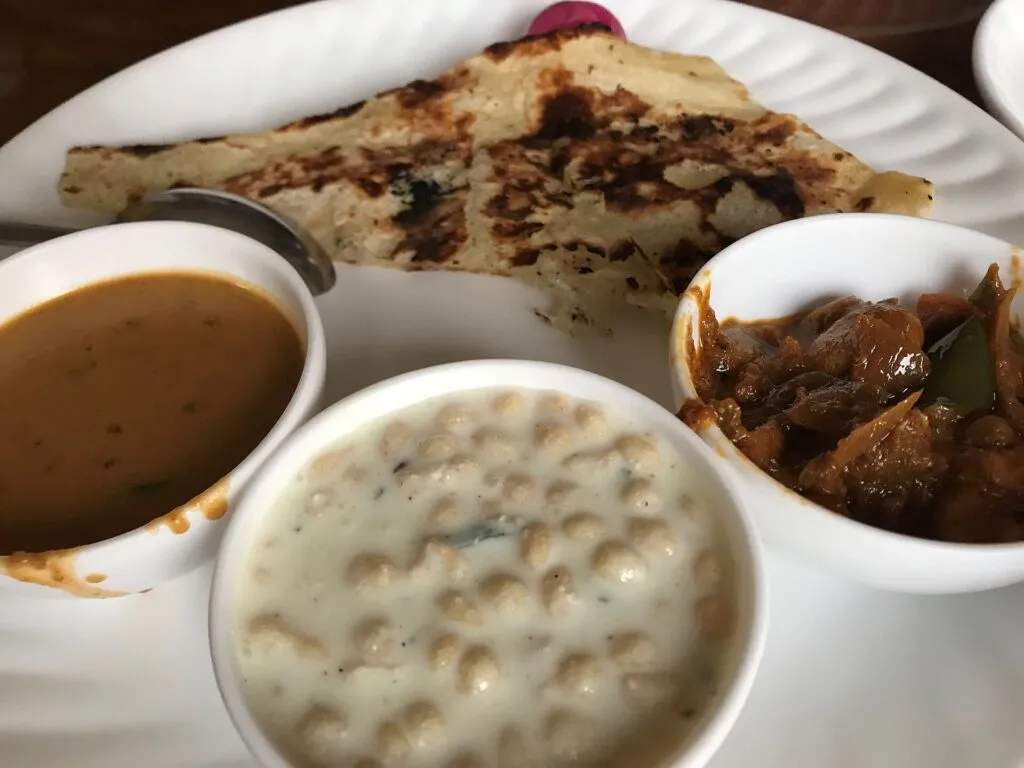
A thali arrives as a round steel platter ringed with little bowls: a golden dal, a green vegetable curry, a spoon of pickle, cool yoghurt, a sweet, with rice in the middle and hot bread on the side. Before you finish one bowl, a server with a bucket is already refilling it.
A thali is a complete Indian meal served on one platter: rice and bread with several small bowls of dal, vegetables, yoghurt, pickle, papad and a sweet, balanced to cover every taste. Every region has its own style, from sweet-and-savoury Gujarati thalis to South Indian “meals” on a banana leaf. Many thali restaurants are “unlimited”, refilling until you stop them. In 2026 a thali costs roughly ₹150–800. Most thalis are vegetarian, which makes them one of the easiest Indian meals for Muslim travellers.
This guide covers what is on a thali, regional styles, how to eat it, where to go, halal points, prices and Hindi phrases.
What is on the plate
| Item | What it is |
|---|---|
| Rice | Plain or jeera (cumin) rice |
| Roti, chapati, puri or bhakri | Flatbreads, often refilled hot |
| Dal | Lentils, the heart of the meal |
| Sabzi | One or two vegetable dishes |
| Kadhi or sambar | A yoghurt curry (north and west) or lentil-tamarind stew (south) |
| Curd or raita | Cooling yoghurt |
| Pickle and chutney | Sharp, salty or sweet accents |
| Papad | Crisp lentil wafer |
| Sweet | Such as gulab jamun, shrikhand or payasam |
Regional styles
| Style | What makes it different |
|---|---|
| Gujarati | Many dishes with a sweet note, farsan snacks like dhokla, kadhi; see our Gujarati thali guide |
| Rajasthani | Dal baati churma, gatte ki sabzi, ghee-rich |
| South Indian “meals” | Served on a banana leaf: rice with sambar, rasam, poriyal and payasam |
| Maharashtrian | Bhakri bread, varan (dal), spicy sabzi |
| Bengali | Rice with dal, fish, vegetables and sweets |
| Punjabi | Dal makhani, paneer, butter roti |
How to eat a thali
- Wash your hands; use your right hand.
- Tear bread and scoop vegetables or dal.
- Move to rice: mix it with dal or sambar, a little at a time.
- Add pickle and yoghurt as you go to balance the heat.
- Finish with the sweet, and with buttermilk if offered.
- To stop refills, cover your plate with your hand or say bas (enough).
Halal note: most thalis are vegetarian and contain no meat or alcohol, which makes them an easy halal-friendly choice. Non-vegetarian thalis (chicken, mutton or fish) exist in some regions; the meat is not always halal, so ask, or eat at Muslim-run restaurants for meat. See our halal food travel guide.
Where to eat a thali
- Ahmedabad and across Gujarat – famous for unlimited Gujarati thalis.
- Rajasthan (Jaipur, Udaipur) – Rajasthani thalis in heritage settings.
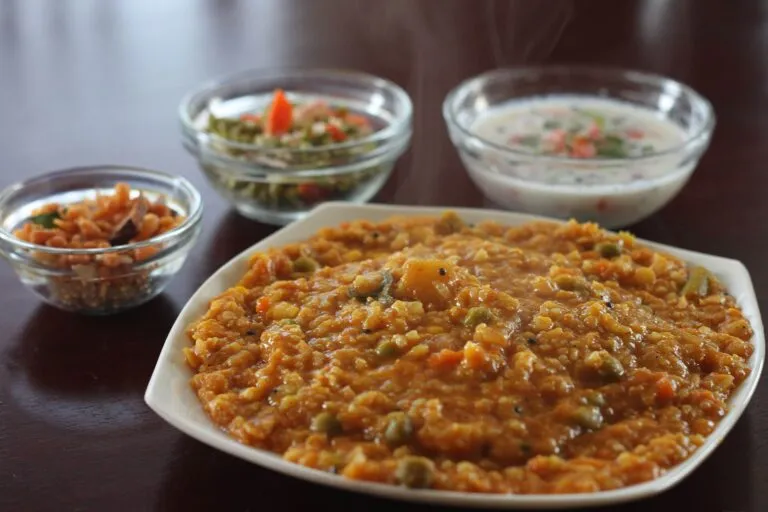
- Chennai, Bengaluru and Kerala – South Indian meals on banana leaves; also try bisi bele bath in Karnataka.
- Mumbai – Gujarati and Maharashtrian thali restaurants at lunch.
- Railway station and roadside eateries – simple, cheap thalis across India.
Lunch is the main thali time. Busy restaurants turn tables quickly.
What it costs (2026)
| Thali | Typical price |
|---|---|
| Simple roadside or canteen thali | About ₹100–250 |
| Unlimited thali at a popular restaurant | About ₹300–700 |
| Premium or heritage thali | About ₹700–1,500 |
Plan with the India food budget calculator and see tipping in India.
Hindi phrases
| Say | Meaning |
|---|---|
| Ek thali, please | One thali, please |
| Aur roti | More bread |
| Bas, shukriya | Enough, thank you |
| Kya yeh shakahari hai? | Is this vegetarian? |
| Kya yeh halal hai? | Is this halal? |
| Teekha kam | Less spicy |
Frequently asked questions
What is a thali?
A complete Indian meal on one platter: rice, bread, dal, vegetables, yoghurt, pickle, papad and a sweet.
Is thali halal?
Most thalis are vegetarian, with no meat or alcohol. For non-vegetarian thalis, ask about the meat or eat at Muslim-run restaurants.
What is an unlimited thali?
A thali where servers keep refilling bowls until you tell them to stop.
How much is a thali in India?
About ₹150–800 in 2026, depending on the restaurant.
More from India: Hyderabadi biryani, Delhi chaat and Goan xacuti. See all India food guides.
Sources
- Incredible India – official tourism site.
- Thali.