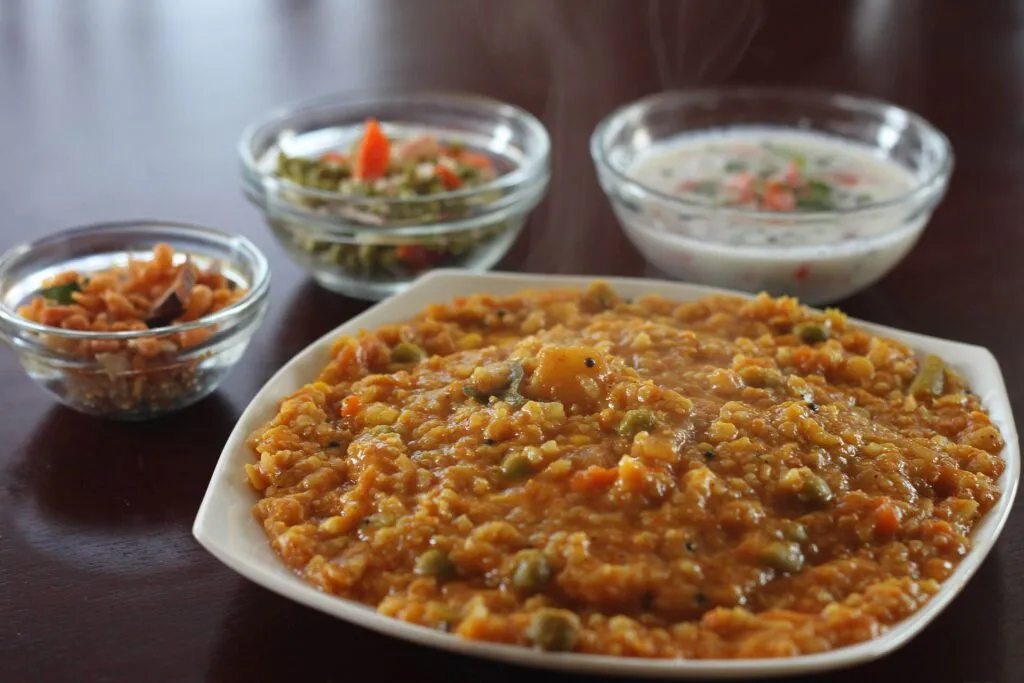
In a busy Bengaluru breakfast hall, bisi bele bath is served in a steel bowl with a spoon of ghee melting on top and a handful of crunchy fried boondi scattered over it. It is thick, tangy, spicy and comforting, and people eat it standing at chest-high counters before rushing to work.
Bisi bele bath (“hot lentil rice” in Kannada) is a one-pot dish from Karnataka: rice, lentils and vegetables cooked soft with tamarind and a special roasted spice powder, finished with ghee. It is sold at breakfast and lunch in Bengaluru’s darshinis (quick self-service eateries) and traditional restaurants such as MTR, open since the 1920s. In 2026 a plate costs roughly ₹60–200. It is vegetarian, with no meat or alcohol.
This guide covers what goes into it, how it is served, where to eat it, other Karnataka breakfasts, prices and Kannada phrases.
What goes into it
- Rice and toor dal, cooked until soft and creamy.
- Vegetables such as beans, carrot, peas, drumstick and potato.
- Tamarind for tang, and a little jaggery for balance.
- Bisi bele bath powder: roasted dried chillies, coriander, cumin, cinnamon, cloves, fenugreek, dried coconut and more.
- A tempering of mustard seeds, curry leaves, cashews and asafoetida in ghee.
How it is served
Hot, in a bowl or on a banana leaf, with a spoon of ghee on top. Common sides are crispy boondi (fried gram-flour pearls), potato chips, papad or raita. It should be spoonable, not dry.
Where to eat it in Bengaluru
- MTR (Mavalli Tiffin Room) – a Bengaluru institution since the 1920s, famous for breakfast; expect queues.
- Darshinis – quick, cheap standing eateries across the city serving idli, dosa and bisi bele bath.
- Basavanagudi and Malleshwaram – old neighbourhoods with traditional breakfast places.
- Mysuru – the old royal city, with its own excellent South Indian breakfast spots.
Bisi bele bath is usually served at breakfast and lunch; some places sell out by early afternoon.
Halal note: bisi bele bath is vegetarian and contains no meat or alcohol; it is cooked with ghee. Most Bengaluru breakfast places are vegetarian. For halal meat, Bengaluru has many Muslim-run restaurants, especially around Frazer Town. See our halal food travel guide.
More Karnataka breakfasts
| Dish | What it is |
|---|---|
| Masala dosa | Crisp rice-lentil crepe with spiced potato; Bengaluru’s is often reddish and buttery |
| Idli and vada | Steamed rice cakes and fried lentil doughnuts with chutney and sambar |
| Kesari bath | Sweet semolina with ghee and saffron |
| Khara bath | Savoury semolina upma; with kesari it is “chow chow bath” |
| Akki rotti | Rice-flour flatbread with onion and herbs |
| Ragi mudde | Finger-millet balls eaten with curry |
Finish with filter coffee, served in a steel tumbler and saucer.
What it costs (2026)
| Order | Typical price |
|---|---|
| Bisi bele bath at a darshini | About ₹60–120 |
| At a traditional restaurant | About ₹120–200 |
| Filter coffee | About ₹20–60 |
Plan with the India food budget calculator.
Kannada phrases
| Say | Meaning |
|---|---|
| Ondu bisi bele bath kodi | One bisi bele bath, please |
| Ondu filter coffee | One filter coffee |
| Eshtu? | How much? |
| Dhanyavaadagalu | Thank you |
Frequently asked questions
What is bisi bele bath?
A Karnataka dish of rice, lentils and vegetables cooked with tamarind and a roasted spice powder, finished with ghee.
Is bisi bele bath halal?
It is vegetarian and contains no meat or alcohol.
Where is the best bisi bele bath in Bengaluru?
MTR is famous, and darshinis across the city serve excellent versions.
What is the difference between bisi bele bath and khichdi?
Both combine rice and lentils. Bisi bele bath adds vegetables, tamarind and a special spice powder, making it tangier and spicier.
More from India: thalis across India and Goan xacuti. See all India food guides.
Sources
- Karnataka Tourism – official state tourism site.
- Bisi bele bath.