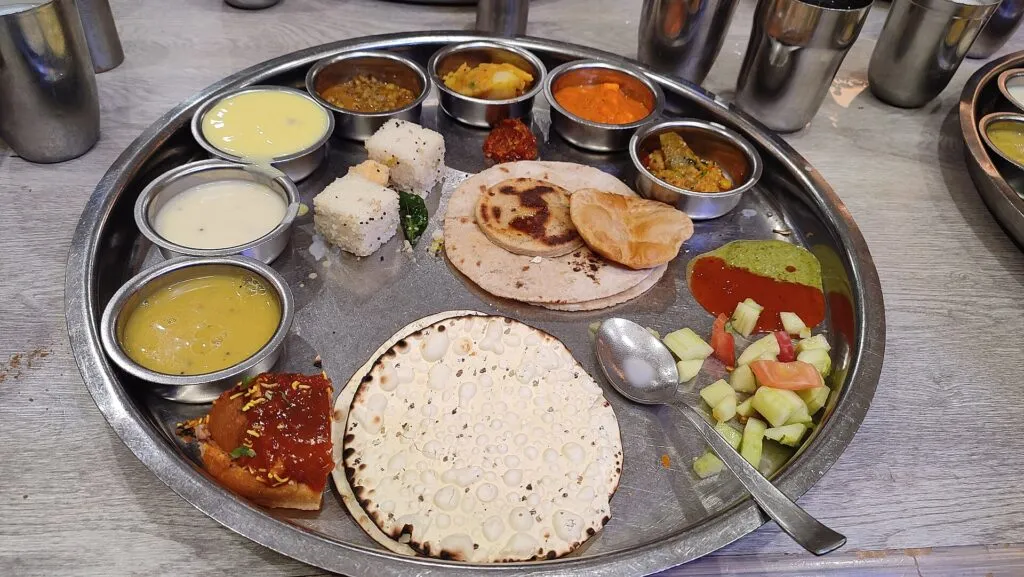
A Gujarati thali is a race you cannot win. You sit down, a steel platter appears with a dozen small bowls, and servers circle the room with buckets and baskets, dropping another spoon of dal here, a hot rotli there, before you have finished the last one.
A Gujarati thali is an unlimited vegetarian meal from western India: sweet-sour dal, yoghurt kadhi, several vegetable dishes, steamed snacks like dhokla, flatbreads (rotli, puri or bhakri), rice, pickles and sweets such as shrikhand, served with buttermilk. Ahmedabad is the best city to try it, from heritage restaurants such as Agashiye to village-style Vishalla. In 2026 a thali costs roughly ₹300–1,500. Gujarat is a mostly vegetarian state where alcohol is prohibited, which makes the thali naturally halal-friendly.
This guide covers the dishes, how the meal flows, where to go in Ahmedabad, halal and Jain points, prices and Gujarati phrases.
What is on the plate
| Dish | What it is |
|---|---|
| Gujarati dal | Thin lentils with a sweet-sour balance of jaggery and kokum or lemon |
| Kadhi | Yoghurt and gram-flour curry, gently sweet |
| Shaak | Vegetable dishes, often two or three |
| Farsan | Snacks: dhokla (steamed gram-flour cake), khandvi (rolled gram-flour sheets), samosa |
| Rotli, puri, bhakri | Flatbreads, thin and buttered, puffed and fried, or thick and rustic |
| Rice and khichdi | Plain rice, sometimes khichdi with kadhi at the end |
| Sweets | Shrikhand (sweet strained yoghurt), basundi, mohanthal |
| Chaas | Salted, spiced buttermilk |
How the meal flows
- Start with farsan and sweets; in Gujarat, sweets are often eaten alongside the meal, not only at the end.
- Eat rotli with vegetables and dal.
- Servers refill everything; keep going as long as you like.
- Finish with rice or khichdi and kadhi.
- Drink chaas to help digestion.
- Say bas (enough) or cover your plate to stop refills.
Seasonal specials
In winter, look for undhiyu, a slow-cooked mix of winter vegetables, beans and fenugreek dumplings, eaten especially around the kite festival (Uttarayan) in January. In summer, mango ras (pulp) with puri is a treat.
Halal note: Gujarati thalis are fully vegetarian and Gujarat is a dry state, so there is no meat or alcohol. Ghee and dairy are used generously. Jain versions leave out onion, garlic and root vegetables. For meat dishes, Ahmedabad’s old city has a large Muslim community; the lanes near Bhadra Fort, such as Bhatiyar Gali, are known for Muslim-run non-vegetarian eateries. See our halal food travel guide.
Where to eat in Ahmedabad
- Agashiye, House of MG – a rooftop thali at a heritage hotel near the old city; elegant and popular with visitors.
- Vishalla – a village-style restaurant on the city’s edge, with meals served on leaf plates in an outdoor setting.
- Traditional dining halls in the city centre – simpler, busy and excellent value.
- Manek Chowk – a square that turns into a street-food market at night, for pav bhaji, sandwiches and kulfi.
Thali restaurants are busiest at lunch; book heritage restaurants ahead.
What it costs (2026)
| Thali | Typical price |
|---|---|
| Dining hall unlimited thali | About ₹300–600 |
| Popular restaurant thali | About ₹500–900 |
| Heritage or premium thali | About ₹900–1,500 |
Plan with the India food budget calculator.
Gujarati phrases
| Say | Meaning |
|---|---|
| Ek thali aapo | One thali, please |
| Bas, aabhaar | Enough, thank you |
| Vadhu rotli | More rotli |
| Tikhu ochhu | Less spicy |
| Jain thali chhe? | Is there a Jain thali? |
Frequently asked questions
What is a Gujarati thali?
An unlimited vegetarian meal of dal, kadhi, vegetables, snacks, breads, rice and sweets from Gujarat.
Is a Gujarati thali halal?
It is fully vegetarian and served in a dry state with no alcohol, so it is halal-friendly.
Why is Gujarati food sweet?
Many dishes balance spice with jaggery or sugar and sour notes from kokum or lemon.
Where is the best Gujarati thali in Ahmedabad?
Agashiye and Vishalla are well known; traditional dining halls in the city centre are excellent value.
More from India: thalis across India and Delhi chaat. See all India food guides.
Sources
- Gujarat Tourism – official state tourism site.
- Gujarati cuisine.