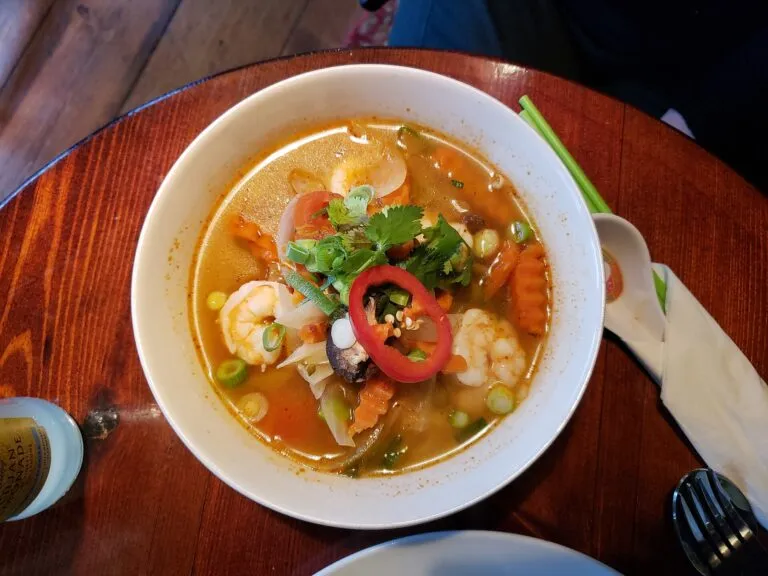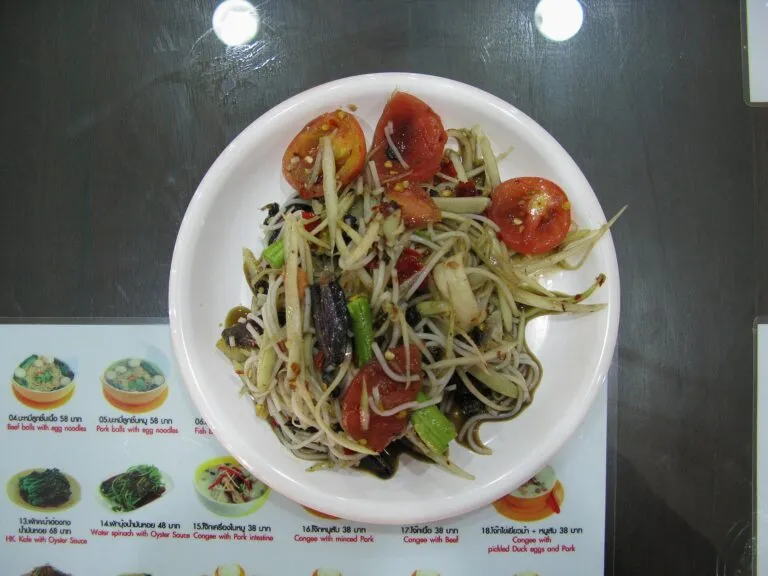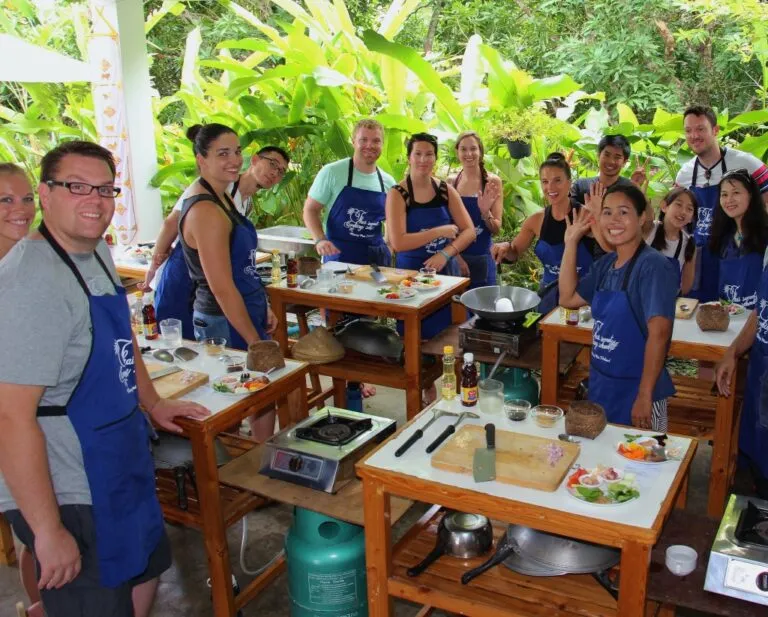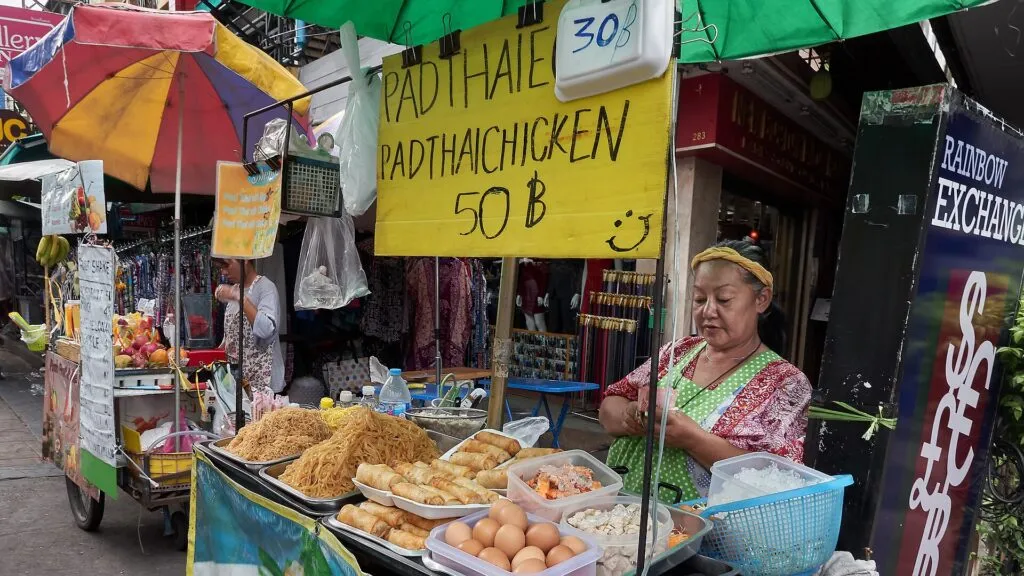
After dark on Yaowarat Road, Bangkok’s Chinatown, the pavement turns into a kitchen. Woks flare, plastic stools fill, and the air smells of charcoal, garlic, lime and chilli. A plate of noodles costs less than a coffee back home.
Bangkok street food means cooked-to-order dishes from carts, stalls and shophouses: pad thai, green papaya salad (som tam), chicken rice (khao man gai), noodle soups, grilled skewers, and mango sticky rice. The busiest areas include Yaowarat (Chinatown), Bang Rak, Victory Monument and Or Tor Kor market. In 2026 most street dishes cost roughly 50–120 baht. Pork is everywhere in Thai street food, but Bangkok also has long-established Muslim neighbourhoods and halal stalls marked with a halal logo, so Muslim travellers can eat very well with a little planning.
This guide covers the dishes, which usually contain pork, where to find halal street food, how to order, safety, prices and the Thai you need.
The dishes to know
| Dish | What it is | Pork? |
|---|---|---|
| Pad thai | Stir-fried rice noodles with egg, tofu, peanuts, prawns or chicken | Usually no, but check the oil |
| Som tam | Pounded green papaya salad with lime, chilli and fish sauce | Usually no |
| Khao man gai | Poached chicken on rice cooked in chicken fat, with ginger sauce | No, but chicken not halal unless marked |
| Kuay teow | Noodle soup, often with pork balls and pork broth | Often yes |
| Pad kra pao | Stir-fry with holy basil and chilli, often pork mince | Often yes; ask for chicken or seafood |
| Moo ping | Grilled marinated pork skewers | Yes |
| Khao mok gai | Thai-Muslim chicken biryani with turmeric rice | Halal at Muslim stalls |
| Roti | Fried flatbread, sweet or savoury, often made by Muslim vendors | Usually no |
| Mango sticky rice | Sweet coconut sticky rice with ripe mango | No |
Halal street food in Bangkok
Thailand’s Muslim community, concentrated in the south, also has deep roots in Bangkok, and several neighbourhoods have streets full of halal food.
- Look for the halal logo of the Central Islamic Committee of Thailand, or a green sign with Arabic script, on stalls and restaurants.
- Bang Rak – around the Haroon Mosque near the river, with long-running Muslim eateries.
- Ramkhamhaeng Road – a busy area with many halal restaurants and street vendors.
- Ban Khrua – a historic Muslim community by the canal, near Siam.
- Thai-Muslim dishes to seek out: khao mok gai (chicken biryani), massaman curry, roti with curry, satay and oxtail soup.
Halal note: at ordinary stalls, woks and oil are shared and pork is very common, even in “chicken” noodle soups made with pork broth. Stick to stalls with a halal logo for meat, or choose dishes such as som tam, mango sticky rice and fruit at other stalls. Seafood is widely available; most schools accept all seafood, while the classical Hanafi view limits it to fish. See our halal food travel guide.
Where to go
- Yaowarat (Chinatown) – the classic evening street-food strip. Much of it is pork-heavy Chinese-Thai food, so pick carefully.
- Or Tor Kor market – a clean, organised fresh market near Chatuchak, excellent for fruit and prepared dishes.
- Victory Monument – famous for small bowls of boat noodles (usually pork or beef in rich broth).
- Bang Rak and Silom – mixed stalls, including Muslim eateries near the river.
- Night markets – good for grazing, with many cuisines in one place.
Some famous names have queues: Jay Fai, whose crab omelette earned a Michelin star, and Thip Samai, a pad thai shop open since the 1960s. Check whether they suit your dietary needs before queueing.
How to order at a stall
- Point at what others are eating, or at photos on the menu board.
- Choose your protein: chicken (gai), beef (neua), shrimp (goong), or ask for mai sai moo (no pork).
- Say how spicy: mai pet (not spicy) or pet nit noi (a little spicy).
- Use the condiment caddy: sugar, fish sauce, dried chilli and chilli vinegar let you season noodles yourself.
- Pay when you finish, or when the food arrives at busy stalls.
Staying healthy
- Eat where the queue is: high turnover means fresh food.
- Choose food cooked hot in front of you.
- Drink bottled water; ice in cafés and restaurants is usually factory-made.
- Go easy on chilli for the first few days.
When to go
- Evenings are prime time for street food in most areas.
- Mornings bring rice porridge, soy milk and fried dough sticks.
- Some districts clear stalls on certain days for street cleaning; ask your hotel.
- November to February is the coolest, most comfortable season.
What it costs (2026)
| Item | Typical price |
|---|---|
| Street noodles or rice dish | About 50–100 baht |
| Som tam | About 50–80 baht |
| Khao mok gai at a Muslim stall | About 60–120 baht |
| Mango sticky rice | About 80–150 baht |
| Fresh fruit bag | About 20–50 baht |
Plan your budget with the Thailand food budget calculator and check tipping in Thailand.
Thai phrases
| Thai | Say | Meaning |
|---|---|---|
| ฮาลาลไหม | Halal mai? | Is it halal? |
| มีหมูไหม | Mee moo mai? | Is there pork? |
| ไม่ใส่หมู | Mai sai moo | No pork, please |
| ไม่เผ็ด | Mai pet | Not spicy |
| ไก่ / กุ้ง | Gai / goong | Chicken / shrimp |
| เท่าไหร่ | Tao rai? | How much? |
Frequently asked questions
Is Bangkok street food halal?
Much of it is not, because pork and shared woks are common. Bangkok has many halal stalls and Muslim neighbourhoods; look for the halal logo.
How much does street food cost in Bangkok?
About 50–120 baht per dish in 2026.
Where is the best street food in Bangkok?
Yaowarat (Chinatown), Or Tor Kor market, Victory Monument and Bang Rak are the classic areas. For halal food, try Bang Rak and Ramkhamhaeng.
Is Bangkok street food safe?
Generally yes, if you choose busy stalls, food cooked to order, and bottled water.
Go deeper with tom yum in Bangkok and Isaan food. See all Thailand food guides.
Sources
- Tourism Authority of Thailand – official tourism site.
- Thai cuisine and Islam in Thailand.