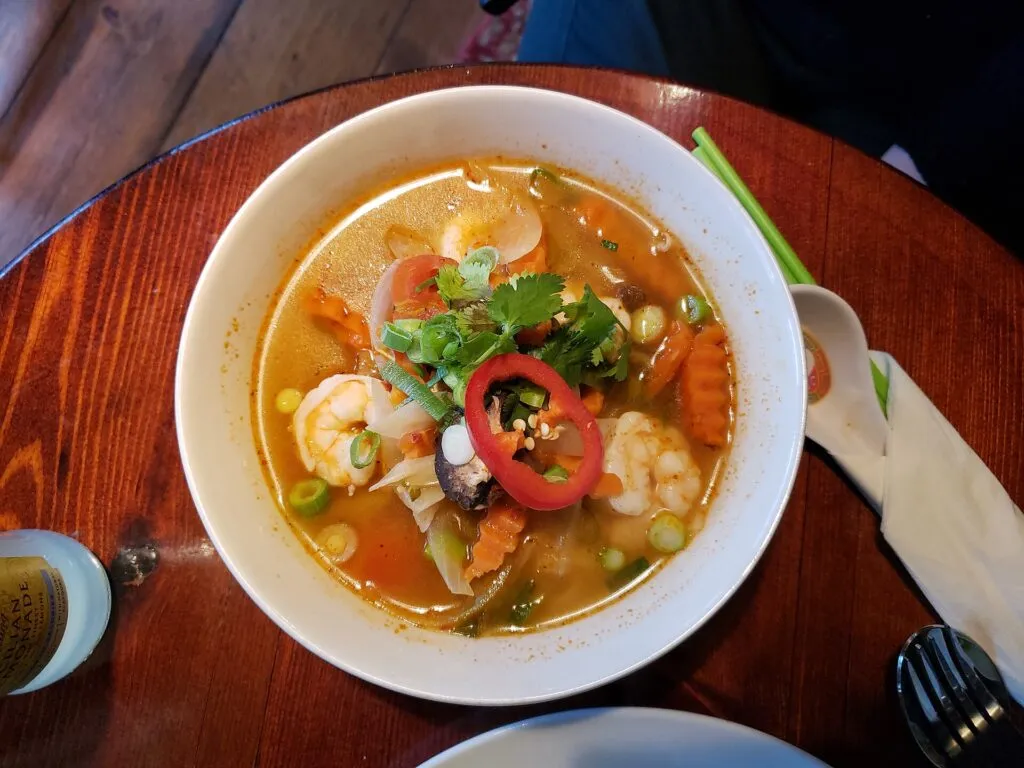
The first spoonful of a good tom yum wakes you up. Sour lime, fiery chilli, the perfume of lemongrass and lime leaves, and a salty depth from fish sauce, all at once. Then the prawns.
Tom yum is Thailand’s hot and sour soup, flavoured with lemongrass, galangal, kaffir lime leaves, chilli, lime juice and fish sauce. The most famous version is tom yum goong, with prawns, served either clear (nam sai) or creamy (nam khon). In Bangkok it is on the menu of almost every Thai restaurant and many street stalls, and in 2026 a bowl costs roughly 100–250 baht. Tom yum goong usually contains no pork, but the stock can vary, so Muslim travellers should ask or eat at a halal restaurant.
This guide explains the versions, what the ingredients do, how to eat it, where to order it in Bangkok, prices and the Thai phrases you need.
Clear or creamy?
| Version | What it is |
|---|---|
| Tom yum nam sai | Clear, sharp broth; the lighter, older style |
| Tom yum nam khon | Creamy, orange broth made richer with evaporated milk or coconut milk and roasted chilli paste |
| Tom yum goong | With prawns; the classic |
| Tom yum talay | With mixed seafood |
| Tom yum pla | With fish |
| Tom yum gai | With chicken |
Do not confuse it with tom kha gai: a milder chicken soup with plenty of coconut milk and galangal.
What gives it that flavour
- Lemongrass – citrusy and floral; bruised and cut into chunks.
- Galangal – a cousin of ginger, sharper and piney.
- Kaffir lime leaves – intensely fragrant; torn to release the oil.
- Bird’s eye chilli – the heat.
- Lime juice and fish sauce – sour and salty, added at the end.
- Nam prik pao – roasted chilli paste, sweet and smoky, used in the creamy version.
- Mushrooms – usually straw or oyster mushrooms.
Tom yum goong was added to UNESCO’s list of intangible cultural heritage in 2024, recognising the soup and the know-how behind it.
How to eat it
- Tom yum is shared, served in a bowl or hot pot, and eaten with plain rice.
- Spoon a little over your rice or sip from a small bowl.
- Do not eat the lemongrass, galangal or lime leaves; they are there for flavour. Push them to the side.
- If it is too spicy, eat more rice, not water.
Halal note: tom yum goong and seafood versions usually contain no pork, but some kitchens use a pork or chicken stock and share cooking equipment. Ask mee moo mai? (is there pork?) or eat at a halal restaurant, marked with the halal logo of the Central Islamic Committee of Thailand. Most schools accept prawns and all seafood; the classical Hanafi view accepts fish only, so tom yum pla (fish) suits Hanafi travellers. See our halal food travel guide.
Where to order it in Bangkok
- Thai restaurants and shophouses – almost all serve it; the busier the better.
- Seafood restaurants by the river – fresh river prawns make a luxurious version.
- Halal Thai restaurants – in Bang Rak, Ramkhamhaeng and around Bangkok’s mosques; see our Bangkok street food guide for areas.
- Cooking classes – tom yum is on nearly every Bangkok cooking-class menu.
Make it at home
- Simmer water or light fish stock with bruised lemongrass, sliced galangal and torn lime leaves for 5 minutes.
- Add mushrooms and prawns (or fish) and cook until the prawns turn pink.
- Turn off the heat. Add fish sauce, lime juice, crushed chillies and, for the creamy version, a spoon of nam prik pao and a splash of evaporated milk.
- Taste: it should be sour, salty and hot in equal measure. Finish with coriander.
What it costs (2026)
| Order | Typical price |
|---|---|
| Tom yum at a street stall or shophouse | About 100–180 baht |
| Tom yum goong at a restaurant | About 150–300 baht |
| River-prawn tom yum at a seafood restaurant | About 300–600 baht |
| Tom kha gai | About 100–200 baht |
Plan your budget with the Thailand food budget calculator and check tipping in Thailand.
Thai phrases
| Thai | Say | Meaning |
|---|---|---|
| ต้มยำกุ้ง | Tom yum goong | Tom yum with prawns |
| น้ำใส / น้ำข้น | Nam sai / nam khon | Clear / creamy |
| เผ็ดนิดหน่อย | Pet nit noi | A little spicy |
| มีหมูไหม | Mee moo mai? | Is there pork? |
| ฮาลาลไหม | Halal mai? | Is it halal? |
Frequently asked questions
What is tom yum?
A Thai hot and sour soup with lemongrass, galangal, lime leaves, chilli, lime and fish sauce, usually with prawns.
What is the difference between tom yum and tom kha?
Tom yum is sour and spicy, with little or no coconut. Tom kha is milder and creamy with lots of coconut milk.
Is tom yum halal?
Seafood tom yum usually contains no pork, but stock and equipment vary. Ask, or eat at a halal-certified restaurant.
How much is tom yum in Bangkok?
About 100–300 baht in 2026, more for river prawns.
More from Thailand: Bangkok street food and Isaan food. See all Thailand food guides.
Sources
- Tourism Authority of Thailand – official tourism site.
- Tom yum.