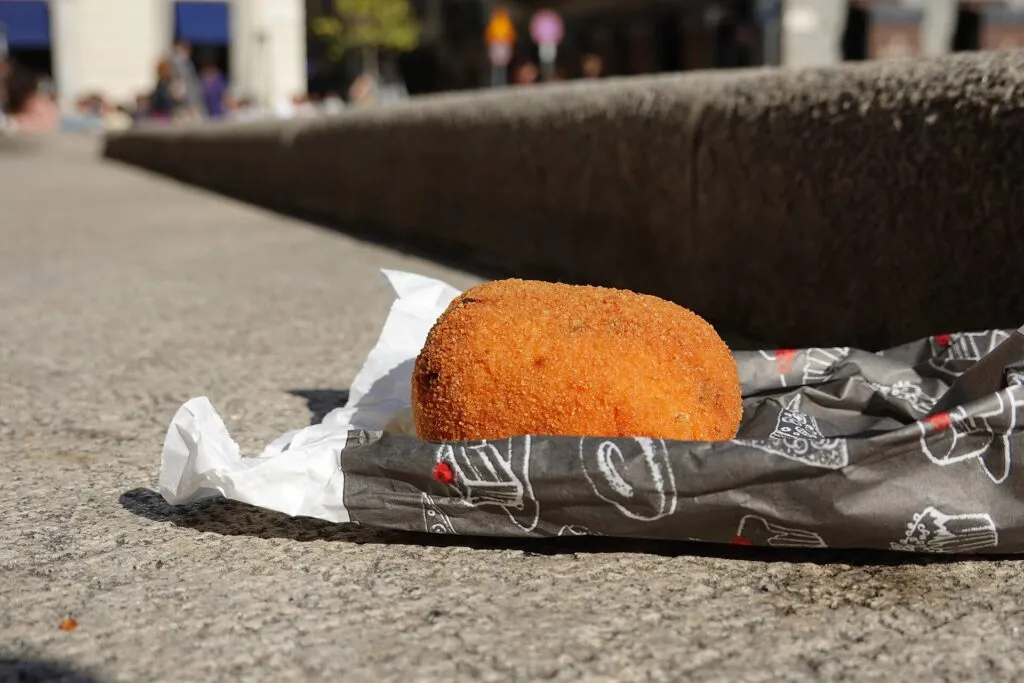
In Palermo, ask for an arancino and someone will correct you: it is an arancina. Cross the island to Catania and the correction goes the other way. Sicilians argue about the name, the shape and the filling of their rice balls with real passion, and they all agree on one thing: they are eaten hot.
Arancini are Sicily’s golden fried rice balls: saffron rice wrapped around a filling such as meat ragù with peas, ham and cheese, spinach, or pistachio, then breaded and deep-fried. You buy them in rosticcerie (snack shops) and bars across Sicily, especially in Palermo and Catania. One costs roughly €2–4 in 2026. Muslim travellers should know that the two classic fillings, ragù and burro, usually contain non-halal meat or ham, so vegetarian fillings are the safer choice.
This guide covers the name debate, the main fillings, how to tell a good one, the Santa Lucia tradition, where to go, prices and what to ask.
Arancina or arancino?
The name means “little orange”, from the round, golden look of the Palermo version. In Palermo and the west it is feminine, arancina, and usually round.
In Catania and the east it is masculine, arancino, and often shaped like a cone, said to recall Mount Etna. Both are correct in their own city. Use the local word and you will get a smile.
Where arancini come from
Rice and saffron were brought to Sicily during the centuries of Arab rule, from the 9th to the 11th century, and many food historians link arancini to that heritage. The breaded, fried form that travels well came later.
Today they are Sicily’s great street snack, eaten at the counter, on trains and on the beach.
The main fillings
| Filling | What is inside | Halal? |
|---|---|---|
| Al ragù (or alla carne) | Slow-cooked meat sauce, peas, often caciocavallo cheese | Usually not: the meat is not halal and may include pork |
| Al burro | Ham, mozzarella or béchamel | No: contains ham (pork) |
| Agli spinaci | Spinach and mozzarella | Usually pork-free; ask about frying oil |
| Al pistacchio | Pistachio cream, often with mozzarella | Some versions add mortadella (pork); ask |
| Alla Norma | Fried aubergine, tomato and ricotta salata | Usually pork-free |
| Ai funghi | Mushrooms and cheese | Usually pork-free |
| Al nero di seppia | Squid-ink rice with cuttlefish | Seafood; usually pork-free |
How to tell a good one
- Hot and freshly fried. Arancini sitting under a lamp for hours go heavy.
- A thin, crisp crust that is golden, not dark or oily.
- Rice that holds together but is still moist, tinted with saffron.
- A generous filling in the centre, not a smear.
- A busy counter. Locals queue at mid-morning and in the early evening.
Santa Lucia: the day of arancine
On 13 December, the feast of Santa Lucia, many people in Palermo avoid bread and pasta, remembering a famine said to have ended when a grain ship arrived. Instead they eat arancine and cuccìa, boiled wheat with ricotta.
Rosticcerie in Palermo make huge numbers that day, often with special fillings. If you are there, join in.
Where to eat them
- Palermo – round arancine at rosticcerie and bars across the city, and at street stalls near the historic markets such as Ballarò and the Vucciria.
- Catania – conical arancini, often with pistachio or aubergine fillings; good with a granita in summer.
- Train stations and ferry ports – surprisingly decent arancini for the journey, especially on the Messina crossing.
Opening hours vary; many rosticcerie are busiest late morning and early evening.
Halal note: the most common fillings, ragù and burro, contain meat that is not halal and often ham. Choose spinach, aubergine (Norma), mushroom or seafood fillings, and ask whether pork is inside and what oil is used for frying (some shops fry all fillings in the same oil). Palermo and Mazara del Vallo have Tunisian communities with halal food if you want meat. See our halal food travel guide.
Arancini and their cousins
| Snack | Where | Difference |
|---|---|---|
| Arancina / arancino | Sicily | Saffron rice, many fillings, round or conical |
| Supplì | Rome | Tomato rice with mozzarella that stretches like a telephone cord |
| Crocchette di patate | Southern Italy | Fried potato croquettes, often with cheese |
| Rice croquettes elsewhere | Worldwide | Usually smaller and simpler |
What arancini cost (2026)
| Order | Typical price |
|---|---|
| Classic arancina / arancino | About €2–3 |
| Special fillings (pistachio, seafood) | About €2.50–4 |
| Mini arancini, by the tray | Priced by weight |
Plan your Italy budget with the Italy food budget calculator.
Italian for the rosticceria
| Say | Meaning |
|---|---|
| Un’arancina agli spinaci, per favore | A spinach arancina, please (Palermo) |
| Un arancino alla Norma | An aubergine arancino (Catania) |
| C’è maiale o prosciutto? | Is there pork or ham? |
| È halal? | Is it halal? |
| Che olio usate per friggere? | What oil do you fry with? |
| Me lo riscalda? | Could you warm it up? |
Frequently asked questions
Is it arancina or arancino?
Both. Palermo and western Sicily say arancina (round); Catania and eastern Sicily say arancino (often conical).
Are arancini halal?
The classic ragù and burro fillings are not: they contain non-halal meat or ham. Spinach, aubergine, mushroom and seafood fillings are usually pork-free; ask about the frying oil.
How much are arancini in Sicily?
About €2–4 each in 2026.
When is Santa Lucia arancini day?
13 December, especially in Palermo.
Follow with something sweet: cannoli in Sicily. Or head north for gelato in Florence. See all Italy food guides and tipping in Italy.
Sources
- Visit Sicily – official Sicilian tourism site.
- Arancini – names, history and fillings.