Climb to the attic of an old Modena house and you may find a row of small wooden barrels, each a little smaller than the last, some older than the family’s grandparents. That attic, the acetaia, is where traditional balsamic vinegar is made, one slow drop at a time.
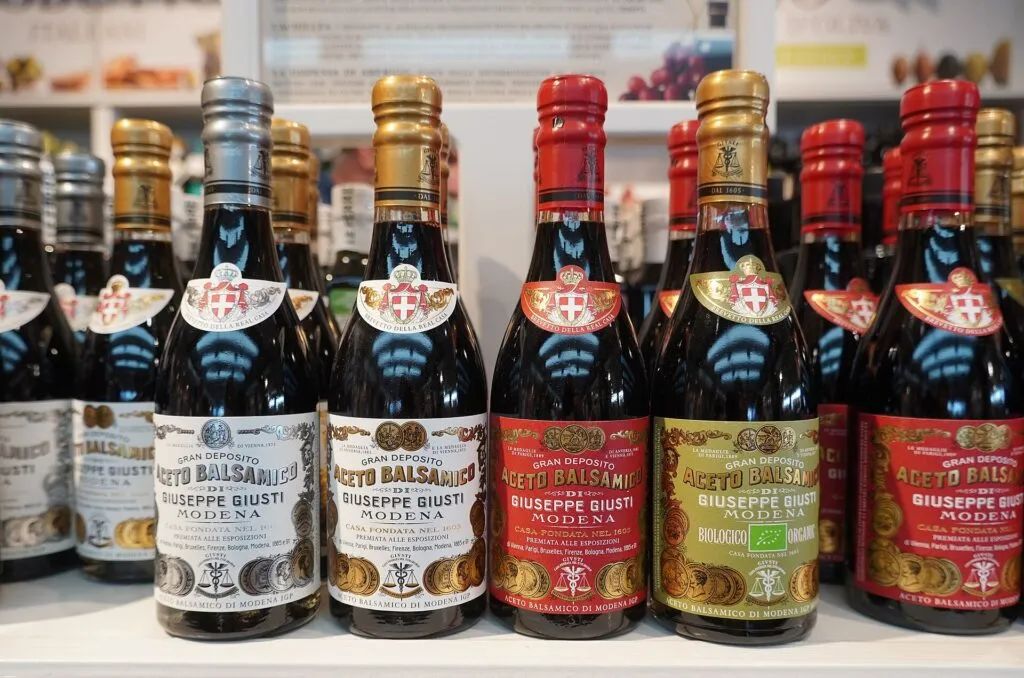
Real balsamic vinegar comes from Modena and nearby Reggio Emilia in northern Italy. The prized kind, Aceto Balsamico Tradizionale DOP, is made only from cooked grape must and aged for at least 12 years in a series of wooden barrels; everyday Aceto Balsamico di Modena IGP is a quicker blend of grape must and wine vinegar. Many family acetaie offer tours and tastings. In 2026 a 100 ml bottle of traditional DOP costs roughly €40–150 depending on age, while IGP bottles cost about €5–25.
This guide explains the difference between the two, how to visit an acetaia, what to taste it with, what to buy, and how Muslim travellers can think about vinegar.
Traditional or IGP: two different products
| Details | Aceto Balsamico Tradizionale (DOP) | Aceto Balsamico di Modena (IGP) |
|---|---|---|
| Made from | Cooked grape must only | Grape must plus wine vinegar |
| Ageing | At least 12 years (affinato); 25+ years for extravecchio | From about 60 days; “invecchiato” at least 3 years |
| Texture | Thick, glossy, syrupy | Thinner, sharper |
| Bottle | Modena: small round 100 ml bottle; Reggio Emilia: tulip-shaped bottle | Any bottle |
| Use | Drops on cheese, fruit, gelato, finished dishes | Salad dressing and cooking |
| Price (2026) | About €40–150 per 100 ml | About €5–25 per bottle |
If a bottle says “balsamic” but is thick, cheap and comes in a big bottle, it is probably a glaze with added thickeners, not the traditional product.
How traditional balsamic is made
- Local grapes, often Trebbiano and Lambrusco, are pressed and the must is cooked slowly in open pans until it darkens and reduces.
- The cooked must ferments and slowly turns to vinegar in the largest barrel.
- Each year a little vinegar moves down a row of ever-smaller barrels of different woods, such as oak, chestnut, cherry, mulberry and juniper.
- Only a small amount is drawn from the smallest barrel each year, after at least 12 years.
- A panel of tasters checks it before it can be bottled and sold as DOP.
Barrels are kept in attics, not cellars, because the hot summers and cold winters help the vinegar concentrate. Many families start a set of barrels when a child is born.
Visiting an acetaia
- What you see: the attic with its rows of barrels, the cooking of the must in season, and a guided tasting of different ages.
- How long: usually 45 minutes to an hour and a half.
- Cost: many family acetaie offer free or low-cost tours and hope you buy a bottle; larger producers may charge a small fee.
- Booking: always call or book online first. These are working family businesses, often outside town.
- Where: the countryside around Modena and Reggio Emilia; some acetaie are inside Modena itself.
What to taste it with
- Chunks of Parmigiano Reggiano, the classic pairing
- Fresh strawberries
- Vanilla gelato or ricotta
- A plain risotto or fried eggs, finished with a few drops
- Never cooked: heat destroys the aroma of traditional balsamic
Halal note: most scholars, including the Hanafi school, regard vinegar as halal, even when it began as wine, because it has fully turned into vinegar. Traditional balsamic is made from cooked grape must, not wine; IGP balsamic includes wine vinegar. Some Muslims prefer to avoid wine vinegar, so follow your own scholar. Around Modena, watch for pork in local specialities (below). See our halal food travel guide.
Other Modena food, and what to watch
| Food | What it is | Halal check |
|---|---|---|
| Parmigiano Reggiano | The famous aged cheese, made nearby | Made with animal rennet; scholars differ |
| Tortellini | Small filled pasta, often in broth | Usually pork filling and meat broth: not halal |
| Gnocco fritto | Puffy fried dough pillows | Often fried in lard; served with cured pork |
| Tigelle | Small round flatbreads | Traditionally spread with lard; ask for cheese or vegetables |
| Zampone and cotechino | Stuffed pork sausage dishes | Pork: not halal |
| Torta Barozzi | A rich chocolate-coffee cake from Vignola | Usually fine; ask about alcohol |
Modena and nearby Bologna have halal restaurants run by North African, Middle Eastern and South Asian communities if you want a hot meal.
What to buy and how to carry it
- For a gift, a traditional DOP bottle aged 12 years is a good start; 25-year extravecchio is a treat.
- For the kitchen, a good IGP labelled invecchiato (aged).
- Traditional bottles are 100 ml, so they fit hand-luggage liquid rules; larger IGP bottles should go in checked bags.
- Keep it at room temperature, away from light. It lasts for years.
What it costs (2026)
| Item | Typical price |
|---|---|
| Traditional DOP, 12 years, 100 ml | About €40–70 |
| Traditional DOP, 25 years (extravecchio), 100 ml | About €70–150 |
| IGP balsamic, 250 ml | About €5–25 |
| Acetaia tour and tasting | Free to a small fee |
Plan the rest with the Italy food budget calculator.
Italian phrases
| Say | Meaning |
|---|---|
| Si può visitare l’acetaia? | Can we visit the acetaia? |
| Possiamo assaggiare? | Can we taste? |
| Quanti anni ha? | How old is it? |
| C’è maiale o strutto? | Is there pork or lard? |
| È halal? | Is it halal? |
Frequently asked questions
What is the difference between traditional balsamic and balsamic of Modena?
Traditional balsamic (DOP) is only cooked grape must aged 12+ years in barrels. Balsamic of Modena (IGP) blends must with wine vinegar and is aged for much less time.
Is balsamic vinegar halal?
Most scholars, including the Hanafi school, consider vinegar halal. Some Muslims avoid wine vinegar; traditional balsamic is made from grape must rather than wine.
Can you visit balsamic producers in Modena?
Yes. Many family acetaie offer tours and tastings; book ahead.
How much does real balsamic vinegar cost?
About €40–150 for a 100 ml bottle of traditional DOP in 2026, depending on age.
More from Italy: white truffles in Piedmont, gelato in Florence and cannoli in Sicily. See all Italy food guides and tipping in Italy.
Sources
- Visit Modena – official Modena tourism site.
- Traditional balsamic vinegar and Balsamic vinegar.