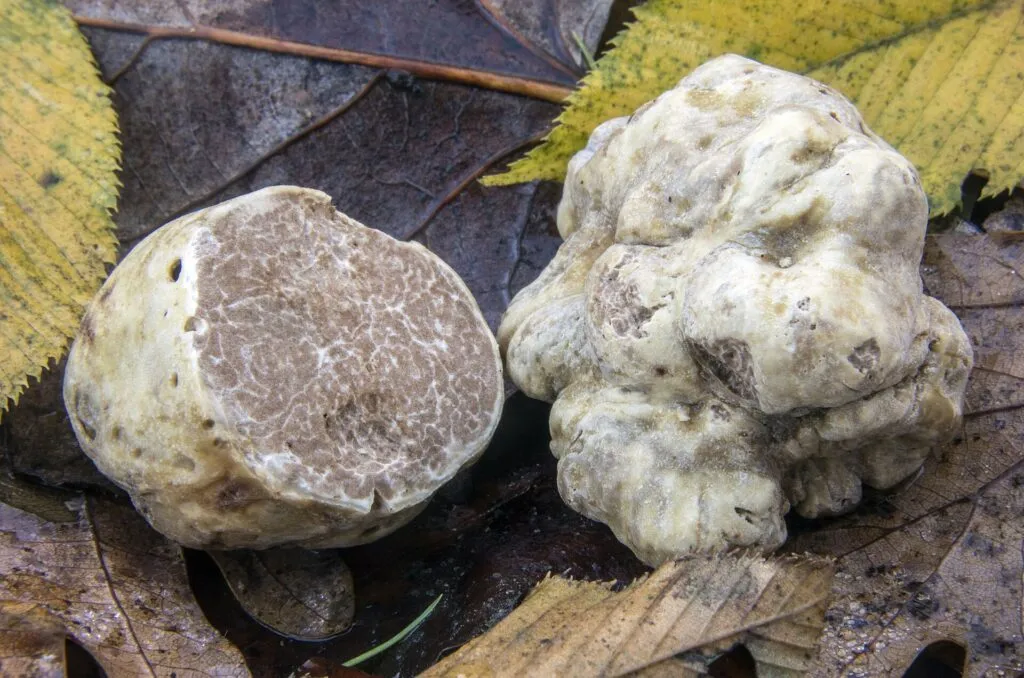
You smell a white truffle before you see it. At the Alba market in autumn, the scent hangs in the air of the hall: earthy, garlicky, a little like honey. Sellers lift glass domes so you can lean in, then quote a price by the gram.
Piedmont, in north-west Italy, is the home of the white truffle (tartufo bianco d’Alba), the most prized truffle in the world. The season runs roughly from October to December, centred on the town of Alba and the Langhe hills, where the annual International White Truffle Fair is held. Truffles are sold by the gram, often around €3–6 per gram in 2026 depending on the harvest, and restaurants shave them over simple dishes such as tajarin pasta or fried eggs.
Truffles themselves are a fungus and halal. The catch in Piedmont is that many classic dishes are cooked with wine or served with non-halal meat. This guide shows you how to enjoy truffle season around that.
White and black truffles
| Truffle | Season (roughly) | Taste and use |
|---|---|---|
| White truffle (Tuber magnatum) | October–December | Intense, garlicky, honeyed. Always raw, shaved thin over hot food |
| Black winter truffle | Winter | Deeper, earthier; can be cooked |
| Summer black truffle (scorzone) | Summer | Milder and much cheaper |
Piedmont is famous for the white. It cannot be farmed, which is why it is so expensive.
How truffles are found
Truffle hunters, called trifolau in Piedmontese, search oak, poplar and hazel woods with trained dogs. Much of the hunting happens at night or at dawn, partly to keep good spots secret.
Several farms and guides in the Langhe offer truffle-hunt experiences for visitors. You walk the woods with a hunter and dog, and usually taste the find afterwards. Book ahead in October and November.
The Alba White Truffle Fair
The International White Truffle Fair of Alba (Fiera Internazionale del Tartufo Bianco d’Alba) has run for decades and takes place on weekends from October to early December.
At its heart is the truffle market, where certified sellers show their truffles and judges check quality. Around it you will find food stalls, cooking demonstrations and crowds. Weekends are busiest; go early.
Truffle dishes and what to check
| Dish | What it is | Halal check |
|---|---|---|
| Tajarin al tartufo | Thin, egg-rich pasta with butter and shaved white truffle | Usually fine; confirm no wine or meat stock |
| Uova al tegamino al tartufo | Fried eggs with shaved truffle | Usually fine |
| Fonduta al tartufo | Warm melted cheese sauce with truffle | Some recipes add wine; ask |
| Risotto al tartufo | Risotto finished with truffle | Often made with wine and meat stock; ask |
| Carne cruda all’albese | Raw veal, olive oil, lemon, truffle | Meat is not halal-slaughtered |
| Brasato | Beef braised in red wine | Not halal: cooked in wine |
Halal note: the truffle itself is halal. The simplest truffle dishes, tajarin with butter and fried eggs, are usually the safest choice: ask the kitchen to confirm there is no wine or meat stock (senza vino e senza brodo di carne). Avoid braises and risottos unless the kitchen confirms. Meat at ordinary Piedmont restaurants is not halal-slaughtered. Turin, an hour away, has halal restaurants, especially around the Porta Palazzo market. See our halal food travel guide.
Buying a truffle
- Smell it. A good white truffle is powerfully aromatic. Weak smell, weak truffle.
- Feel it. It should be firm, not spongy.
- Check it is whole and clean, without soft spots.
- Buy small. 10–20 grams is plenty for several plates.
- Use it fast. Wrap it in paper towel, keep it in a closed jar in the fridge, change the paper daily and use it within about five days.
Be wary of cheap “truffle oil”: most is flavoured with synthetic aroma, not real truffle.
More Piedmont food to try
- Hazelnuts – the Langhe grows some of Italy’s best, sold roasted, as paste and in cakes such as torta di nocciole.
- Gianduja – chocolate blended with hazelnut, a Turin invention; also try gianduiotti, the small wedge-shaped chocolates.
- Grissini – hand-stretched breadsticks, born in Turin.
- Bicerin – Turin’s layered drink of coffee, chocolate and cream; no alcohol.
- Cheeses – such as Castelmagno and Raschera; ask about rennet if it matters to you.
When to go and where to stay
- October and November – peak truffle season, fair weekends and autumn colours in the vineyards. Book rooms early.
- December – quieter, and truffles are still around in a good year.
- Alba – walkable old town, the fair and plenty of restaurants.
- Turin – a bigger city base with easier halal options, about an hour by car or train.
What it costs (2026)
| Item | Typical price |
|---|---|
| White truffle, retail | Often €3–6 per gram, depending on the harvest |
| Truffle shaved over a dish in a restaurant | Charged by the gram; commonly adds €20–60 to a plate |
| Tajarin without truffle | About €12–18 |
| Truffle hunt experience | Priced per group; book ahead |
Plan your budget with the Italy food budget calculator and read about tipping in Italy.
Italian phrases
| Say | Meaning |
|---|---|
| Quanto costa al grammo? | How much per gram? |
| Dieci grammi, per favore | Ten grams, please |
| C’è vino nella ricetta? | Is there wine in the recipe? |
| Senza vino e senza brodo di carne | Without wine and without meat stock |
| C’è maiale? | Is there pork? |
| È halal? | Is it halal? |
Frequently asked questions
When is white truffle season in Piedmont?
Roughly October to December, with the Alba fair on weekends in that period. The exact dates change each year.
How much does a white truffle cost?
Prices change with the harvest. In 2026 expect roughly €3–6 per gram retail; restaurants charge by the gram shaved.
Are truffles halal?
Yes. Truffles are a fungus. Check the dish they are served on, since many Piedmont recipes use wine or meat stock.
Can I join a truffle hunt?
Yes. Farms and guides around Alba offer hunts with a trifolau and dog; book ahead in season.
More from Italy: gelato in Florence, balsamic vinegar in Modena, cannoli in Sicily and arancini. See all Italy food guides.
Sources
- Visit Piemonte – official regional tourism site.
- Alba White Truffle Fair and Tuber magnatum.