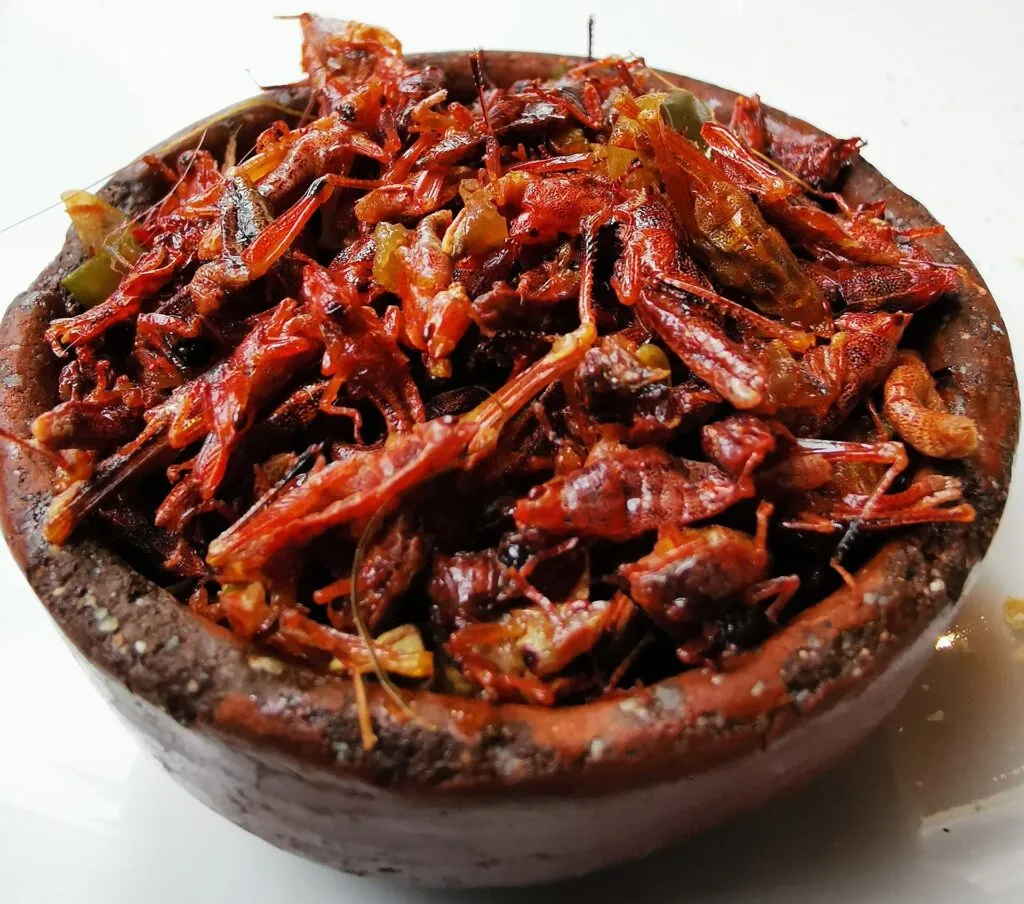
In Oaxaca’s Benito Juárez market, women sit behind great baskets of red-brown grasshoppers, sorted by size from tiny to thumb-length. Ask for a taste and one will scoop a few into your palm: crunchy, salty, sour with lime and gently hot with chilli.
Chapulines are grasshoppers of the genus Sphenarium, collected in the fields of Oaxaca and central Mexico, cleaned, then toasted on a clay griddle (comal) with garlic, lime, salt and chilli. Locals eat them by the handful as a snack, in tacos with guacamole, on tlayudas and in quesadillas. A local saying promises that if you eat chapulines, you will return to Oaxaca.
This guide explains what they taste like, how they are prepared, where and when to buy them, safety, Oaxaca’s other edible insects, and dietary and halal notes.
What Do Chapulines Taste Like?
Mostly like their seasoning: salty, tangy and spicy, with a toasty, slightly nutty flavour underneath, sometimes compared to sunflower seeds or crisp prawn shells. The texture is crunchy, with some chewiness in larger ones. The legs can tickle your throat, which is why many people start with the small ones.
How Chapulines Are Prepared
- Grasshoppers are collected in the early morning from maize and alfalfa fields during the rainy season, when they are slow and easy to catch.
- They are cleaned and soaked or boiled in water.
- They are toasted on a comal until crisp, with garlic and salt.
- Lime juice and ground chilli are added, sometimes with a little oil.
- They are sorted by size and sold by the scoop.
Small chapulines are the crunchiest and most popular for snacking; larger ones are meatier and often go into tacos and sauces.
How to Eat Them
- As a snack (botana): straight from the bag, like peanuts.
- In tacos: in a warm corn tortilla with guacamole and salsa.
- On tlayudas: the large Oaxacan toasted tortillas topped with beans, cheese and toppings.
- In quesadillas and omelettes: mixed with Oaxacan string cheese (quesillo) or eggs.
- In sauces: ground into salsa for an earthy, savoury flavour.
- As salt (sal de chapulín): ground with salt and chilli, a seasoning sold in markets.
Where and When to Buy Chapulines in Oaxaca
The best places are Oaxaca City’s markets: Mercado Benito Juárez and Mercado 20 de Noviembre, side by side in the centre, and the big Sunday market in Tlacolula. Vendors are usually happy to offer a free taste, so try a few sizes before you buy.
Chapulines are collected from about May, after the first rains, through late summer and early autumn, when they are freshest. Dried and toasted chapulines are sold all year.
Outside Oaxaca, you will find them around Mexico City, in Puebla and in towns such as Tepoztlán, and in some Mexican restaurants and shops in the United States and Europe.
Are Chapulines Safe to Eat?
Toasted chapulines from busy market stalls are eaten every day by many people, and travellers on forums asking whether they will get sick are usually told they are fine. A few points help:
- Buy from busy, reputable vendors, where stock turns over quickly.
- Be aware of past lead reports. In 2007, US public-health officials reported lead contamination in chapulines from the Zimatlán area that were sold in California. Children and pregnant people may want to eat them only occasionally.
- Check for spoilage if you buy packaged or refrigerated chapulines: moisture in the container or a sour smell are bad signs.
- Shellfish allergy: insects are related to crustaceans, so people with shellfish allergies can react to them.
Nutrition
Grasshoppers are high in protein and low in fat, with useful minerals such as iron and zinc. That is why edible insects are often promoted as a sustainable protein source, though the seasoning makes market chapulines quite salty.
Oaxaca’s Other Edible Insects
| Insect | What it is | How it is eaten |
|---|---|---|
| Chicatanas | Large flying ants, collected after the first heavy rains | Toasted and ground into salsas, prized by chefs |
| Escamoles | Ant larvae and pupae | Sautéed with butter and herbs; expensive, called “insect caviar” |
| Gusano de maguey | Caterpillars that live in agave plants | Fried, or ground into salt; also served with mezcal |
| Chinicuiles | Red agave worms | Fried or ground with salt and chilli |
Dietary and Halal Notes
Halal note: locusts are one of only two foods, with fish, that a well-known hadith permits without slaughter, and many scholars consider grasshoppers to fall within the same category (jarād). Others limit the permission to locusts proper, so check with your own scholar. Other insects such as ants, larvae and worms are not considered halal by most scholars. Ask whether the chapulines were toasted plain or fried in lard (manteca), and note that chapulines are often sold alongside mezcal, which contains alcohol. See our halal food travel guide.
Chapulines are gluten-free and dairy-free when sold plain, but not vegetarian or vegan.
What Chapulines Cost in 2026
| Item | Typical price |
|---|---|
| Small scoop or bag at a market stall | A few US dollars’ worth of pesos, roughly MXN 30–80 |
| Chapulín taco or tlayuda topping | Small extra charge at market stalls |
| Packaged chapulines to take home | About MXN 80–200 per pack |
| Chapulines in Mexican restaurants abroad | Often USD 10–20 for a shared plate |
Plan your Mexico budget with our food budget calculator and check tipping in Mexico.
Frequently Asked Questions
What are chapulines in English?
Grasshoppers. The word comes from the Nahuatl chapolin. In Mexico it refers specifically to edible grasshoppers of the genus Sphenarium.
Are chapulines crickets?
No. They are grasshoppers, although many English menus call them crickets.
Is it okay to eat chapulines?
Yes. They have been eaten in Mexico for centuries and are sold in every Oaxacan market. Buy from busy vendors, and eat them in moderation if you are pregnant or buying for children, because of past lead reports.
Can you get food poisoning from chapulines?
It is uncommon, because they are toasted and seasoned with lime and salt. As with any food, choose busy stalls and avoid packs with moisture or a sour smell.
How do you eat chapulines?
Straight from the bag as a snack, in tacos with guacamole, on tlayudas, in quesadillas or ground into salsa or seasoning salt.
When is chapulín season?
From about May, after the first rains, until late summer or early autumn. Dried chapulines are available all year.
Are chapulines halal?
Many scholars permit them, considering grasshoppers part of the locust family that a hadith permits; others do not. Check how they were cooked, avoid any fried in lard, and ask your own scholar.
Can I bring chapulines home?
Packaged, dried chapulines are allowed into many countries, but rules on insects vary. Declare them at customs and check your country’s regulations.
Why do people eat insects in Oaxaca?
Insects have been part of the diet in the region since before the Spanish arrived. They are abundant in season, nutritious and tasty, and remain part of everyday life and identity.
What other foods is Oaxaca known for?
Its seven moles, tlayudas, quesillo (string cheese), tejate (a maize and cacao drink), chocolate and mezcal.
Where can I try chapulines outside Mexico?
Some Mexican restaurants in the United States, Europe and elsewhere serve them, and Mexican grocery shops sell packaged ones. A baseball stadium in Seattle even made them a popular snack.
What is sal de chapulín?
A seasoning of ground chapulines, salt and chilli, sold in Oaxacan markets and used on fruit, cucumber and in drinks.
More from Latin America: huitlacoche, churros in Latin America, chocolate tours in Costa Rica and all Latin America and Caribbean food guides.
Sources
- Chapulines, Wikipedia (species, season, preparation, 2007 lead reports)
- Eating insects in Oaxaca, Oaxaca Eats food tours (markets, other insects)
- Chapulines, Atlas Obscura (ways of eating them)