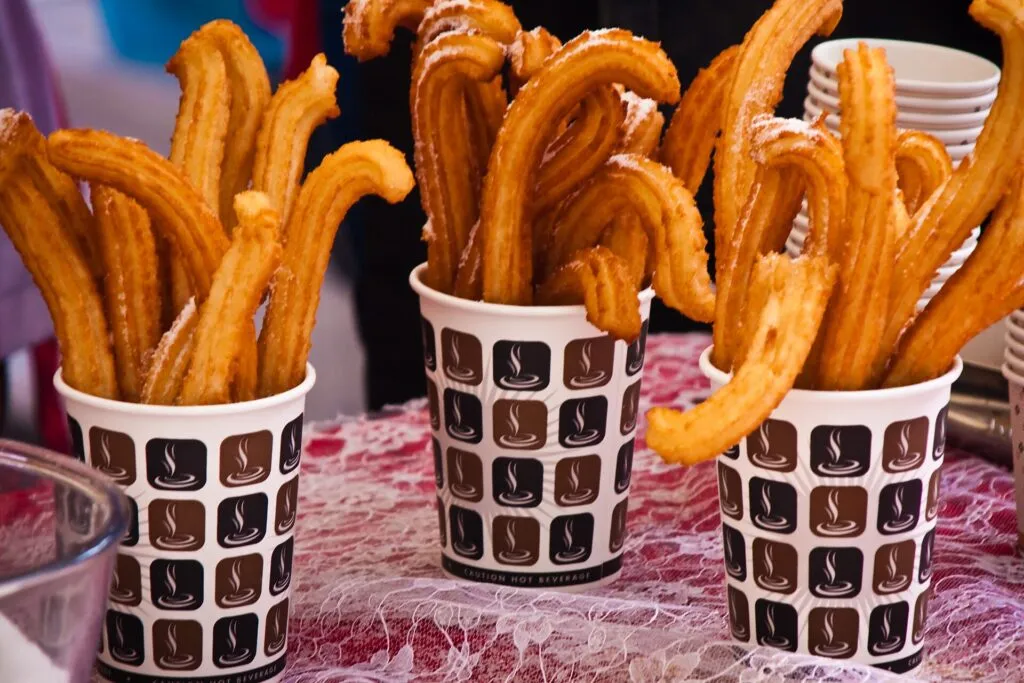
In Mexico City you dip them in cinnamon-scented hot chocolate. On an Argentine beach a vendor walks past with a basket of churros filled with dulce de leche. In Havana they might be stuffed with guava, and in Uruguay you can even get one filled with melted cheese. Same fried dough, very different snack.
Churros came to Latin America from Spain and Portugal and became everyday street food from Mexico to Argentina. Each country now has its own shape, filling and time of day for eating them. In 2026 a bag of fresh churros costs only a few dollars almost anywhere in the region.
This guide compares the main styles country by country, explains what to order and where, and covers the dietary details, from frying fat to fillings.
Latin American Churros at a Glance
| Country | Typical churro | Usual filling or pairing |
|---|---|---|
| Mexico | Thick, ridged, rolled in cinnamon sugar | Hot chocolate; filled with cajeta, chocolate or cream |
| Argentina | Long and straight, often filled | Dulce de leche, sometimes dipped in chocolate |
| Uruguay | Like Argentina’s | Dulce de leche, or a savoury cheese filling |
| Brazil | Thick, split and filled to order | Doce de leite or chocolate |
| Cuba | Straight, sugared | Sometimes filled with guava |
| Chile, Peru, Bolivia, Colombia | Plain or filled, sugared | Manjar (dulce de leche), chocolate or cream |
Where Churros Came From
Churros are fried choux dough, the same kind of paste used for éclairs, piped through a star nozzle into hot oil. Spain and Portugal both have long churro traditions, and the Spanish brought them to their American colonies.
Two origin stories circulate online. One says Spanish shepherds invented them as an easy bread to fry over an open fire in the mountains. Another says Portuguese sailors brought the idea from China, where a fried dough stick called youtiao is common. Spanish food writers have described the China story as a myth, and the shepherd story is just as hard to prove, so treat both as legends.
In Spain the dough is usually just flour, water and salt, and churros are breakfast food dipped in thick chocolate or coffee. Latin American cooks often added sugar, egg or butter, rolled them in sugar and began to fill them. That is the biggest difference you will notice. For the original style, read our guide to churros con chocolate in Madrid.
Mexico: Cinnamon Sugar and Hot Chocolate
Mexican churros are thick, deeply ridged and rolled in sugar mixed with cinnamon. Street vendors fry them on corners and outside markets, and churrerías sell them fresh, often late into the evening.
The classic order is churros con chocolate, with a cup of Mexican hot chocolate. It is thinner than Spanish chocolate and flavoured with cinnamon. Filled churros (churros rellenos) are common too, with cajeta (goat’s-milk caramel), chocolate, vanilla cream or strawberry jam.
In Mexico City, Churrería El Moro has fried churros in the historic centre since the 1930s and now has several branches. Travellers on forums often ask where else to go. Old-style cafés in Coyoacán and long-running churrerías across the city are frequent answers, along with a simple rule: buy from whoever is frying in front of you, because churros are best within minutes of leaving the oil.
Churros are also part of Mexican pop culture. A famous 1978 storyline of the comedy El Chavo del Ocho was built around selling churros, and many people across Latin America still connect the two.
Argentina and Uruguay: Filled With Dulce de Leche
In Argentina the churro is long, straight and usually filled. Churros rellenos de dulce de leche are the classic, and some are dipped in chocolate (bañados) as well.
They are a beach tradition. On the Atlantic coast, especially in Mar del Plata, vendors walk the sand in summer with baskets of churros, and visiting a churrería is part of the holiday routine. In winter, churros with hot chocolate are a cold-afternoon treat in Buenos Aires and Montevideo.
Uruguay adds a surprise: churros filled with melted cheese, a savoury snack sold alongside the sweet kind.
Dulce de leche is everywhere in the River Plate region; learn more in our dulce de leche guide, and look for alfajores in the same bakeries.
Brazil, Cuba, Chile and the Rest of the Region
- Brazil: churros are thick and are split open and filled to order from street carts, usually with doce de leite or chocolate. You find them at parks, beaches and outside schools.
- Cuba: churros are a street and fair snack, plain and sugared, and sometimes filled with guava.
- Chile: a beach and fair snack, plain with sugar or filled with manjar, Chile’s name for dulce de leche.
- Peru and Bolivia: churros filled with manjar or dulce de leche are sold at street stalls and bakeries.
- Colombia: street vendors fry churros at parks and fairs, often thin and sugared, sometimes with arequipe (dulce de leche).
How Churros Are Made
- Water, salt and often a little sugar and fat are brought to the boil.
- Flour goes in all at once and is stirred into a smooth, thick dough; many Latin American recipes add egg.
- The dough is pushed through a star-shaped nozzle straight into hot oil, often as one long coil that is cut after frying.
- The churros fry until golden and crisp, then drain.
- They are rolled in sugar or cinnamon sugar, or split and filled while warm.
The star nozzle is not just for looks. The ridges help the dough cook evenly, stop it bursting as steam escapes, and hold more sugar.
How to Choose a Good Churro
- Fried to order or very recently. A churro that has sat for an hour turns soft and oily.
- Crisp outside, soft inside. It should crack slightly when you bite, not bend.
- Golden, not dark brown. Very dark churros usually mean old or overheated oil.
- Clean-smelling oil. A strong, stale smell from the fryer is a bad sign.
- A queue of locals. Busy stalls turn over their stock fastest.
Dietary Notes: Frying Fat, Fillings and Allergies
Churros are one of the easiest street sweets in Latin America for people who avoid pork or alcohol, but a few details are worth checking.
Halal note: churros contain no meat, and most vendors fry them in vegetable oil. Some traditional recipes use animal fat in the dough or for frying: manteca de cerdo is lard, and in Argentina and Uruguay grasa means beef fat, which will not be halal-slaughtered. Fillings such as dulce de leche, cajeta, guava, chocolate and cream are usually fine; flavoured creams very rarely contain liqueur, so ask if unsure. The phrase “¿Con qué aceite los fríen?” (what oil do you fry them in?) covers most cases. Our halal food travel guide has more phrases.
For vegans, Spanish-style dough is often just flour, water and salt, but many Latin American recipes add butter or egg, and most fillings contain milk. People with nut allergies should ask about chocolate coatings and toppings.
What Churros Cost in 2026
| Where | Typical price |
|---|---|
| Mexico, street vendor | About MXN 10–25 per churro; filled churros cost more |
| Mexico City churrería with hot chocolate | About MXN 80–160 for churros and a drink |
| Argentina and Uruguay, beach or churrería | A few US dollars for a bag of filled churros |
| Brazil, street cart | About BRL 8–15 for a filled churro |
Prices change quickly in some countries, especially Argentina. Plan daily food costs with our budget calculator for Mexico or Argentina.
Spanish Phrases for Ordering Churros
| Say | Meaning |
|---|---|
| Una docena de churros, por favor | A dozen churros, please |
| Rellenos de dulce de leche | Filled with dulce de leche |
| Con azúcar y canela | With sugar and cinnamon |
| Con chocolate caliente | With hot chocolate |
| ¿Con qué aceite los fríen? | What oil do you fry them in? |
| ¿Tienen manteca de cerdo o grasa? | Do they contain lard or animal fat? |
Frequently Asked Questions
What is the difference between Mexican and Spanish churros?
Spanish churros are usually thinner, unsweetened and served with very thick chocolate for breakfast. Mexican churros are thicker, rolled in cinnamon sugar and often filled, and are eaten as a snack or dessert at any time.
Are filled churros common in Mexico?
Yes. Plain cinnamon-sugar churros are the classic, but churrerías and street vendors also sell churros filled with cajeta, chocolate, vanilla cream or jam.
What is cajeta?
Cajeta is a Mexican caramel made from goat’s milk and sugar, cooked slowly until thick. It is a favourite churro filling and topping in Mexico.
What is manjar?
Manjar is the name used in Chile, Peru and Bolivia for dulce de leche, the thick caramel made from milk and sugar.
What is a porra?
A porra is a thicker, longer churro, common in Madrid and other parts of Spain. Some Latin American churrerías use the word too.
Are churros breakfast food or dessert?
In Spain they are mainly breakfast or an afternoon snack. In Latin America they are eaten at any time: at the beach, at fairs, as a snack or after dinner.
What is Mexican hot chocolate?
Mexican hot chocolate is made from chocolate tablets flavoured with sugar and cinnamon, whisked with water or milk until frothy. It is thinner than the thick Spanish chocolate used for dipping.
How do you keep churros crisp?
Eat them within a few minutes of frying. To reheat, use a hot oven or air fryer for a few minutes; a microwave makes them soft.
Can you freeze churros?
Yes. Freeze cooked churros before sugaring or filling them, then reheat in a hot oven and roll them in sugar just before serving.
Are churros gluten-free?
No. Churro dough is made with wheat flour. Some bakeries make gluten-free versions with other flours, but street churros are not.
More from the region: chimarrão in southern Brazil and all Latin America and Caribbean food guides.
Sources
- Churro, Wikipedia (origins, filled churros by country, El Chavo del Ocho)
- Eating churros is a different experience in Spain, Tasting Table
- Día Mundial del Churro, El Sol, Argentina (regional styles)