In Buenos Aires they come wrapped in foil at every kiosk, next to the newspapers. In Lima they are dusted with icing sugar in bakery windows. In southern Spain they are honey-and-almond cylinders sold at Christmas. All of them are called alfajores.
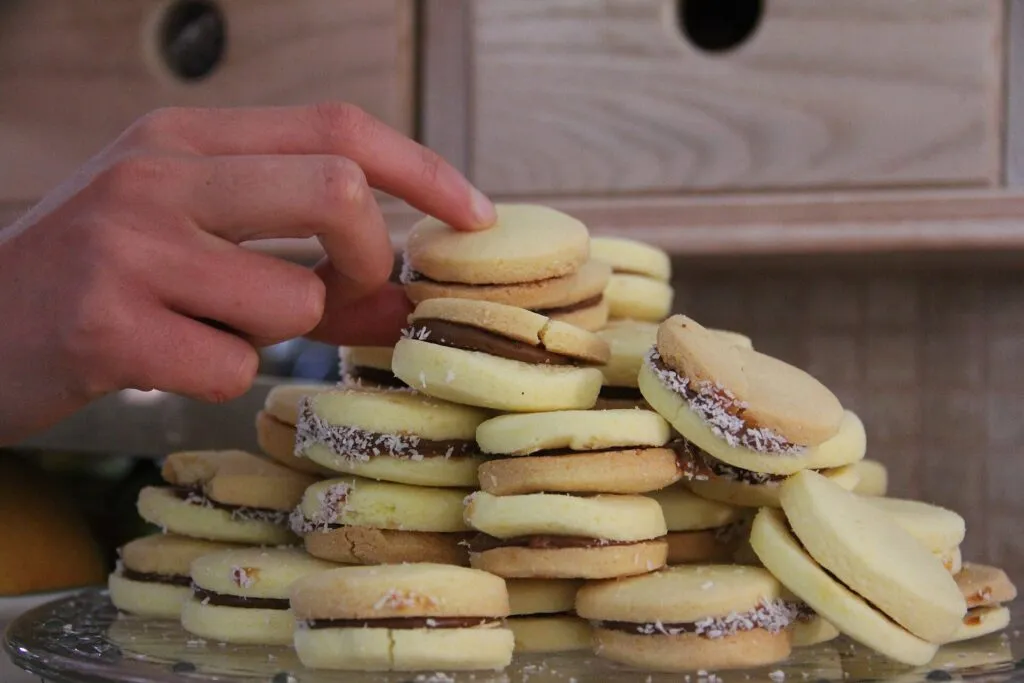
An alfajor is, in most of South America, two soft, crumbly biscuits (cookies, if you are American) sandwiching a layer of dulce de leche, a thick milk caramel. They may be rolled in coconut, dusted with sugar or coated in chocolate. Argentina eats more than anyone, with over a billion a year, but Uruguay, Peru, Chile and Spain all have strong traditions of their own.
This guide explains the styles country by country, the brands locals argue about, what to bring home, where to find alfajores outside South America, and what to check on the label if you avoid alcohol or animal gelatin.
Alfajores at a Glance
| Country | Typical alfajor | Look out for |
|---|---|---|
| Argentina | Chocolate-coated or cornstarch biscuits with dulce de leche | Havanna, Cachafaz, Jorgito, Guaymallén; regional styles from Santa Fe and Córdoba |
| Uruguay | Chocolate-coated, or covered in meringue (de nieve) | Portezuelo, Punta Ballena, Sierras de Minas |
| Peru | Delicate cornstarch biscuits with manjar blanco, dusted with icing sugar | Bakery and artisan alfajores, especially in Lima |
| Chile | Cornstarch alfajores, plus a southern honey-and-dough version | Alfajores chilenos at September national holidays |
| Spain | A honey, almond and spice paste rolled into a cylinder | Alfajor de Medina Sidonia, protected by EU geographical indication |
| Philippines | Small butter biscuits with a caramel filling | Alfajores sold by the Good Shepherd sisters in Baguio |
From al-Andalus to the Americas
The alfajor began in Muslim Spain, al-Andalus. The word is Arabic in origin: the philologist Manuel Alvar López traced it to al-fakhir, meaning luxurious, while other writers derive it from a word for filling. The first Spanish dictionary entry dates from 1495.
The Spanish original is nothing like the South American sandwich. In Medina Sidonia, near Cádiz, alfajores are still made from honey, almonds, hazelnuts, breadcrumbs and spices, shaped into small cylinders and sold mostly around Christmas. In 2004 they received protected geographical indication, later recorded by the European Union.
Spanish settlers brought the name to the Americas in the colonial period, and cooks there reinvented it. With dairy farming and the spread of dulce de leche, the sweet became a sandwich of biscuits and milk caramel, the form most people know today.
Argentina: The Alfajor Superpower
Argentines eat alfajores as an afternoon snack, a lunchbox treat and a kiosk pick-me-up. Industrial production took off on the Atlantic coast in the 1950s, when brands such as Havanna and Balcarce, from Mar del Plata, began selling boxed alfajores to holidaymakers. The chocolate-dipped kind is still called marplatense after the city.
The Main Argentine Styles
- Alfajor de maicena: soft, crumbly cornstarch biscuits with dulce de leche, edges rolled in grated coconut. The homemade classic.
- Chocolate-coated (marplatense): dark, milk or white chocolate over biscuits and dulce de leche. The kiosk standard.
- Triple: three biscuits and two layers of filling, a style made famous by Fantoche.
- Santafesino: from Santa Fe, three thin, crisp pastry layers joined with dulce de leche and covered in a white sugar glaze.
- Cordobés: from Córdoba, filled with fruit jelly, usually quince, instead of dulce de leche.
- Rogel: a cake-sized version of the layered alfajor, covered in meringue.
Brands Locals Talk About
Argentines argue about alfajores the way others argue about football. The names you will hear most are Havanna and Cachafaz at the premium end, Jorgito, Guaymallén and Capitán del Espacio at the kiosk, and Fantoche for the triple. In 2025, the food guide TasteAtlas published a list of the world’s best alfajores in which 19 of the 20 were Argentine, led by small artisan makers rather than the big brands.
Each year, the Mundial del Alfajor fair holds a blind tasting of hundreds of alfajores from Argentina and beyond, with categories from best dulce de leche filling to best three-layer alfajor.
Uruguay: Meringue, Chocolate and Fierce Local Pride
Uruguayans eat around 10 million alfajores a month, and many insist theirs are better than Argentina’s. The two market leaders are Portezuelo and Punta Ballena; Punta Ballena’s alfajores contain no preservatives and have a short shelf life of around 40 days, which is part of their appeal. The artisan alfajores of Sierras de Minas are known as the country’s first.
Look out for alfajores de nieve (snow alfajores), covered in a crisp white meringue instead of chocolate. Travellers on forums often ask what to bring back from Colonia or Montevideo: a mixed box from the big local brands and a few artisan alfajores from a bakery is the usual answer.
Uruguay is also the land of the chivito, and alfajores are the classic sweet to finish a day of eating there.
Peru: Delicate Cornstarch and Manjar Blanco
Alfajores have been made in Peru since the 16th century, when the Viceroyalty of Peru was the centre of Spanish South America. The Peruvian style is the most delicate: two thin, melt-in-the-mouth cornstarch biscuits filled with manjar blanco (Peru’s name for dulce de leche) and dusted with icing sugar.
You will find them in every bakery in Lima, often alongside a coffee or a cup of hot chocolate. Artisan versions, sometimes in miniature, are a popular gift to take home.
Chile, Spain, the Philippines and Beyond
- Chile: two types. One is the cornstarch alfajor found across South America, filled with manjar. The other, the traditional alfajor chileno of the south, is made especially for the September national holidays.
- Spain: the honey-almond alfajor de Medina Sidonia in Andalusia, plus the related alajú of Cuenca, both Christmas sweets.
- The Philippines: small butter biscuits with a caramel filling, famously sold by the Good Shepherd sisters in Baguio and taken home as a souvenir from the mountains.
- Colombia, Venezuela and the Caribbean: alfajores exist, filled with arequipe in Colombia and Venezuela, but they are less of a national habit than in the south. Puerto Rico has its own cassava-based version.
How a Classic Alfajor de Maicena Is Made
- Butter and sugar are creamed, then egg yolks, a little lemon zest and vanilla are added.
- Cornstarch and a smaller amount of wheat flour are mixed in with baking powder to make a soft, crumbly dough. Many family recipes also add a spoonful of brandy or cognac.
- The dough is rolled thin, cut into rounds and baked until set but still pale.
- Once cool, pairs of biscuits are joined with a generous layer of dulce de leche.
- The edges are rolled in grated coconut, or the whole alfajor is coated in chocolate or dusted with icing sugar.
The filling matters as much as the biscuit; read our guide to dulce de leche to understand why Argentines are so particular about it.
How to Choose a Good Alfajor
- The biscuit should crumble softly, not snap like a cracker or taste dry.
- The filling should be generous and thick, sitting in a clear layer rather than soaking into the biscuit.
- Chocolate should be real chocolate, glossy and snapping cleanly, not waxy. Check the label for “chocolate” rather than “cobertura” or “baño de repostería”.
- Fresher is better. Artisan and preservative-free alfajores have short shelf lives; check the date.
- Mix industrial and artisan. Kiosk brands are part of everyday life; artisan alfajores show what the sweet can be.
Alcohol, Gelatin and Other Things to Check
Most alfajores are simply flour, cornstarch, butter, sugar, eggs, milk and chocolate, but a few details are worth knowing, especially for readers who avoid alcohol or animal products.
Halal note: alfajores contain no meat, and most are fine for Muslim readers, but some contain alcohol. Many home and bakery recipes add brandy, cognac or rum to the dough or filling, and some premium brands use liqueur for flavour: one Argentine premium brand’s distributor describes a slight hint of liqueur as part of its character, and some award-winning artisan alfajores are made with Malbec wine. Ask, or read the label for licor, coñac, ron, vino or brandy. Mousse- and marshmallow-style fillings can contain animal gelatin. In Argentina and Uruguay, look for an alcohol-free (sin alcohol) label or choose a classic kiosk alfajor and check its ingredients.
Alfajores are not gluten-free unless labelled: even cornstarch biscuits usually contain some wheat flour, although gluten-free alfajores (sin TACC in Argentina) are widely sold. They contain milk, eggs and often nuts or coconut.
Where to Buy Alfajores, at Home or Abroad
- In Argentina and Uruguay: kiosks for everyday brands, branded cafés and shops for premium boxes, and bakeries for artisan alfajores. Airports sell gift boxes at higher prices.
- In Peru and Chile: bakeries, cafés and supermarkets; artisan shops in Lima sell gift boxes.
- In Spain: Medina Sidonia’s alfajores are sold in Andalusian shops and online, mostly before Christmas; Argentine and Uruguayan bakeries in Madrid and Barcelona sell the South American kind all year.
- Elsewhere: Latin American bakeries and grocery shops in cities with large South American communities, from London and Miami to Sydney, usually stock them, and several Argentine brands sell and ship internationally. Check import rules for dairy products if you order across borders.
What Alfajores Cost in 2026
| Where | Typical price |
|---|---|
| Kiosk alfajor, Argentina or Uruguay | Usually under USD 2 each; prices in pesos change quickly |
| Box of premium alfajores, Argentina | Roughly USD 10–25, depending on size and brand |
| Peruvian bakery alfajor, Lima | About PEN 2–6 each |
| Imported alfajores in Europe, North America or Asia | Typically 2–4 times the local South American price |
Plan your daily food budget with our calculator for Argentina, Peru or Chile.
Spanish Phrases for Buying Alfajores
| Say | Meaning |
|---|---|
| Un alfajor de dulce de leche, por favor | A dulce de leche alfajor, please |
| ¿Es de chocolate negro o blanco? | Is it dark or white chocolate? |
| ¿Tiene alcohol o licor? | Does it contain alcohol or liqueur? |
| ¿Son artesanales? | Are they handmade? |
| Una caja para regalo | A gift box |
| ¿Hay sin TACC? | Do you have gluten-free ones? |
Frequently Asked Questions
What is an alfajor in English?
There is no exact English word. The closest description is a dulce de leche sandwich biscuit, or sandwich cookie in American English.
How do you pronounce alfajores?
Roughly “al-fa-HOR-es”. The “j” is a throaty “h” sound, as in Scottish “loch”.
Are alfajores Arabic?
Their origin is. The sweet and its name come from al-Andalus, Muslim Spain, and the word is Arabic in origin. The South American sandwich with dulce de leche developed later in the Americas.
Which country is known for alfajores?
Argentina is the best known and eats the most, but Uruguay and Peru have strong traditions too, and the original comes from Spain.
Which country eats the most alfajores?
Argentina, by a wide margin, with more than a billion a year. Uruguay is a heavy consumer for its size, at around 10 million a month.
What is the difference between Argentine and Peruvian alfajores?
Argentine alfajores are often coated in chocolate and sold industrially, as well as homemade. Peruvian alfajores are usually smaller, more delicate cornstarch biscuits filled with manjar blanco and dusted with icing sugar.
How many calories are in an alfajor?
It depends on size and coating. A standard chocolate-coated kiosk alfajor typically has around 200–300 calories; the label on each pack gives the exact figure.
How long do alfajores last?
Industrial alfajores usually last several months unopened. Artisan and preservative-free ones can last only a few weeks, so check the date before buying them as gifts.
Can you take alfajores on a plane?
Yes, they are a classic souvenir and fine in hand luggage. Some countries restrict dairy imports, so check your destination’s rules if you are carrying large quantities.
What is dulce de leche?
Dulce de leche is milk and sugar cooked slowly until thick, golden and caramel-flavoured. It is called manjar or manjar blanco in Chile and Peru, and arequipe in Colombia and Venezuela.
More from the region: churros in Latin America, empanadas across South America, Bolivian salteñas and all Latin America and Caribbean food guides.
Sources
- Alfajor, Wikipedia (origins, Medina Sidonia, regional styles, brands)
- Ranking de los 20 mejores alfajores del mundo, La Nación (TasteAtlas 2025 list)
- Las marcas de alfajores expandieron la mira, The Food Tech (Uruguayan market)
- Alfajores argentinos en Uruguay, El Observador (Fantoche, Cachafaz)