Order a roti in Trinidad and you taste India. A plate of rice and beans in Puerto Rico tastes of Spain and West Africa; a bowl of soup joumou in Haiti tells the story of a revolution. The Caribbean is not one cuisine but dozens, shaped by Indigenous peoples, Africa, Europe, India and China, island by island.
Caribbean food shares a few common threads: rice and peas or beans, plantain, cassava and breadfruit, salt fish, curry, slow-cooked stews, fiery pepper sauces and very fresh seafood. Beyond that, each island has its own national dish and its own way of doing things.
This guide is a map to all of it: the national dishes island by island, the street food worth queuing for, which islands are easiest for halal and vegetarian food, the dishes that contain pork or alcohol, and links to our in-depth guides.
Caribbean National Dishes at a Glance
| Island | National or signature dish | What it is | Pork or alcohol? |
|---|---|---|---|
| Jamaica | Ackee and saltfish | Ackee fruit sautéed with salt cod, onion and pepper | Usually neither |
| Trinidad and Tobago | Doubles; callaloo and crab; pelau | Curried chickpeas in fried bread; greens stew; rice and meat pot | Usually neither; ask about pelau |
| Barbados | Cou-cou and flying fish | Steamed fish with cornmeal and okra | No |
| The Bahamas | Conch salad | Raw conch with citrus and peppers | No |
| Dominican Republic | La bandera; sancocho | Rice, beans and meat; seven-meat stew | Sancocho often has pork |
| Puerto Rico | Mofongo; arroz con gandules | Mashed fried plantain; rice with pigeon peas | Often pork or pork fat |
| Cuba | Ropa vieja | Shredded beef in tomato sauce | Usually no pork; ask about the beans |
| Haiti | Griot; soup joumou | Fried pork; pumpkin soup | Griot is pork |
| Grenada | Oil down | Breadfruit, coconut milk and salted meat | Often pig tail or salt pork |
| St Lucia | Green fig and saltfish | Green banana with salt cod | No |
| Antigua and Barbuda | Fungee and pepperpot | Cornmeal with a vegetable and meat stew | Pepperpot may contain pork |
| Curaçao | Keshi yená | Cheese stuffed with spiced meat | Ask |
Jamaica: Jerk, Patties and Ackee
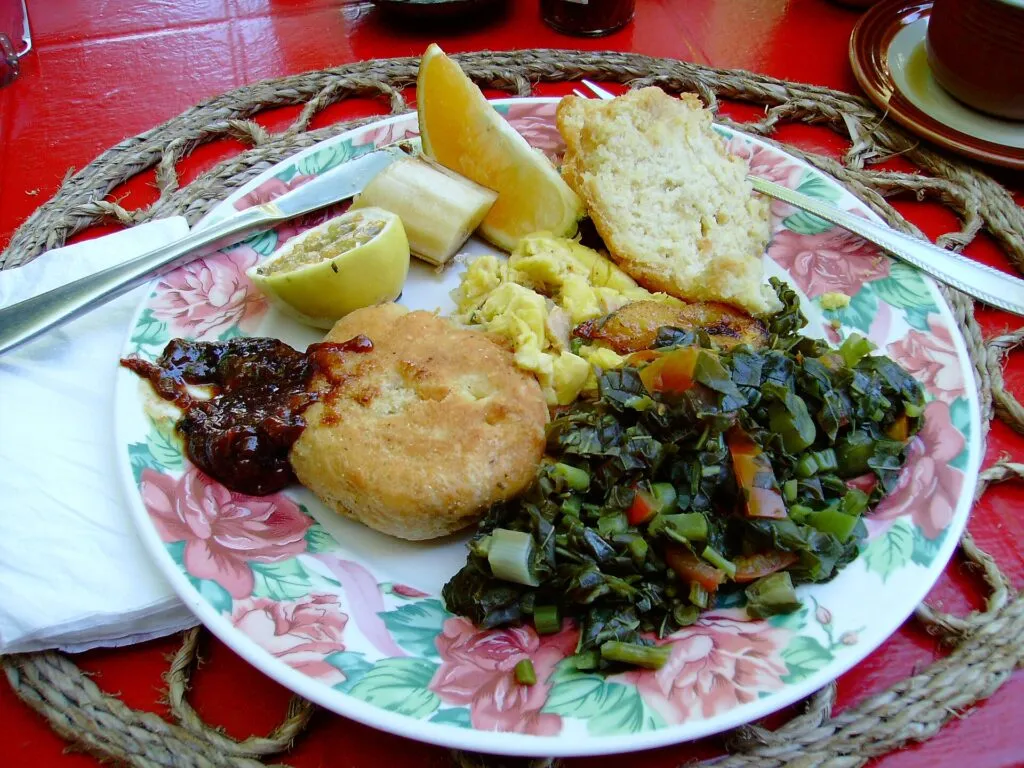
Jamaica’s national dish, ackee and saltfish, is a breakfast: the buttery yellow flesh of the ackee fruit, sautéed with salt cod, onion, tomato and Scotch bonnet pepper, served with fried dumplings, boiled green banana or breadfruit.
Beyond that, Jamaica gave the world jerk, meat rubbed with allspice, Scotch bonnet and thyme and smoked over pimento wood. Chicken jerk is everywhere, but jerk pork is equally common, so check which is on the grill. Also look for curry goat with rice and peas, flaky beef patties sold in bakeries, and escovitch fish, fried fish under a sharp pickled-vegetable dressing.
Read our full guide to Jamaican jerk.
Trinidad and Tobago: The Street Food Capital
Trinidad has some of the best street food in the Caribbean, largely thanks to its Indian heritage. Doubles, two pieces of soft fried bread with curried chickpeas and chutneys, are the island’s favourite breakfast; they were created in the 1930s by a Trinidadian Muslim, Emamool Deen.
Roti shops wrap curried chicken, goat, shrimp or vegetables in soft flatbread. Bake and shark, fried shark in a fried bread with sauces, is the classic at Maracas Bay. Pelau is a one-pot rice dish with meat and pigeon peas, and callaloo, a dasheen-leaf and okra stew, is a Sunday staple.
Read our guide to doubles in Trinidad.
Barbados and the Bahamas: Fish and Conch
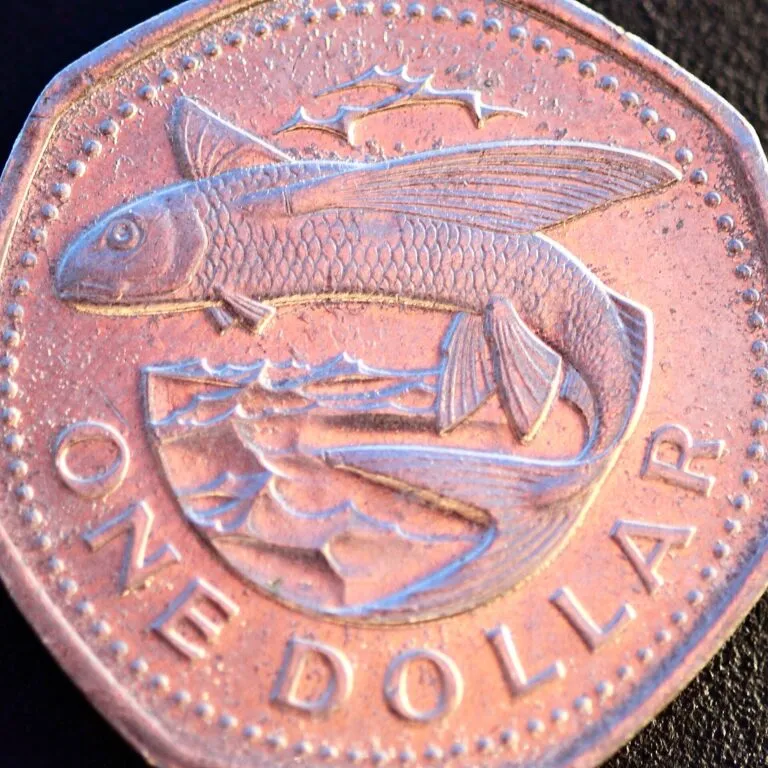
Barbados’s national dish is cou-cou and flying fish, though flying fish has become scarcer since sargassum seaweed arrived in 2011. The Friday night fish fry at Oistins is the island’s great food event. Read our guide to cou-cou and flying fish.
In the Bahamas, everything revolves around conch, a large sea snail eaten raw in conch salad, fried as fritters and cracked conch, and in chowder. Read our guide to Bahamian conch salad.
The Spanish-Speaking Caribbean: Cuba, the Dominican Republic and Puerto Rico
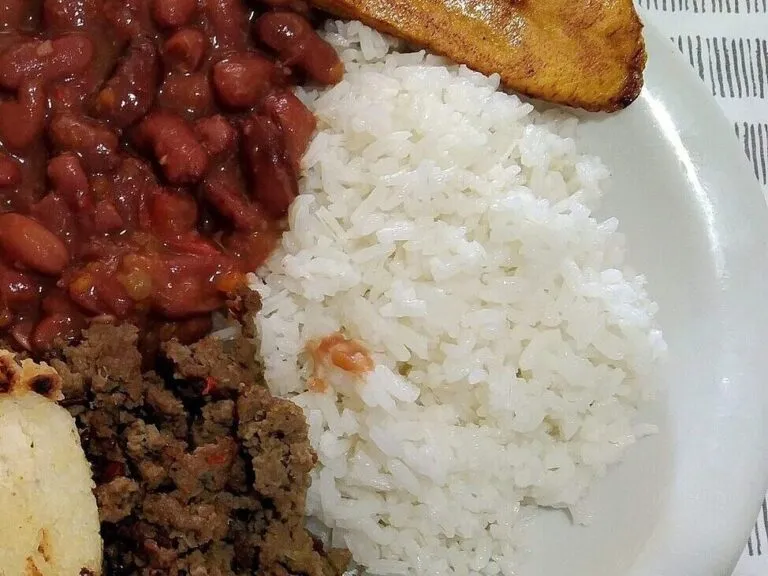
The Hispanic islands share rice and beans, plantain and slow-cooked stews, with strong Spanish and West African roots.
- Cuba: ropa vieja (shredded beef in tomato and pepper sauce), black beans and rice (moros y cristianos), fried plantains and yuca with garlic sauce. Roast pork is the festive centrepiece.
- Dominican Republic: la bandera (rice, red beans and stewed meat) for everyday lunch, mangú (mashed plantain) for breakfast, and sancocho for celebrations. Read our Dominican sancocho guide.
- Puerto Rico: mofongo (fried green plantain mashed with garlic, traditionally with pork crackling), arroz con gandules (rice with pigeon peas, often cooked with pork) and lechón, whole roast pig.
The French and Creole Caribbean: Haiti, Martinique and Guadeloupe
Haiti’s food is bold and deeply flavoured: griot (fried marinated pork) with pikliz, a fiery pickled cabbage, diri ak djon djon (rice cooked black with wild mushrooms) and soup joumou, a pumpkin soup eaten on 1 January to mark Haiti’s independence in 1804.
In Martinique and Guadeloupe, French and Creole cooking meet: accras (salt-cod fritters), colombo (a curry brought by Indian workers), court-bouillon fish stew and boudin créole, a spicy blood sausage made with pork.
The Eastern Caribbean: Grenada, St Lucia, Antigua and More
- Grenada: oil down, breadfruit, dumplings, vegetables and salted meat simmered in coconut milk until the liquid is absorbed. Salted pig tail is common, so ask for a version without it.
- St Lucia: green fig and saltfish, green banana with salt cod, the national dish.
- Antigua and Barbuda: fungee (cornmeal and okra, like cou-cou) with pepperpot, a thick vegetable and meat stew.
- Dominica and St Vincent: roasted breadfruit and fried jackfish, plus callaloo soups and fresh river crayfish.
The Dutch Caribbean: Aruba, Curaçao and Bonaire
The ABC islands mix Dutch, Latin American and Afro-Caribbean cooking. Keshi yená is a hollowed Edam or Gouda cheese stuffed with spiced meat and baked. Look for pastechi (fried pastries filled with cheese, tuna or meat), funchi (cornmeal, like cou-cou) and fresh grilled fish.
Street Food Worth Queuing For
- Doubles in Trinidad: breakfast from a roadside stand, eaten standing up.
- Beef patties in Jamaica: from bakeries, often stuffed into coco bread.
- Bake and shark at Maracas Bay, Trinidad.
- Conch fritters in the Bahamas.
- Flying fish cutters in Barbados: fried flying fish in a salt-bread roll.
- Accras in Martinique and Guadeloupe.
- Pastechi in Curaçao, at breakfast with coffee.
Halal Food in the Caribbean: Where It Is Easy and Where It Is Not
Halal food in the Caribbean varies more than almost anywhere else. A few places have large Muslim communities; most do not.
- Trinidad and Tobago: the easiest. Muslims make up around 5–6% of the population, mostly of Indian descent, especially around Chaguanas and Port of Spain. Many roti shops and some fast-food outlets are halal, and the Darul Uloom of Trinidad and Tobago publishes a halal booklet listing approved outlets. Doubles are vegetarian.
- Guyana and Suriname, on the South American mainland but culturally Caribbean: large Muslim communities (around 6% in Guyana and about 15% in Suriname, the highest share in the Americas), with plenty of halal food.
- Barbados, Jamaica, the Bahamas and the Eastern Caribbean: small Muslim communities, a few halal restaurants and butchers in the capitals. Fish and vegetarian dishes are the easiest options.
- Cuba, the Dominican Republic, Puerto Rico and Haiti: halal food is rare, and pork is central to the cuisine. Plan around seafood, vegetables and beans, and ask about pork fat and stock.
Halal note: pork appears in more Caribbean dishes than visitors expect: jerk pork, lechón, griot, pudding and souse, pig tail in oil down and stews, salt pork in rice dishes, and lard in pastries. Rum goes into black cake, rum cake, sauces and desserts across the islands. Fish, conch, vegetables, roti fillings, doubles and ital (Rastafarian plant-based) food are the safest starting points. Seafood fits the majority view; some Hanafi scholars permit only fish, so check with your own scholar about conch, crab and shrimp. See our halal food travel guide for phrases and tips.
Halal-Friendly All-Inclusive Resorts
This is one of the most common questions Muslim travellers ask about the Caribbean. Fully halal all-inclusive resorts are rare in the region. Some large resorts will arrange halal meat or a dedicated menu on request, especially in Jamaica, the Dominican Republic and Barbados, if you ask in writing before booking. Ask who supplies the meat, whether it is certified, and how it is kept separate in the kitchen.
Vegetarian and Ital Food
The Caribbean is easier for vegetarians than its meat-heavy reputation suggests. Trinidad’s Indian-influenced food is full of vegetarian curries, doubles and dhal. In Jamaica, Rastafarian ital cooking avoids meat, salt and processed food, using vegetables, coconut milk, peas and roots, and ital shops are a great find for both vegetarian and halal-conscious eaters.
How to Eat Well in the Caribbean
- Eat local, not only at the resort. The best food is in roadside shacks, markets, rum-shop kitchens and fish fries.
- Follow the queues at lunchtime; busy stands have the freshest food.
- Respect the pepper. Scotch bonnet and goat peppers are very hot; ask for sauce on the side.
- Check the day. Many national dishes are cooked on particular days, such as cou-cou on Fridays in Barbados and fish fries at weekends.
- Carry small cash. Street food and market stalls rarely take cards.
Which Caribbean Island Has the Best Food?
Ask on any travel forum and you will start an argument. Trinidad is often named for its street food and variety, Jamaica for jerk and bold flavours, Puerto Rico and Haiti for depth and comfort food, and Barbados for its fish fries. For halal-conscious travellers, Trinidad stands out because so much of its everyday food is vegetarian or halal.
What Food Costs in the Caribbean in 2026
| Meal | Typical price |
|---|---|
| Doubles in Trinidad | About TTD 7–12 each |
| Jamaican beef patty | About JMD 300–500 |
| Local lunch plate (rice, beans, stew or fish) | Roughly USD 8–15 across most islands |
| Fish fry plate (Oistins, Arawak Cay) | Roughly USD 15–25 |
| Resort restaurant main course | Often USD 30 or more |
Prices vary widely between islands; the Bahamas, Cayman and the Virgin Islands are much more expensive than Trinidad or the Dominican Republic. Plan your daily budget with our food travel budget calculator.
Frequently Asked Questions
What is the most popular food in the Caribbean?
Rice and peas (or beans) with stewed chicken or fish is the most common everyday meal across many islands. Jerk chicken, roti and patties are the best-known dishes abroad.
What is the difference between Caribbean and Jamaican food?
Jamaican food is one part of Caribbean food. Each island has its own dishes: Jamaica has jerk and ackee, Trinidad has doubles and roti, Barbados has cou-cou and flying fish, and the Spanish-speaking islands have their own traditions.
What is ackee?
Ackee is a tropical fruit originally from West Africa, eaten in Jamaica. When ripe and properly prepared, its flesh is soft and buttery, a little like scrambled egg. Unripe ackee is toxic, so it should only be bought from reliable sellers or eaten in restaurants.
Is Caribbean food spicy?
Some of it is very spicy, especially dishes with Scotch bonnet or goat peppers, but many dishes are mild and the heat is often served on the side as pepper sauce.
What is ital food?
Ital is the plant-based cooking of the Rastafarian movement in Jamaica, avoiding meat, processed food and often salt. It uses vegetables, roots, peas, grains and coconut milk.
What is the difference between rice and peas and rice and beans?
In Jamaica and much of the English-speaking Caribbean, “rice and peas” means rice cooked with kidney beans or pigeon peas in coconut milk. In the Spanish-speaking islands, the equivalent is rice and beans, cooked in many regional styles.
What is callaloo?
Callaloo is a leafy green dish, made with amaranth in Jamaica and with dasheen (taro) leaves and okra in Trinidad. It can be a side dish or a thick soup, sometimes with crab.
Can you drink tap water in the Caribbean?
It depends on the island. Tap water is generally treated in places such as Barbados, the Bahamas and the Cayman Islands, while bottled water is advised in others, including Haiti and parts of the Dominican Republic. Check local advice for each island.
Is street food safe in the Caribbean?
Generally yes, at busy stands where food is cooked fresh in front of you. Be more careful with raw seafood and with food that has been sitting out in the heat.
Where can I find Caribbean food outside the Caribbean?
Large Caribbean communities have brought their food to London, Birmingham, Toronto, New York, Miami and Amsterdam. Toronto and New York have many halal roti and doubles shops run by Trinidadian and Guyanese Muslims.
What should I try on my first day?
Whatever the island is proudest of: doubles in Trinidad, ackee and saltfish or jerk in Jamaica, a fish fry in Barbados, conch salad in the Bahamas, and mofongo or a plate of rice and beans in the Spanish-speaking islands.
Is Caribbean food healthy?
Much of it is: fresh fish, vegetables, roots, beans and fruit. Fried street food, salt meats and sweet desserts are richer, so balance them with grilled fish and fresh produce.
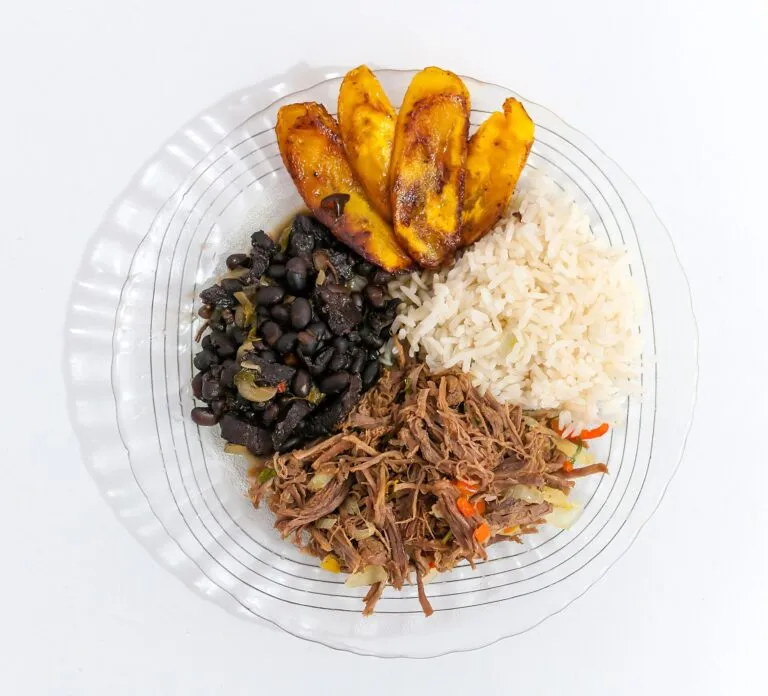
Explore more: all Latin America and Caribbean food guides, churros in Latin America and Venezuela’s arepas and pabellón.
Sources
- Halaal booklet, Darul Uloom Trinidad and Tobago (approved halal outlets)
- Muslim populations in the Americas, WorldAtlas (Suriname, Guyana, Trinidad)
- Muslims in the Caribbean, Exceptional Caribbean (doubles and Emamool Deen)
- The national dishes of the Caribbean, Exceptional Villas