At nine in the morning in La Paz, the queue outside a salteñería moves fast. People walk out with paper bags and a stack of napkins, bite off one corner, sip, and carry on down the street without spilling a drop.
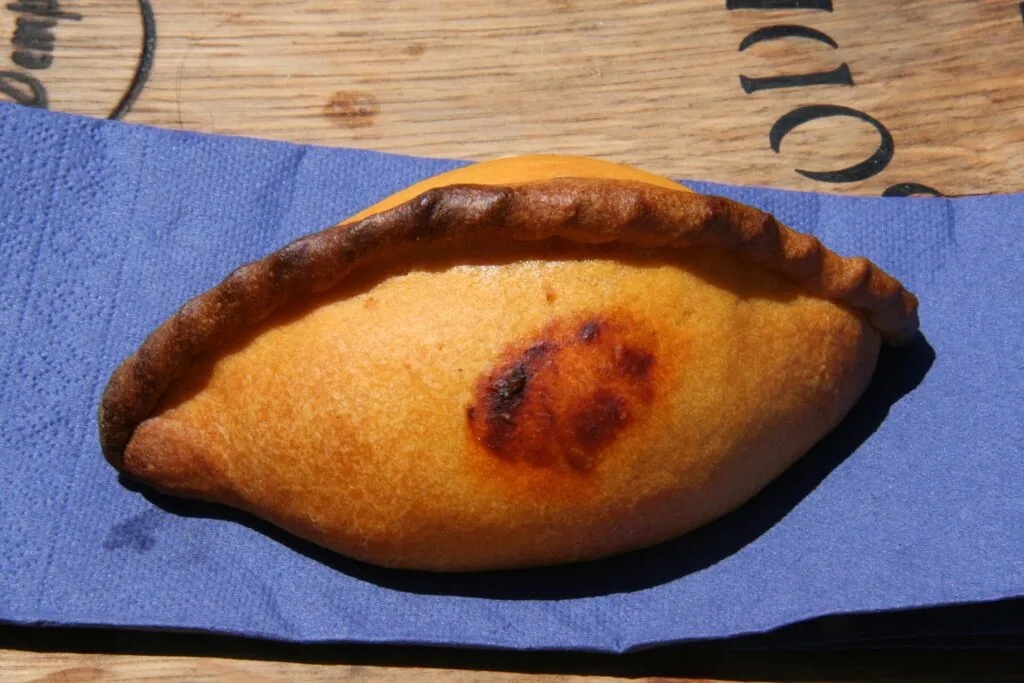
A salteña is Bolivia’s mid-morning pastry: a sweet, golden, baked crust around a stew of beef or chicken, potato, peas, olive and egg that turns into hot broth in the oven. Bakeries and street stands sell them from early morning until about noon in every Bolivian city. In 2026 one costs roughly BOB 6–15.
For Muslim travellers the short answer is caution. The meat is not halal-slaughtered, the filling is set with gelatin of unknown origin, and the dough is often made with manteca, a fat that can be lard or vegetable shortening. This guide explains why, how salteñas are eaten, where locals buy them, and what to eat instead.
What is inside a salteña
The filling is called jigote. It is diced beef or chicken simmered with onion, ají (Bolivian chilli), cumin, oregano, a little sugar, potato and peas, so it tastes sweet, savoury and mildly hot at once.
Each salteña usually hides a slice of hard-boiled egg and a black olive. Some kitchens add a raisin.
The crust is firmer and sweeter than most empanada dough. Its orange colour comes from achiote (annatto, called urucú in eastern Bolivia), which is warmed in the fat before the fat goes into the flour.
Beef (carne) and chicken (pollo) are the standard choices at almost every shop. Pork versions exist in some regions. Spice is labelled simply: picante or no picante.
Salteña Fillings and Styles on the Menu
Most salteñerías sell only two or three kinds, written on a board above the counter. Knowing the words saves you holding up a fast-moving queue.
| On the board | What you get |
|---|---|
| De pollo | Chicken filling, usually the mildest and juiciest |
| De carne | Beef filling, firmer and more strongly spiced |
| Picante | Extra ají (Bolivian chilli) in the stew |
| Dulce or no picante | Mild, slightly sweeter filling |
| Vegetariana | Vegetables and sometimes cheese, at some shops in bigger cities |
| De queso | Cheese filling, offered by a few shops |
Sizes vary too. Some shops make a large salteña that is a meal on its own; others sell smaller ones that people buy two at a time. Spice levels are not standard either, so a picante in one shop can be mild in the next.
Regional character comes through in small details: some cities make the filling sweeter, others put more potato in it or use more cumin. Locals are loyal to their own city’s style and will happily tell you theirs is the best.
Why the inside is liquid: how salteñas are made
The broth inside is a cooking trick, not a sauce poured in afterwards.
- The jigote is cooked with plenty of stock, usually the day before.
- Gelatin is stirred in and the stew is chilled overnight until it sets firm.
- Cold spoonfuls of filling go onto rounds of sweet dough with the egg and olive.
- The dough is folded and the seam is crimped along the top into a rope-like braid called the repulgue.
- The salteñas bake at high heat. The crust sets before the gelatin melts back into broth.
The gelatin is what makes the dish possible: without it, a liquid stew could not be wrapped. Almost every salteña contains it, and a stall worker rarely knows whether the gelatin came from pork or beef.
How to eat a salteña without wearing it
Hold the salteña upright with the braid on top, like a small boat. Never lay it flat, or the broth runs out of the far end.
- Bite a small hole in one top corner.
- Let the steam out for a moment, then sip some broth.
- Eat downwards, turning the pastry and sipping as the level drops.
- Finish the loose filling with a teaspoon. Many shops hand you one.
Lean forward over the plate. Bolivians judge the technique by one result: no broth on your hands or shirt.
How to Spot a Good Salteña
You do not need to be Bolivian to judge one. Look for these signs before and after the first bite:
- The crust is dry and firm outside. A greasy or soft crust usually means the filling has leaked or the salteña has sat too long.
- The braid is intact. A cracked seam means the broth may have escaped in the oven.
- It feels heavy for its size. A light salteña has little broth left inside.
- It is warm, not hot enough to burn. Salteñas fresh from the oven need a minute or two before the first bite.
- The shop is busy before 10 am. A queue of office workers and students is the most reliable review.
Late in the morning, when trays are nearly empty, the remaining salteñas have usually lost some of their broth. Earlier is better.
When and where Bolivians buy them
Timing matters more than the shop. Salteñas are baked in one morning batch, sold from about 7 am, busiest between 9 and 11 am, and popular shops are often sold out before noon. In the afternoon the shutters are down, and the fried tucumana takes over.
| City | What locals say about its salteñas |
|---|---|
| La Paz | Salteñerías all over Sopocachi, Miraflores and the southern zone; Paceña La Salteña is the best-known name. |
| Cochabamba | Often called the best in the country, generous and well spiced; Los Castores has made them since 1989. |
| Sucre | Known for a sweeter dough and filling; broth empanadas appear in a 1917 Sucre recipe book. |
| Potosí | Calls itself the cradle of the salteña, and many travellers make a point of trying the local version. |
| Santa Cruz | Same morning habit in the lowlands, with more chicken and vegetarian choices. |
Shop names here are for orientation only. None of them is halal-certified.
Halal note: treat salteñas as not halal unless a shop can clearly show otherwise. Three things are usually a problem: the meat is not halal-slaughtered, the filling is set with gelatin that may come from pork, and the dough is often made with manteca, which can be lard. Vegetarian salteñas (salteñas vegetarianas), sold at some shops in La Paz and Santa Cruz, remove the meat but not necessarily the gelatin or lard, so ask about both. Bolivia’s Muslim community is small and halal-certified food is hard to find, so plan your meals around fish, vegetables and dishes you can check. Our halal food travel guide covers how to ask and what to pack.
Halal-friendly things to eat in Bolivia instead
You can still enjoy a Bolivian morning without the salteña. These are common, widely available and easier to check:
- Trucha (trout) from Lake Titicaca, fried or grilled, is the classic lunch in Copacabana and is easy to find in La Paz. Ask for it cooked in oil (aceite).
- Cuñapé, small cheese buns made with cassava starch, are the snack of Santa Cruz and the eastern lowlands. They contain no meat.
- Api, a thick, hot purple-corn drink spiced with cinnamon and clove, is the traditional cold-morning drink on the altiplano. It is often served with a fried cheese pastel; ask what fat the pastry is fried in.
- Choclo con queso, large-kernel Andean corn with fresh cheese, is sold at markets and roadside stalls.
Salteña, tucumana or empanada?
All three are stuffed pastries, but Bolivians treat them as different foods eaten at different times.
| Pastry | Cooked | Filling | When |
|---|---|---|---|
| Salteña | Baked | Juicy meat stew with broth | Morning, until noon |
| Tucumana | Fried | Similar stew, thicker and less soupy | Afternoon |
| Empanada de queso | Baked or fried | Cheese | Any time |
Across the border the empanada takes many other forms; see our guide to empanadas across South America. For another sweet-and-savoury dish from the region, read about pastel de choclo in Chile.
Where the name comes from
The popular story credits Juana Manuela Gorriti, a writer from Salta in Argentina who lived in exile in Bolivia in the 19th century. People supposedly asked for empanadas from la salteña, the woman from Salta, and the name stuck.
Historians point out that the story has no documentary basis. The older paper trail leads to Potosí, where a 1776 recipe book kept by Doña Josepha de Escurrechea, described as the only colonial recipe book found in Bolivia, already includes empanadas. Later Bolivian cookbooks record broth empanadas spiced with ají, the dish that became the salteña.
What salteñas cost in 2026
| Where | Typical price per salteña |
|---|---|
| Street stand or market | About BOB 6–10 |
| Well-known salteñería | About BOB 10–15 |
Prices rise a little each year and vary by city, so treat these as a guide. Two salteñas make a full breakfast for most people.
Spanish phrases at the counter
| Say | Meaning |
|---|---|
| Una salteña de pollo, por favor | A chicken salteña, please |
| ¿Es picante? | Is it spicy? |
| ¿La masa tiene manteca de cerdo? | Is the dough made with lard? |
| ¿Tiene gelatina? ¿De qué es? | Does it contain gelatin? What is it made from? |
| ¿Hay salteñas vegetarianas? | Are there vegetarian salteñas? |
| No como cerdo. ¿Es halal? | I don’t eat pork. Is it halal? |
Frequently asked questions
What does salteña mean?
Salteña means a woman from Salta, a province of northern Argentina. The name comes from a popular story about an Argentine exile who sold the pastries in Bolivia.
Are salteñas halal?
Usually not. The meat is not halal-slaughtered, the filling contains gelatin that may come from pork, and the dough may be made with lard. Ask carefully even about vegetarian salteñas.
Are there vegetarian salteñas?
Yes, some shops in La Paz and Santa Cruz sell vegetable and cheese salteñas. They are still not guaranteed halal, because of the gelatin and the fat in the dough.
Is Argentina’s empanada salteña the same as a Bolivian salteña?
No. In Argentina, an empanada salteña is the empanada style of Salta province: smaller, with a firmer filling and no broth to sip. The Bolivian salteña is larger, sweeter and much juicier, and Bolivians are quick to point out the difference.
Why are salteñas sweet?
Sugar goes into both the dough and the filling. Bolivian cooking often balances sweet and spicy, and the sweet crust against the hot, savoury broth is the whole point of a salteña. Sucre’s version is known for being the sweetest.
Are salteñas spicy?
Mildly, unless you ask for heat. Shops sell them picante (spicy, with more ají) or no picante (mild, sometimes labelled dulce). If you are unsure, ask “¿Es picante?” before you order.
What do Bolivians drink with salteñas?
Usually a soft drink, fresh fruit juice or coffee. On cold mornings in the highlands, some people pair breakfast pastries with api, a hot purple-corn drink.
Can you reheat salteñas?
They are best eaten fresh, the same morning. If you have to reheat one, a moderate oven works better than a microwave, which softens the crust and can make the filling burst.
Can you buy salteñas outside Bolivia?
Yes. Bolivian bakeries make them in cities with large Bolivian communities, such as Buenos Aires, São Paulo and the Washington DC area. Quality varies, so look for places busy with Bolivian customers.
Are salteñas gluten-free?
No. The crust is made with wheat flour. People who avoid gluten should choose cassava-based snacks such as cuñapé instead.
More from the region: Latin America and Caribbean food guides and alfajores across South America.