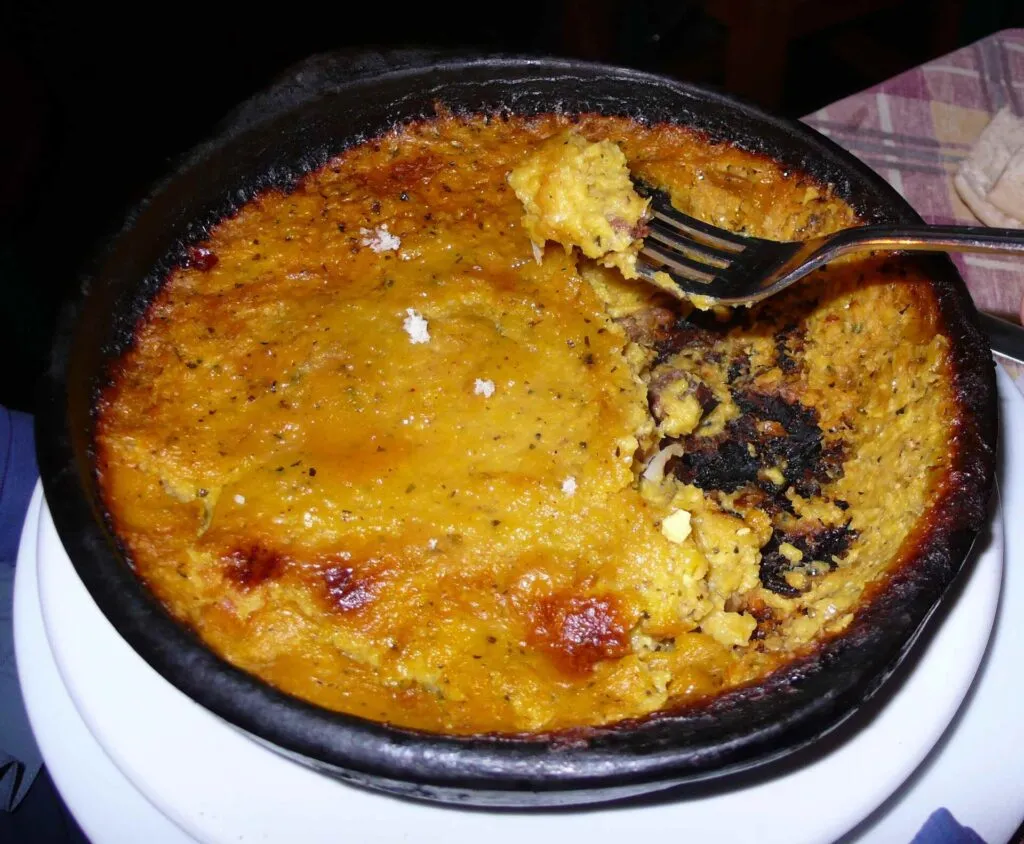
It arrives in a brown clay bowl, still bubbling at the edges, with a crust of caramelised sugar on top. Push a spoon through the sweet corn and you hit a layer of spiced beef, a piece of chicken, half an egg, a black olive and a few raisins.
Pastel de choclo is Chile’s corn and beef pie: a savoury filling called pino under a thick layer of puréed fresh corn and basil, baked until golden. It is a summer lunch dish, best from December to March when fresh corn is in season, and in 2026 a portion costs roughly CLP 7,000–13,000 at a traditional Santiago restaurant.
For Muslim travellers, the dish itself contains no pork or alcohol in its usual form, but the beef and chicken at ordinary Chilean restaurants are not halal-slaughtered, and some cooks still add lard to the corn. This guide covers what is inside, how it is made, where locals eat it, and halal-friendly dishes to order instead.
What is inside a pastel de choclo
Every layer has a job, and Chileans notice when one is missing.
| Layer | What it is | Halal check |
|---|---|---|
| Pino (base) | Minced beef fried with lots of onion, cumin, paprika and a little chilli | Beef not halal-slaughtered at ordinary restaurants |
| Hidden extras | A piece of chicken, hard-boiled egg, a black olive, raisins | Chicken not halal-slaughtered at ordinary restaurants |
| Pastelera (top) | Fresh corn ground with basil, cooked with milk and butter or lard | Ask whether lard (manteca) is used |
| Finish | A sprinkle of sugar, caramelised in the oven | Fine |
The pino is the same filling used in Chile’s baked empanadas de pino. The corn topping is called pastelera, and it is what makes the dish: thick, sweet and fragrant with basil.
The sugar on top: sweet or not?
Most Chileans sprinkle sugar over the corn before baking, which turns the top into a thin, crackly caramel. The fresh corn is already sweet, so some cooks leave it off, and some diners add more at the table.
This is one of the most argued-over details of the dish. If you dislike sweet and savoury together, ask for it without sugar (sin azúcar); many traditional restaurants will still put a sugar bowl on the table for those who want it.
How pastel de choclo is made
- Onions are cooked slowly with minced beef, cumin, paprika and salt until soft and juicy. This is the pino.
- The pino goes into individual clay bowls (pailas de greda) or one large dish.
- A piece of cooked chicken, egg, olives and raisins are pressed into the meat.
- Fresh corn is ground with basil and cooked with milk and fat into a thick paste.
- The corn is spread over the filling, dusted with sugar and baked at high heat until the top browns.
Chileans prefer choclo humero, a starchy local corn sold from mid-December to early March. Outside that window, many places use frozen corn or take the dish off the menu, which is why it is thought of as summer food.
When and how Chileans eat it
Pastel de choclo is a main course for lunch, the big meal of the Chilean day, often on weekends and at family gatherings. It is heavy, so a portion is usually the whole meal.
The standard side is ensalada chilena: sliced tomato and onion with a little oil and salt, sometimes coriander. The fresh, sharp salad cuts through the sweet corn.
Eat it with a spoon or fork straight from the clay bowl, and let it rest a few minutes first. The filling stays very hot long after the top looks ready.
Where to eat it in Santiago
Forum questions from travellers usually ask the same thing: where do locals go, rather than tourist restaurants? The answer is the traditional, no-frills places Chileans call picadas and fuentes de soda, which serve home-style lunches at fair prices.
- Bellavista and Providencia: long-running traditional restaurants such as Galindo and Juan y Medio come up again and again in local recommendations.
- Barrio Franklin and the city centre: older, cheaper lunch places with set menus.
- Mercado Central and La Vega Central: market stalls for humitas and other corn dishes in season.
None of these is halal-certified; the names are for orientation only. Many places serve pastel de choclo only in summer, so check before you go if you visit between April and November.
Halal note: pastel de choclo contains no pork or alcohol in its usual form, but the beef and chicken served at ordinary restaurants in Chile are not halal-slaughtered, and some cooks use lard (manteca) in the corn topping. Chile’s Muslim community is small. In Santiago, Middle Eastern restaurants, many of them around the Patronato area, are the usual place to look for halal meat, but ask each one, because Arab-run does not always mean halal. Vegetarian versions without meat exist at some modern restaurants; ask what fat is used. See our halal food travel guide for how to ask.
Halal-friendly Chilean dishes to try instead
Several of Chile’s best-loved dishes need no meat at all, and the country’s seafood is excellent:
- Pastel de jaiba (crab pie): crab baked with bread, milk and cheese in a clay bowl, the seafood cousin of pastel de choclo. Some cooks add white wine, so ask for it without (sin vino).
- Humitas: the same basil-scented corn paste, wrapped in corn husks and steamed. Ask whether they are made with lard.
- Porotos granados: a summer stew of fresh beans, squash and corn, usually meat-free.
- Congrio frito: fried conger eel, a classic in Chilean fish restaurants and at Santiago’s Mercado Central.
- Empanadas de queso: fried cheese empanadas sold everywhere. Ask what the dough and frying fat are.
Seafood fits the Hanafi position on fish easily. For crab and shellfish, note that some Hanafi scholars permit only fish; check with your own scholar.
Pastel de choclo in other countries
Chile treats it as a national dish, but corn pies are eaten across South America, including Peru, Bolivia and Argentina. Versions differ: some are made as a corn cake with cheese inside, others as layered casseroles.
An early Chilean description, in Claudio Gay’s 1862 history of Chilean agriculture, describes minced lamb under ground corn seasoned with sugar, fat and chilli, so the sweet-and-savoury idea is old. For Bolivia’s own sweet-savoury pastry, see our guide to salteñas, and for the pino filling in pastry form, read empanadas across South America.
What it costs in 2026
| Where | Typical price |
|---|---|
| Traditional picada or fuente de soda | About CLP 7,000–10,000 |
| Well-known traditional restaurant | About CLP 10,000–13,000 |
| Set lunch (menú del día) that includes it | About CLP 6,000–10,000 |
Plan the rest of your food spending with our food budget calculator for Chile, and check service customs in the tipping guide for Chile: a 10% tip is usually suggested on the bill.
Spanish phrases for ordering
| Say | Meaning |
|---|---|
| Un pastel de choclo, por favor | One pastel de choclo, please |
| Sin azúcar, por favor | Without sugar, please |
| ¿Tiene manteca de cerdo? | Does it contain lard? |
| ¿La carne es halal? | Is the meat halal? |
| ¿Hay pastel de choclo vegetariano? | Is there a vegetarian pastel de choclo? |
| Con ensalada chilena | With a Chilean salad |
Frequently asked questions
What does pastel de choclo mean?
It means corn pie or corn cake. Choclo is the Andean word for fresh corn, from Quechua, and pastel means pie or cake.
What is Chile’s national dish?
Chile has no official national dish. Empanadas de pino, pastel de choclo and cazuela, a meat and vegetable soup, are the dishes Chileans most often name.
Is pastel de choclo halal?
Not usually. It contains no pork or alcohol, but the beef and chicken at ordinary Chilean restaurants are not halal-slaughtered, and the corn topping may be made with lard. Look for halal-certified places or vegetarian versions, and ask about the fat.
What is the difference between pastel de choclo and humitas?
Both use the same basil-scented corn paste. Pastel de choclo bakes it over a meat filling in a dish; humitas wrap it in corn husks and steam it, usually without meat.
When is pastel de choclo season?
Summer, from about mid-December to early March, when fresh choclo humero is in the markets. Some restaurants serve it all year with frozen corn.
Is pastel de choclo like shepherd’s pie?
In shape, yes: a meat filling under a soft topping, baked. The taste is different, because the corn topping is sweet and the filling hides egg, olives and raisins.
Is pastel de choclo healthy?
It is filling rather than light. Corn, beef and sugar make it rich in calories and carbohydrates, so most people eat one portion as a full meal with a salad.
Can pastel de choclo be made with frozen corn?
Yes, and many restaurants do so outside the summer. Frozen corn gives a looser, sweeter topping than fresh choclo humero, so cooks often add a little extra flour or cornstarch to firm it up.
Is there a vegetarian pastel de choclo?
Some modern restaurants in Santiago make one with a vegetable, mushroom or soy filling under the corn. It is not common in traditional places, so ask before you go.
Is pastel de choclo spicy?
No. The pino is seasoned with cumin and paprika, and sometimes a little chilli, but the dish is mild and slightly sweet. Chileans add pebre, a fresh chilli and coriander salsa, at the table if they want heat.
What do Chileans drink with pastel de choclo?
In summer, many order mote con huesillo, a cold, sweet drink of dried peaches and husked wheat, or a fresh fruit juice. Both are sold widely when pastel de choclo is in season.
More guides from the region: Latin America and Caribbean food.
Sources
- Pastel de choclo, Wikipedia (preparation, Claudio Gay 1862)
- Chilean corn pie, Chilean Food & Garden (choclo humero season)
- Ruta del pastel de choclo, The Clinic (Santiago restaurant prices)