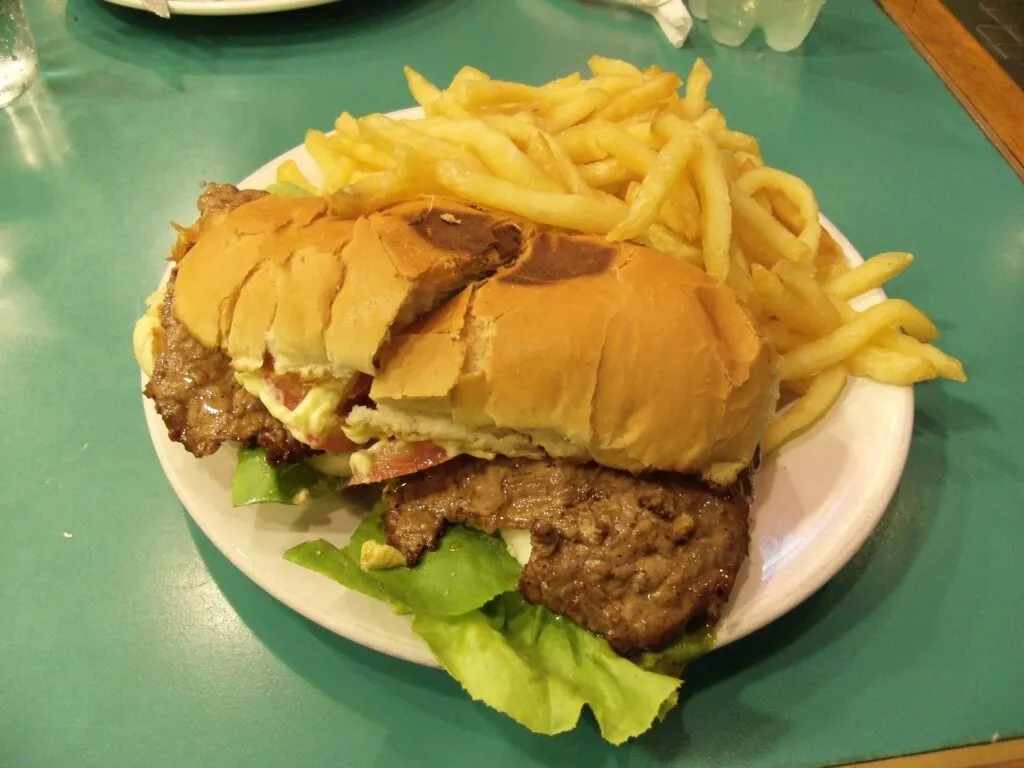
The plate lands with a thud: a soft bun stacked so high it needs a toothpick, a pile of chips on the side, and often a spoonful of potato salad too. This is the chivito, and in Uruguay it is a meal, not a snack.
A chivito is Uruguay’s national steak sandwich: thin, tender beef steak with mozzarella, ham, tomato, lettuce, mayonnaise and olives, and usually bacon and egg as well. You find it in every bar, grill and café in Montevideo, Punta del Este and Colonia del Sacramento. In 2026 a full chivito costs roughly UYU 550–850, more as a plated version.
Muslim travellers need to know this up front: the standard chivito contains ham and usually bacon, so it is not halal. This guide explains what is in it, its variations, how to order one without pork, and what to eat in Uruguay instead.
What goes into a chivito
The steak is the base: a thin slice of beef fillet (lomo) or churrasco, cooked fast on a hot plate. The rest is layered on top, and every bar has its own order.
| Ingredient | Always or sometimes | Halal check |
|---|---|---|
| Beef steak (lomo or churrasco) | Always | Not halal-slaughtered at ordinary places |
| Mozzarella, tomato, lettuce, mayonnaise | Always | Usually fine |
| Ham (jamón) | Almost always | Pork: not halal |
| Bacon (panceta) | Usually | Pork: not halal |
| Egg (fried or boiled), olives, red pepper | Usually | Fine |
| Chips or potato salad (ensalada rusa) | On the side | Ask what oil the chips are fried in |
The pork is not a garnish. Ham and bacon are part of what Uruguayans expect, and they are often cooked on the same hot plate as the steak.
Why is it called chivito if there is no goat?
Chivito means young goat, and there is no goat in it at all. The popular story says that in the 1940s, at a restaurant called El Mejillón in Punta del Este, an Argentine customer asked for chivito, the roast kid she knew from home. The kitchen had none, served her a beef sandwich instead, and the name stuck.
Accounts disagree on the year and on the name of the cook, so treat the details as legend. What is certain is that the sandwich spread from the beach resort to the whole country.
The main types of chivito
Menus in Uruguay list several versions, and travellers often ask what the difference is.
- Chivito al pan: the classic sandwich in a bun, served with chips.
- Chivito al plato: the same ingredients served open on a plate with no bun, usually with chips and salads. It is the biggest version.
- Chivito canadiense: a fuller version with extra pork, such as more bacon. Avoid it entirely if you do not eat pork.
- Chivito de pollo: chicken breast instead of beef, offered at some places. It still comes with ham and bacon unless you ask.
- Chivito vegetariano: some modern places in Montevideo offer meat-free versions.
Can you order a chivito without pork?
You can ask, but it is not a reliable halal option. Saying sin jamón y sin panceta (without ham and without bacon) removes the pork you can see, but the steak is not halal-slaughtered, and the meat often shares a hot plate with the ham and bacon.
If you avoid pork but are relaxed about non-halal beef, ask for no ham and no bacon and say why, so the cook takes it seriously. If you eat only halal meat, skip the chivito and look at the alternatives below.
Halal note: the usual chivito is not halal. It contains ham and usually bacon, the beef is not halal-slaughtered, and everything is often cooked on one shared grill. Uruguay has a very small Muslim community and halal-certified restaurants are rare, so ask locally and check before you rely on any place. Seafood, cheese and vegetable dishes are your easiest options. Our halal food travel guide explains how to ask and what to look for.
What to eat in Uruguay instead
Uruguay is a beef country, but these local favourites need no meat at all:
- Fainá: a thin chickpea-flour flatbread sold in pizzerias, often eaten on top of a slice of pizza (pizza a caballo). It is made from chickpea flour, water, oil and salt.
- Pizza de muzzarella: Montevideo’s thick, cheesy pizza, a staple of every neighbourhood pizzeria. Choose cheese-only toppings.
- Fish and seafood: fried or grilled fish at coastal restaurants in Montevideo and Punta del Este, and seaweed fritters (buñuelos de algas) on the Rocha coast. Some Hanafi scholars permit only fish; check with your own scholar about shellfish.
- Dulce de leche: the caramel spread found in pastries, biscuits and alfajores everywhere.
For more on the caramel spread shared across the River Plate, read our guide to dulce de leche. Tortas fritas, the fried dough sold on rainy days, are often fried in beef or pork fat, so ask before you buy.
Where Uruguayans eat chivitos
Travellers on forums ask where to find the best chivito, and the honest answer is that locals argue about it endlessly. The sandwich is served almost everywhere:
- Bars and cafés in central Montevideo, especially along and around Avenida 18 de Julio.
- Grill restaurants (parrillas), including those around the Mercado del Puerto in the old town.
- Beach restaurants in Punta del Este, the sandwich’s birthplace, busiest in the January summer season.
- Food carts and sandwich bars, the cheapest option, often open late.
None of these is halal-certified, and Mercado del Puerto is a meat grill hall, so it is better visited for the atmosphere than for halal food.
What a chivito costs in 2026
| Version | Typical price |
|---|---|
| Chivito al pan with chips, bar or cart | About UYU 550–850 |
| Chivito al plato, restaurant | About UYU 700–1,200 |
| Fainá slice at a pizzeria | Much cheaper, a fraction of a chivito |
Uruguay is one of South America’s more expensive countries, and some restaurants add a cover charge (cubierto) for bread. Check the menu before you sit down.
Spanish phrases for ordering
| Say | Meaning |
|---|---|
| Un chivito al pan, por favor | A chivito sandwich, please |
| Sin jamón y sin panceta | Without ham and without bacon |
| No como cerdo | I don’t eat pork |
| ¿Lo cocinan en la misma plancha que el cerdo? | Do you cook it on the same hot plate as the pork? |
| ¿Hay chivito vegetariano? | Is there a vegetarian chivito? |
| Una porción de fainá | A slice of fainá |
Frequently asked questions
Is a chivito halal?
No. The standard chivito contains ham and usually bacon, the steak is not halal-slaughtered, and it is often cooked on a grill shared with pork.
Is the chivito Uruguayan or Argentine?
The chivito sandwich is Uruguayan and is considered the country’s national dish. In Argentina, chivito usually means roast kid goat, a different food altogether.
Can I get a vegetarian chivito?
Some modern cafés and sandwich bars in Montevideo offer vegetarian chivitos. Traditional bars rarely do, so ask before you order.
What do Uruguayans eat with a chivito?
Chips are the standard side, often with Russian potato salad (ensalada rusa). Most people drink a soft drink with it.
How do you eat a chivito?
A chivito al pan is usually cut in half and held together with toothpicks; most people eat it with their hands and a lot of napkins. A chivito al plato is eaten with a knife and fork.
Can one person finish a chivito?
A hungry person can, but it is a full meal with chips on the side. Many people share a chivito al plato between two, especially at restaurants where portions are large.
Is a chivito the same as an Argentine lomito?
They are close relatives. The Argentine lomito is also a steak sandwich that often comes with ham, cheese and egg, but the chivito is usually more loaded and is treated as a national symbol in Uruguay.
What sauce goes on a chivito?
Mayonnaise is standard, and many places add mustard or let you add it yourself. Some diners add hot sauce or chimichurri at the table.
When do Uruguayans eat chivitos?
At lunch, at dinner and late at night. Dinner in Uruguay is often eaten late, around 9 or 10 pm, and chivito bars stay busy after football matches and nights out.
Is a chivito healthy?
It is a heavy meal: steak, cheese, eggs, mayonnaise and chips add up to a lot of calories. Ordering it without chips or sharing a plated version makes it lighter.
More from the region: Latin America and Caribbean food guides, empanadas across South America and Chile’s pastel de choclo.
Sources
- Chivito (sandwich), Wikipedia (ingredients, El Mejillón origin story, al plato)
- The art of the chivito sandwich, Explore Parts Unknown (origin story)
- Food prices in Montevideo, Quanto Custa Viajar (chivito prices)