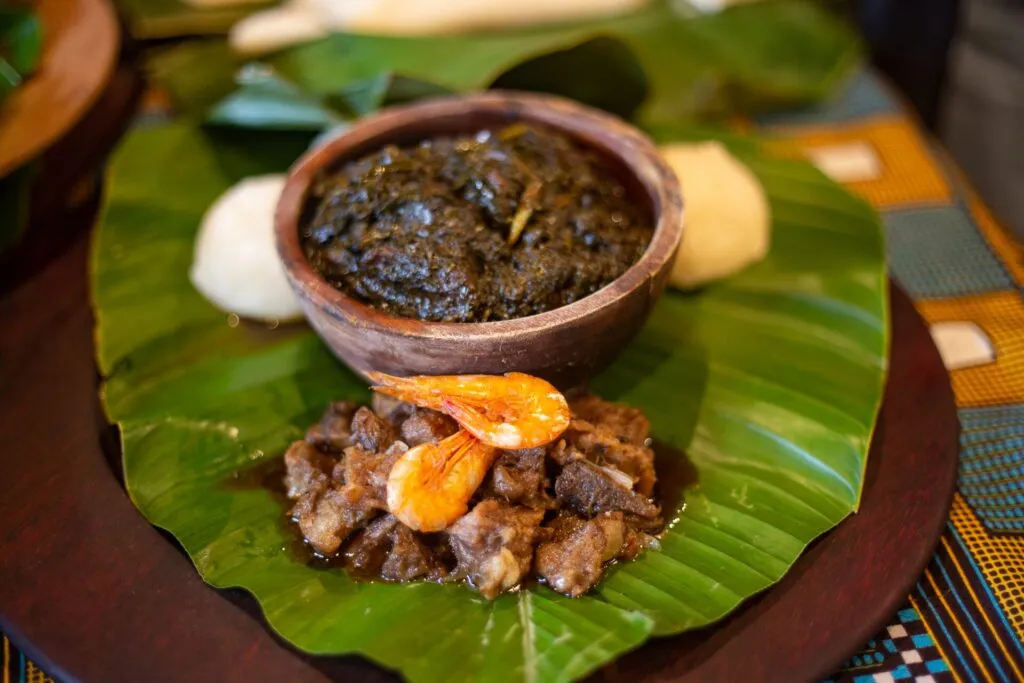
At Kinshasa’s Gambela market, a vendor sits behind a mountain of dark-green threads: wild leaves shredded so finely they look like grass clippings. At home, they will be simmered for hours with peanut paste, palm oil and smoked fish into a thick, savoury stew, and eaten with a white ball of fufu.
Fumbwa is a Congolese stew of finely shredded wild Gnetum africanum leaves cooked with peanut paste, palm or vegetable oil, onion, tomato and smoked fish or chicken. It is a family favourite across the Democratic Republic of the Congo and the Republic of the Congo, and the same leaves are eaten as eru in Cameroon, okok in Cameroon and koko in Gabon. In 2025 Congo’s national news agency described it as a culinary treasure and a living memory of the country.
This guide explains what fumbwa is, how it is made and eaten, its relatives across Central Africa, where to find it, and dietary and halal notes.
What Is Fumbwa?
Gnetum africanum is a wild forest vine of Central Africa whose glossy leaves are tough and chewy. Cooks roll them tightly and slice them into very fine threads, then cook them slowly until tender. The result is earthy and slightly bitter, enriched by peanuts and smoked fish.
How Fumbwa Is Made
- The dried or fresh leaves are shredded very finely, then washed and soaked if dried.
- Onion, garlic and tomato are softened in palm or vegetable oil.
- Peanut paste is stirred in with water to make a creamy sauce.
- The leaves go in and simmer, often for an hour or more, until tender.
- Smoked fish, salted fish or chicken is added, and the stew is seasoned and finished with a little chilli.
What Fumbwa Is Served With
- Fufu (foufou): a smooth paste of cassava or maize flour, the classic partner.
- Kwanga (chikwangue): fermented cassava bread wrapped in leaves.
- Rice or boiled plantain.
Fumbwa’s Relatives
| Country | Name | How it is cooked |
|---|---|---|
| DR Congo and Republic of the Congo | Fumbwa | With peanut paste, palm oil and smoked fish |
| Cameroon | Eru, okok | Eru with waterleaf and palm oil; okok often with peanuts or cassava |
| Gabon | Koko | With peanut paste or palm nut |
| Nigeria | Okazi or afang | In soups with meat and fish |
Gnetum leaves are harvested mostly from the wild, and conservation groups have raised concerns about over-harvesting in parts of Central Africa; cultivated leaves are becoming more common.
Where to Eat Fumbwa
- Kinshasa: home kitchens, small restaurants (malewa) and markets such as Gambela, where the shredded leaves are sold.
- Brazzaville: local restaurants serving Congolese family dishes.
- Abroad: Congolese restaurants in Brussels (especially Matonge), Paris, London and Montreal, and African grocers selling dried leaves.
Dietary and Halal Notes
Halal note: fumbwa is usually made with fish or chicken and contains no alcohol; the leaves, peanuts and oil are all halal. The Congos are mainly Christian, so chicken at ordinary restaurants is not necessarily halal-slaughtered, while smoked and salted fish versions suit every diet. Kinshasa and Brazzaville have Muslim communities with halal butchers. See our halal food travel guide.
Fumbwa is naturally gluten-free, and a vegetarian version with only leaves and peanuts is easy. It contains peanuts, so avoid it with a nut allergy.
Frequently Asked Questions
What is fumbwa?
A Congolese stew of finely shredded wild Gnetum leaves cooked with peanut paste, oil, onion, tomato and fish or chicken.
What is fumbwa called in French and English?
It is often called feuilles de gnetum in French; in English the leaves are known as wild spinach or by their Cameroonian name, eru.
Is fumbwa the same as eru?
Both use Gnetum africanum leaves. Eru, from Cameroon, is usually cooked with waterleaf and palm oil; fumbwa is cooked with peanut paste.
What do you eat fumbwa with?
Fufu, kwanga (chikwangue), rice or boiled plantain.
How long does fumbwa take to cook?
Usually an hour or more, because the leaves are tough and need slow simmering.
Is fumbwa healthy?
The leaves are rich in fibre and nutrients, and peanuts add protein. Palm oil makes it rich, so portion size matters.
Where can I buy fumbwa leaves abroad?
African grocery shops in Belgium, France, the UK and North America sell dried, shredded leaves.
Is fumbwa halal?
With fish or halal chicken, yes. Ask about the meat at restaurants.
What is the difference between fumbwa and pondu?
Fumbwa uses shredded Gnetum leaves; pondu (saka saka) uses pounded cassava leaves. Read our guide to saka saka.
Is fumbwa vegetarian?
It can be, without fish or chicken. Ask, because smoked fish is common.
More from Central Africa: saka saka, ndolé and muamba de galinha.
Sources
- Le fumbwa, trésor culinaire de la RDC, Agence Congolaise de Presse (2025)
- Fumbwa au poisson, The Blue Fufu
- Comment cuisiner le fumbwa, Accrofoodie