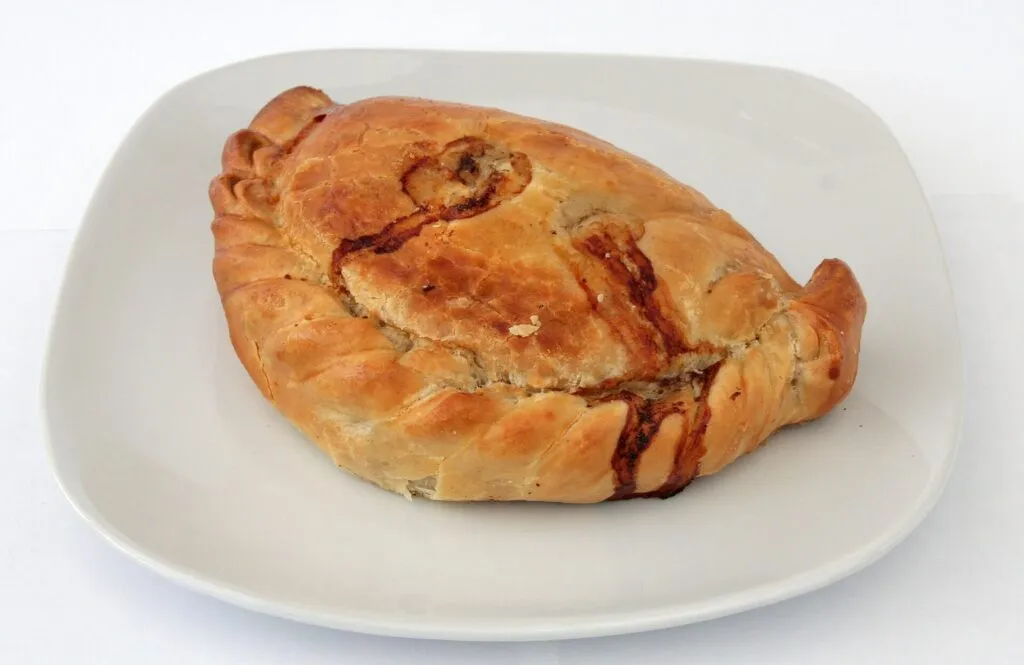
In a Cornish harbour town, the bakery queue starts before lunch. Pasties come out of the oven in rows, golden and heavy, each with a thick rope of crimped pastry along one side. You carry yours in a paper bag to the sea wall and watch the gulls watch you.
A Cornish pasty is a D-shaped pastry crimped along the side and filled with raw beef, potato, swede and onion that cook together inside it. Under protected (PGI) rules a “Cornish pasty” must be made in Cornwall. You buy them in bakeries across Cornwall, including long-running names such as Warrens and Philps. In 2026 a pasty costs roughly £4–7. The traditional beef pasty is not halal-slaughtered and the pastry sometimes contains lard, so cheese-and-onion or vegetable pasties are the safer choice.
This guide covers the history, what makes a real Cornish pasty, the fillings you will see, where to buy, how to eat one, prices and halal tips.
The miners’ lunch
Pasties fed Cornwall’s tin and copper miners, who needed a filling meal they could carry underground. The thick crimp is often said to have been a handle for dirty hands, thrown away after eating. Historians debate the details, but the pasty is still the county’s symbol.
Cornish miners took the pasty around the world, to mining towns in Mexico, the USA and Australia, where versions are still made.
What makes a real Cornish pasty
- Made in Cornwall, though it can be baked elsewhere from Cornish-made pasties.
- D-shaped, crimped on the side, not on top.
- Filling: roughly diced or sliced beef, swede (called turnip in Cornwall), potato and onion, with salt and pepper.
- Cooked from raw, so the juices make their own gravy inside.
- Golden pastry that holds its shape without cracking.
Fillings you will see
| Pasty | Filling | Halal check |
|---|---|---|
| Traditional Cornish | Beef, potato, swede, onion | Beef not halal-slaughtered; pastry may contain lard |
| Cheese and onion | Cheddar, onion, often potato | Usually pork-free; ask about the pastry fat |
| Vegetable | Mixed vegetables, sometimes with cheese | Usually pork-free; ask about the pastry fat |
| Steak and stilton | Beef with blue cheese | Beef not halal; check pastry |
| Pork and apple | Pork with apple | Pork: not halal |
| Breakfast pasty | Sausage, bacon, egg, beans | Pork: not halal |
Halal note: the classic beef pasty uses meat that is not halal-slaughtered, and some bakeries use lard or a lard-and-butter mix in the pastry. Ask “Is there lard in the pastry?” and choose cheese-and-onion or vegetable pasties made with butter or vegetable fat. Outside Cornwall, some bakeries in cities with large Muslim communities sell halal pasties. See our halal food travel guide.
Where to buy one
- Warrens Bakery – a Cornish bakery that dates its pasty-making back to the 19th century, with many shops.
- Philps – a family bakery from Hayle, open since the 1950s, with a big local following.
- Independent bakeries in towns such as St Ives, Padstow, Falmouth, Penzance and Fowey.
- Village shops and farm shops – often bake their own in the morning.
Every Cornish family has an opinion about the best pasty. Buy them hot from a bakery rather than a chilled cabinet. Hours vary and some shops sell out by mid-afternoon.
Each spring Cornwall also hosts the World Pasty Championships, where amateur and professional bakers compete.
How to eat a pasty
- Eat it from the paper bag, starting from one end, holding the crimp.
- Let it cool for a minute: the filling stays very hot.
- No cutlery needed; no sauce needed, though some people add brown sauce or ketchup.
- Watch out for seagulls in harbour towns: they are bold.
What it costs (2026)
| Pasty | Typical price |
|---|---|
| Medium traditional pasty | About £4–6 |
| Large pasty | About £5.50–7.50 |
| Cheese and onion or vegetable | About £3.50–5.50 |
| Mini or party-size | About £1.50–3 |
Plan your UK spending with the UK food budget calculator.
More Cornish food
- Cream tea – scones with jam first, then clotted cream, the Cornish way; see afternoon tea in Britain.
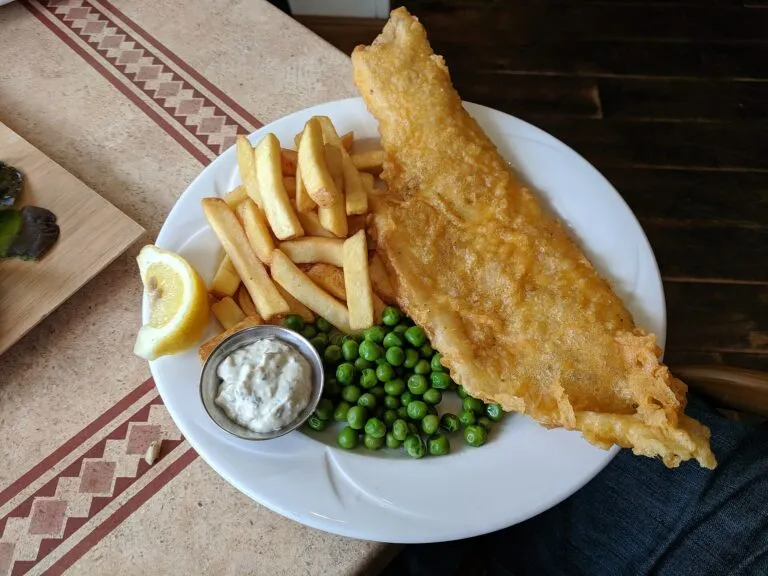
- Fish and chips – fresh from harbours like Padstow and Newlyn; see fish and chips in the UK.
- Saffron buns – yellow, lightly spiced sweet buns.
- Cornish fudge and ice cream – rich with local clotted cream.
Questions to ask
| Ask | Why |
|---|---|
| “Is there lard in the pastry?” | Some bakeries use lard |
| “Do you have a cheese and onion or vegetable pasty?” | Pork-free choices |
| “Is it halal?” | Rare in Cornwall, more common in big cities |
| “Are they fresh today?” | Hot and fresh is best |
Frequently asked questions
What is in a Cornish pasty?
Beef, potato, swede and onion, seasoned and baked raw inside a crimped pastry case.
Is a Cornish pasty halal?
The traditional beef pasty is not, and the pastry may contain lard. Choose cheese-and-onion or vegetable pasties and ask about the fat.
How much is a Cornish pasty?
About £4–7 in 2026, depending on size.
Why is a pasty crimped on the side?
The Cornish PGI rules require the side crimp. Tradition says it served as a handle for miners.
See all UK food guides and tipping in the UK.
Sources
- Visit Cornwall – official tourism site.
- Pasty – history and PGI rules.