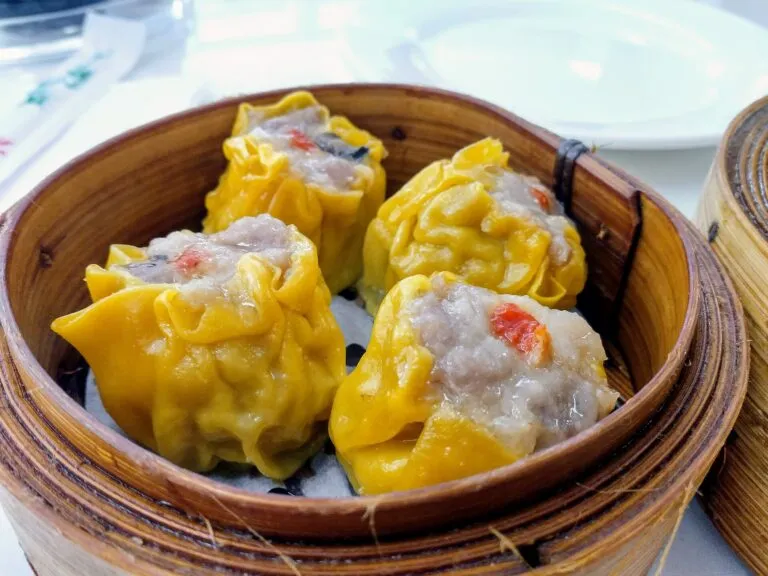
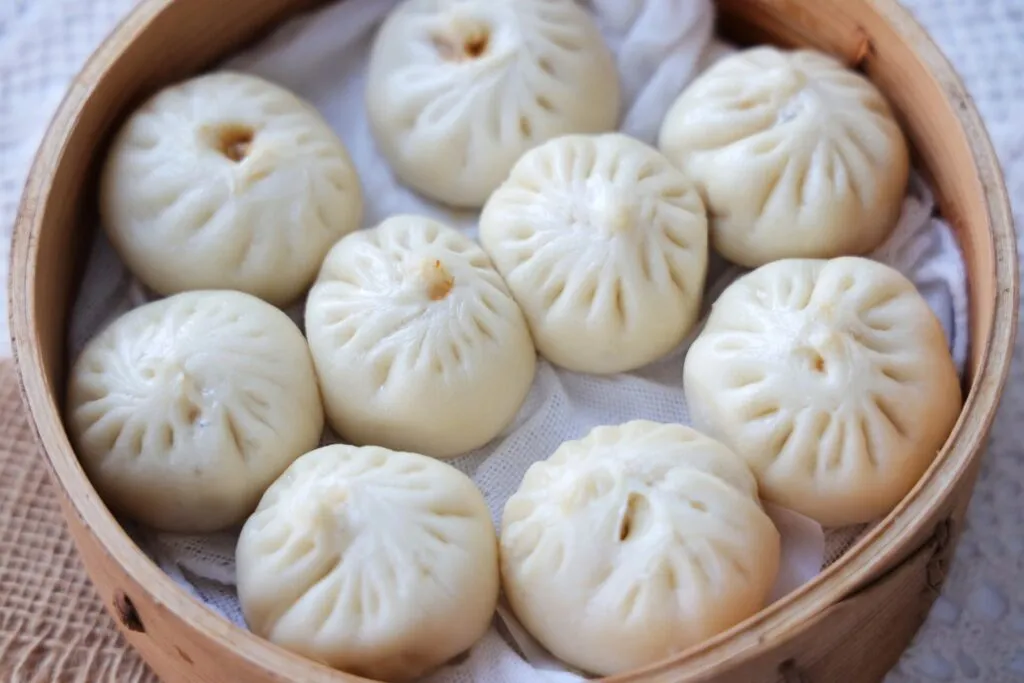
Xiaolongbao are Shanghai’s famous soup dumplings: thin-skinned parcels filled with minced meat and a spoonful of hot broth. The catch for Muslim travellers is that the standard filling, and the jellied stock that becomes the soup, are made from pork. Treat ordinary xiaolongbao as not halal. For a halal meal, look for restaurants marked qīngzhēn (清真) and order beef or lamb dumplings or buns instead. A basket of xiaolongbao costs roughly ¥20–60 in 2026.
This guide explains the dumpling honestly, then shows you how to eat well around it.
What a xiaolongbao actually is
The dough is pleated around a filling of minced pork mixed with pork aspic, a stock set to jelly. When the dumpling steams, the jelly melts into soup.
They come from Nanxiang, a town now inside Shanghai, and are served in bamboo baskets with black vinegar and shredded ginger. Crab-and-pork versions are common too, and still contain pork.
Why “no pork filling” is not enough
Even a shrimp or vegetable xiaolongbao at an ordinary shop is often made with pork stock or lard in the soup and steamed in the same baskets. Asking for a “non-pork” version rarely solves the problem.
Halal note: the reliable route is a qīngzhēn restaurant. These are usually run by Hui Muslims and display 清真 on the sign, often in green. Hand-pulled Lanzhou beef noodle shops, found on almost every Shanghai street, are the easiest place to start.
What to eat instead
- Lanzhou beef noodles (兰州拉面) – clear beef broth, hand-pulled noodles, chilli oil. Cheap, quick and nearly always qīngzhēn.
- Beef or lamb dumplings (牛肉 / 羊肉饺子) – boiled or steamed dumplings at qīngzhēn restaurants. The closest you will get to the xiaolongbao experience.
- Beef buns (牛肉包子) – fluffy steamed buns, a common qīngzhēn breakfast.
- Lamb skewers (羊肉串) – cumin-dusted, grilled, and often sold by Uyghur or Hui cooks in the evening.
Shanghai’s historic mosques are good landmarks for halal food, including the Fuyou Road Mosque in the old city and the Huxi Mosque in Putuo District. Restaurants cluster nearby.
Mandarin you will need
| Say | Characters | Meaning |
|---|---|---|
| Qīngzhēn ma? | 清真吗? | Is it halal? |
| Yǒu zhūroù ma? | 有猪肉吗? | Is there pork? |
| Bù yào zhūroù | 不要猪肉 | No pork, please |
| Niúryòu / yángròu | 牛肉 / 羊肉 | Beef / lamb |
| Duōshǎo qián? | 多少钱? | How much? |
Save the characters: screenshot 清真 and 有猪肉吗 on your phone. Showing the screen is faster than pronouncing tones in a busy shop.
Common questions
Are xiaolongbao halal?
Standard xiaolongbao are not: the filling and the soup are pork-based. Only dumplings from a qīngzhēn (清真) restaurant should be considered halal.
Can I find halal soup dumplings in Shanghai?
True soup dumplings made without pork are rare. Beef or lamb dumplings and buns at qīngzhēn restaurants are the practical alternative.
How do I recognise a halal restaurant in China?
Look for 清真 (qīngzhēn) on the sign or menu. Many also show Arabic script.
More from China: dim sum in Guangzhou and China’s regional cuisines. See China food guides, our halal food travel guide, the China food budget calculator and tipping in China.
Sources
- Meet in Shanghai – official Shanghai tourism site.
- Xiaolongbao and Chinese Islamic cuisine.