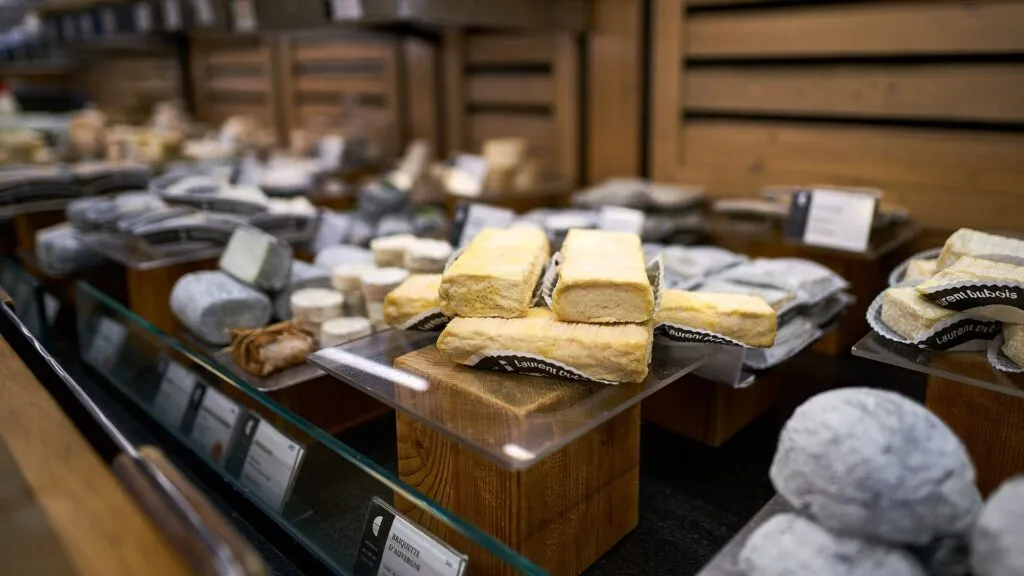
A good Paris fromagerie hits you at the door: a cool, damp room, a strong farmyard smell, and a counter piled with wheels, logs and pyramids of cheese. The person behind it will ask you a question most shops never do: “When are you eating it?”
To buy cheese in Paris, go to a specialist fromagerie or a market stall, say when and how you will eat it, and let the fromager choose cheeses that are ripe (à point) for that day. Long-established names include Androuët, founded in 1909, and Barthélémy on rue de Grenelle, and every neighbourhood market has good stalls. In 2026 most cheeses cost about €20–50 per kilo; plan on 100–150 g per person for a tasting. Muslim travellers should know that many French cheeses use animal rennet and a few are washed with alcohol.
This guide covers the cheeses to know, how to buy, where to go, how to build a cheese plate, taking cheese home, and the halal questions.
Cheeses to know
| Cheese | Milk and style | Taste |
|---|---|---|
| Comté | Cow; hard, aged in the Jura | Nutty, sweet; older wheels are more crystalline |
| Brie de Meaux | Cow; soft bloomy rind | Creamy, mushroomy |
| Camembert de Normandie | Cow; soft bloomy rind, raw milk | Rich, earthy |
| Roquefort | Sheep; blue, aged in caves | Salty, sharp, creamy |
| Saint-Nectaire | Cow; semi-soft | Earthy, hazelnut |
| Reblochon | Cow; washed rind, from the Alps | Mild, buttery |
| Sainte-Maure de Touraine | Goat; log with a straw through it | Fresh, lemony |
| Mont d’Or | Cow; soft, in a spruce box; winter only | Spoonable, woodsy |
| Époisses | Cow; washed rind | Very strong; washed with grape spirit (see halal note) |
Labels such as AOP (protected designation of origin) guarantee where and how a cheese is made. Lait cru means raw milk.
How to buy like a local
- Say when you will eat it. “For tonight” or “for a picnic tomorrow” lets the fromager pick cheeses at the right ripeness.
- Ask for a mix. A classic plate has one soft cheese, one hard, one goat and one blue.
- Buy by weight. Ask for un morceau pour deux personnes (a piece for two), or about 100–150 g per person in total.
- Taste. Good shops will offer a sliver if you ask.
- Ask about rennet or alcohol if it matters to you (phrases below).
Where to buy cheese in Paris
- Androuët – a Paris cheese house founded in 1909, with several shops across the city.
- Barthélémy, rue de Grenelle (7th) – a small, old-fashioned shop famous for carefully aged cheeses.
- Market streets – rue Cler (7th), rue Montorgueil (2nd) and rue Mouffetard (5th) all have good fromageries.
- Covered and open-air markets – such as Marché d’Aligre (12th), with lively cheese stalls and good prices.
Many shops close on Mondays and in the middle of the day. Check hours before going.
Halal note: most traditional French cheeses are made with animal rennet, and scholars differ on it: many, including a well-known Hanafi position, accept rennet cheese, while others prefer microbial or vegetable rennet (présure microbienne or végétale). Some cheeses, such as Époisses, are washed with alcohol, and a few are aged with wine or spirits. Ask the fromager (phrases below) and follow your own scholar. For halal meals, Paris has many halal restaurants; see our halal food travel guide.
Building a cheese plate
- Serve cheese at room temperature: take it out of the fridge an hour before.
- Go from mild to strong: goat, soft, hard, then blue or washed rind.
- Serve with a fresh baguette, not crackers.
- Add fruit: grapes, figs, pears or apples, plus walnuts.
- Cut to share the rind fairly: wedges from the centre of round cheeses, never “the nose” of a brie.
A Paris picnic plan
Buy two or three cheeses, a baguette and some fruit on a market street in the morning, then head to a park: the Champ de Mars, the Luxembourg Gardens, or the banks of the Seine. Bring a knife from home or ask the shop for plastic cutlery.
Taking cheese home
- Ask for it vacuum-packed (sous vide); many shops will do it.
- Hard cheeses like Comté travel best. Soft, runny cheeses are messy on long trips.
- Within the EU you can carry cheese freely. Other countries have rules: some limit dairy imports or young raw-milk cheeses, so check your destination’s customs rules.
- Keep it cool and wrapped, away from other luggage.
What cheese costs (2026)
| Item | Typical price |
|---|---|
| Everyday cheeses | About €20–35 per kilo |
| Aged or AOP cheeses (e.g. old Comté) | About €30–60 per kilo |
| Tasting for two (300 g mixed) | About €8–15 |
| Cheese course in a bistro | About €8–15 |
Plan the rest with the France food budget calculator and read about tipping in France.
French for the fromagerie
| Say | Meaning |
|---|---|
| C’est pour ce soir | It’s for tonight |
| Un morceau pour deux personnes | A piece for two people |
| Je peux goûter ? | Can I taste? |
| C’est quelle présure ? | What kind of rennet is it? |
| Il y a de l’alcool dans la croûte ? | Is there alcohol in the rind? |
| Sous vide, s’il vous plaît | Vacuum-packed, please |
Frequently asked questions
Where is the best cheese shop in Paris?
Long-established names include Androuët and Barthélémy, and market streets such as rue Cler and rue Mouffetard have excellent fromageries.
Is French cheese halal?
Many French cheeses use animal rennet, on which scholars differ, and a few are washed with alcohol. Ask about rennet and rind washing, and follow your own scholar.
How much cheese should I buy per person?
About 100–150 g in total per person for a tasting plate.
Can I take French cheese on a plane?
Solid cheese is usually fine; soft, spreadable cheeses may count as liquids in hand luggage. Check customs rules at your destination.
More in Paris: croissants and baguettes. Elsewhere in France: Burgundy food and Alsace tarte flambée. See all France food guides.
Sources
- Paris je t’aime – official Paris tourism site.
- List of French cheeses and Rennet.