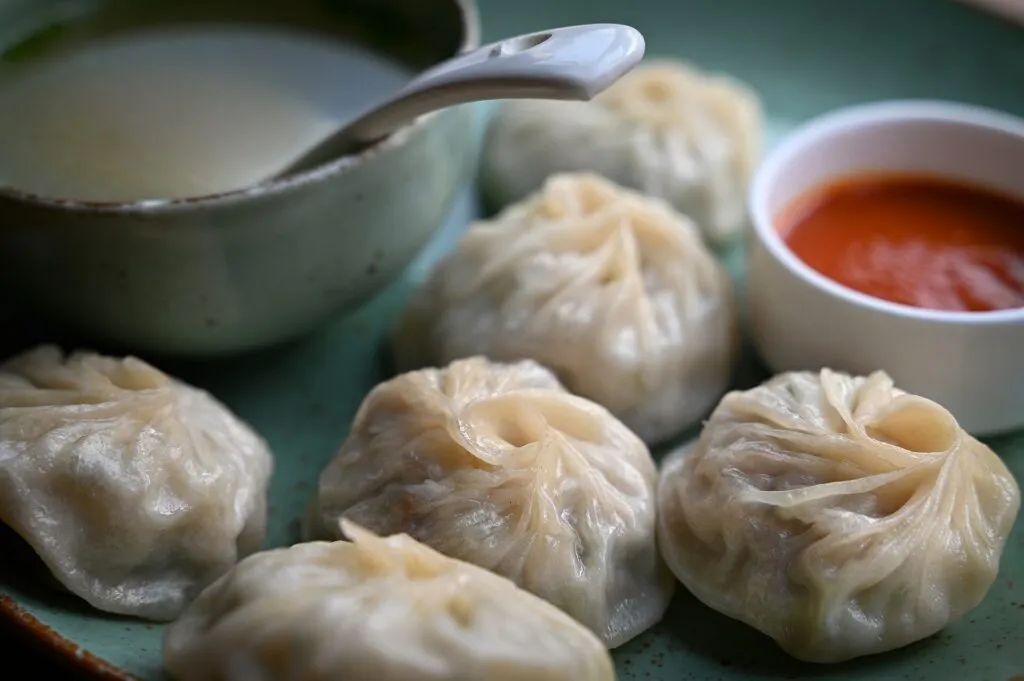
A momo shop in the Himalayas is a cloud of steam. Stacked aluminium steamers hiss on the stove, and a cook pleats dumplings at lightning speed on a floury table. A plate of ten arrives with a bowl of fiery red tomato-chilli sauce, and the first bite bursts with hot, peppery juice.
Momos are Tibetan-style dumplings: thin wheat-flour wrappers filled with minced meat or vegetables, usually steamed, sometimes fried or served in soup, and eaten with a spicy tomato-chilli dip. They are loved across Tibet, Nepal, Bhutan and the Indian Himalayas, and in Tibetan communities such as McLeod Ganj (Dharamsala) and Delhi’s Majnu-ka-Tilla. In 2026 a plate of about ten costs roughly NPR 150–400 in Kathmandu or ₹80–250 in India. Vegetable momos are the easy halal-friendly choice; meat fillings vary and are often not halal.
This guide covers the fillings and styles, the sauces, where to eat momos, halal points, prices and phrases.
Fillings
| Filling | Where | Halal check |
|---|---|---|
| Vegetable (cabbage, carrot, onion, sometimes paneer) | Everywhere | Usually fine |
| Chicken | Nepal and India | Not halal unless the shop is |
| Buff (water buffalo) | Kathmandu, very common | Not halal-slaughtered |
| Yak | Tibet and high Himalaya | Not halal-slaughtered |
| Beef | Tibetan communities | Not halal unless stated |
| Pork | Some shops | Not halal |
| Cheese | Bhutan and trekking areas | Usually fine |
Styles
- Steamed – the classic, soft and juicy.
- Kothey – pan-fried on one side, crisp and golden.
- Fried – deep-fried all over.
- Jhol momo – served in a tangy, spiced sesame-tomato soup; a Kathmandu favourite.
- C-momo – tossed in a hot chilli sauce.
- Tingmo – a steamed Tibetan bread often served alongside.
The sauces
Momos come with achar, a chutney of roasted tomatoes, chillies, garlic and sometimes sesame or Sichuan pepper (timur). It can be very hot. Tibetan shops may add a clear soup and chilli oil.
Halal note: vegetable and cheese momos are the safe choice. Meat momos in Nepal and the Himalayas are usually buffalo, chicken, yak or pork that is not halal-slaughtered, and steamers are shared. In India, some Muslim-run restaurants make halal chicken momos; ask. See our halal food travel guide.
Where to eat momos
- Kathmandu, Nepal – momo shops on every street; jhol momo is a local speciality.
- McLeod Ganj (Dharamsala), India – the home of the Tibetan government-in-exile, with many Tibetan restaurants.
- Majnu-ka-Tilla, Delhi – a Tibetan settlement with narrow lanes of momo and thukpa shops.
- Darjeeling and Gangtok – momos with mountain views.
More Himalayan comfort food
- Thukpa – noodle soup with vegetables or meat.
- Thenthuk – hand-pulled noodle soup.
- Dal bhat – Nepal’s rice and lentil meal; see our Himalayan trekking food guide.
- Butter tea – salty tea churned with butter, a Tibetan staple.
What it costs (2026)
| Order | Typical price |
|---|---|
| Plate of veg momos, Kathmandu | About NPR 150–300 |
| Jhol momo | About NPR 200–400 |
| Plate of momos in Delhi or McLeod Ganj | About ₹80–250 |
Plan with the Nepal food budget calculator or the India food budget calculator.
Phrases
| Say | Language | Meaning |
|---|---|---|
| Ek plate veg momo | Nepali / Hindi | One plate of veg momos |
| Kati ho? | Nepali | How much is it? |
| Dhanyabad | Nepali | Thank you |
| Thuk-je-che | Tibetan | Thank you |
| Kya yeh halal hai? | Hindi | Is it halal? |
Frequently asked questions
What are momos?
Tibetan-style dumplings filled with meat or vegetables, usually steamed and eaten with a spicy tomato-chilli sauce.
Are momos halal?
Vegetable and cheese momos usually are. Meat momos are often not halal-slaughtered; ask, or look for halal shops in India.
What is buff momo?
A momo filled with water-buffalo meat, very common in Kathmandu.
What is jhol momo?
Momos served in a tangy, spiced soup, a Kathmandu speciality.
More dumplings: xiaolongbao and halal alternatives and khinkali in Tbilisi. See all Asia food guides.
Sources
- Nepal Tourism Board – official tourism site.
- Momo.